1
ESC/Java2 Implementation Notes
David R. Cok
[email protected]
Joseph R. Kiniry
[email protected]
Dermot Cochran
[email protected]
October 2008
Abstract: ESC/Java2 is a tool for statically checking program specifications. It expands
significantly upon ESC/Java, on which it is built. It is consistent with the definition of JML
and of Java 1.4. It adds additional static checking to that in ESC/Java; most significantly, it
adds support for checking frame conditions and annotations containing method calls. This
document describes the status of the final release of ESC/Java2, along with some notes
regarding the details of that implementation.
Keywords: Behavioral interface specification, Java, JML, Escjava, ESC/Java, ESC/Java2,
model-based specification, assertion, precondition, postcondition, frame.
2003 CR Categories: D.2.1 [Software Engineering] Requirements/Specifications — languages, tools, theory, JML, ESC/Java, ESC/Java2; D.2.4 [Software Engineering] Software/Program Verification — assertion checkers, class invariants, formal methods, programming by contract; F.3.1 [Logics and Meanings of Programs] Specifying and Verifying
and Reasoning about Programs — assertions, invariants, logics of programs, pre- and postconditions, specification techniques.
c 2003-2004 David R. Cok, 2005-2008 Joseph R. Kiniry, 2008 Dermot Cochran
Copyright i
Table of Contents
1
Introduction . . . . . . . . . . . . . . . . . . . . . . . . . . . . . . . . . . . . . 1
1.1
1.2
1.3
1.4
Motivation and Background . . . . . . . . . . . . . . . . . . . . . . . . . . . . . . . . . . . .
Acknowledgements . . . . . . . . . . . . . . . . . . . . . . . . . . . . . . . . . . . . . . . . . . . . .
Dependencies and license restrictions . . . . . . . . . . . . . . . . . . . . . . . . . . .
Contacts and information . . . . . . . . . . . . . . . . . . . . . . . . . . . . . . . . . . . . . .
1
1
2
2
2
Running ESC/Java2 . . . . . . . . . . . . . . . . . . . . . . . . . . . . 4
3
Status of JML features . . . . . . . . . . . . . . . . . . . . . . . . . 5
3.1
3.2
3.3
File finding and refinement sequences . . . . . . . . . . . . . . . . . . . . . . . . . . . 5
Format of annotations . . . . . . . . . . . . . . . . . . . . . . . . . . . . . . . . . . . . . . . . . . 8
Compilation unit annotations . . . . . . . . . . . . . . . . . . . . . . . . . . . . . . . . . 10
3.3.1 refine statements . . . . . . . . . . . . . . . . . . . . . . . . . . . . . . . . . . . . . . . . . 10
3.3.2 model import statements . . . . . . . . . . . . . . . . . . . . . . . . . . . . . . . . . 12
3.3.3 automatic imports. . . . . . . . . . . . . . . . . . . . . . . . . . . . . . . . . . . . . . . . 13
3.4 Access (privacy) modifiers . . . . . . . . . . . . . . . . . . . . . . . . . . . . . . . . . . . . . 13
3.5 Type modifiers . . . . . . . . . . . . . . . . . . . . . . . . . . . . . . . . . . . . . . . . . . . . . . . . 13
3.5.1 pure (JML) . . . . . . . . . . . . . . . . . . . . . . . . . . . . . . . . . . . . . . . . . . . . . . 14
3.5.2 model (JML) . . . . . . . . . . . . . . . . . . . . . . . . . . . . . . . . . . . . . . . . . . . . . 14
3.5.3 weakly (JML) . . . . . . . . . . . . . . . . . . . . . . . . . . . . . . . . . . . . . . . . . . . . 14
3.5.4 non null by default (JML) . . . . . . . . . . . . . . . . . . . . . . . . . . . . . . . 14
3.5.5 nullable by default (JML) . . . . . . . . . . . . . . . . . . . . . . . . . . . . . . . . 15
3.5.6 final (Java). . . . . . . . . . . . . . . . . . . . . . . . . . . . . . . . . . . . . . . . . . . . . . . 15
3.5.7 abstract (Java) . . . . . . . . . . . . . . . . . . . . . . . . . . . . . . . . . . . . . . . . . . . 16
3.5.8 strictfp (Java) . . . . . . . . . . . . . . . . . . . . . . . . . . . . . . . . . . . . . . . . . . . . 16
3.5.9 static (Java) . . . . . . . . . . . . . . . . . . . . . . . . . . . . . . . . . . . . . . . . . . . . . 16
3.6 Annotations pertinent to a class or interface . . . . . . . . . . . . . . . . . . . 16
3.6.1 Ghost fields . . . . . . . . . . . . . . . . . . . . . . . . . . . . . . . . . . . . . . . . . . . . . . 16
3.6.2 Model fields . . . . . . . . . . . . . . . . . . . . . . . . . . . . . . . . . . . . . . . . . . . . . . 17
3.6.3 Model methods. . . . . . . . . . . . . . . . . . . . . . . . . . . . . . . . . . . . . . . . . . . 17
3.6.4 Model constructors . . . . . . . . . . . . . . . . . . . . . . . . . . . . . . . . . . . . . . . 17
3.6.5 Model class and model interface declarations . . . . . . . . . . . . . . 18
3.6.6 Java initializer blocks . . . . . . . . . . . . . . . . . . . . . . . . . . . . . . . . . . . . 18
3.6.7 initializer . . . . . . . . . . . . . . . . . . . . . . . . . . . . . . . . . . . . . . . . . . . . . . . . 18
3.6.8 static initializer . . . . . . . . . . . . . . . . . . . . . . . . . . . . . . . . . . . . . . . . . . 19
3.6.9 Java method, constructor and field declarations . . . . . . . . . . . 19
3.6.10 Nested Java type declarations . . . . . . . . . . . . . . . . . . . . . . . . . . . 19
3.7 Annotation clauses for a class or interface . . . . . . . . . . . . . . . . . . . . . 19
3.7.1 invariant, invariant redundantly . . . . . . . . . . . . . . . . . . . . . . . . . . 19
3.7.2 constraint, constraint redundantly . . . . . . . . . . . . . . . . . . . . . . . . 19
3.7.3 represents, represents redundantly . . . . . . . . . . . . . . . . . . . . . . . . 20
3.7.4 axiom . . . . . . . . . . . . . . . . . . . . . . . . . . . . . . . . . . . . . . . . . . . . . . . . . . . . 20
ii
3.7.5 initially, initially redundantly. . . . . . . . . . . . . . . . . . . . . . . . . . . . .
3.7.6 readable and writable . . . . . . . . . . . . . . . . . . . . . . . . . . . . . . . . . . . .
3.7.7 monitors for . . . . . . . . . . . . . . . . . . . . . . . . . . . . . . . . . . . . . . . . . . . . .
3.8 Annotations for a method or constructor . . . . . . . . . . . . . . . . . . . . . .
3.8.1 Lightweight and heavyweight specifications . . . . . . . . . . . . . . .
3.8.2 also . . . . . . . . . . . . . . . . . . . . . . . . . . . . . . . . . . . . . . . . . . . . . . . . . . . . . .
3.8.3 model program. . . . . . . . . . . . . . . . . . . . . . . . . . . . . . . . . . . . . . . . . . .
3.8.4 code contract . . . . . . . . . . . . . . . . . . . . . . . . . . . . . . . . . . . . . . . . . . . .
3.8.5 implies that . . . . . . . . . . . . . . . . . . . . . . . . . . . . . . . . . . . . . . . . . . . . . .
3.8.6 for example specification . . . . . . . . . . . . . . . . . . . . . . . . . . . . . . . . .
3.9 Annotation clauses for a method or constructor . . . . . . . . . . . . . . . .
3.9.1 forall . . . . . . . . . . . . . . . . . . . . . . . . . . . . . . . . . . . . . . . . . . . . . . . . . . . . .
3.9.2 old . . . . . . . . . . . . . . . . . . . . . . . . . . . . . . . . . . . . . . . . . . . . . . . . . . . . . . .
3.9.3 requires, requires redundantly, pre, pre redundantly . . . . . .
3.9.4 ensures, ensures redundantly, post, post redundantly . . . . .
3.9.5 signals, signals redundantly,
exsures, exsures redundantly . . . . . . . . . . . . . . . . . . . . . . . . . . . . . . . .
3.9.6 modifies, modifiable, assignable, modifies redundantly,
modifiable redundantly, assignable redundantly . . . . . . . . . . . . .
3.9.7 diverges, diverges redundantly . . . . . . . . . . . . . . . . . . . . . . . . . . . .
3.9.8 when . . . . . . . . . . . . . . . . . . . . . . . . . . . . . . . . . . . . . . . . . . . . . . . . . . . . .
3.9.9 duration . . . . . . . . . . . . . . . . . . . . . . . . . . . . . . . . . . . . . . . . . . . . . . . . .
3.9.10 working space . . . . . . . . . . . . . . . . . . . . . . . . . . . . . . . . . . . . . . . . . . .
3.9.11 accessible . . . . . . . . . . . . . . . . . . . . . . . . . . . . . . . . . . . . . . . . . . . . . . .
3.9.12 callable . . . . . . . . . . . . . . . . . . . . . . . . . . . . . . . . . . . . . . . . . . . . . . . . .
3.9.13 measured by . . . . . . . . . . . . . . . . . . . . . . . . . . . . . . . . . . . . . . . . . . . .
3.9.14 Redundancy . . . . . . . . . . . . . . . . . . . . . . . . . . . . . . . . . . . . . . . . . . . .
3.10 Annotation modifiers for a method or constructor . . . . . . . . . . . .
3.10.1 pure (JML) . . . . . . . . . . . . . . . . . . . . . . . . . . . . . . . . . . . . . . . . . . . . .
3.10.2 non null (JML - methods only) . . . . . . . . . . . . . . . . . . . . . . . . . .
3.10.3 nullable (JML - methods only) . . . . . . . . . . . . . . . . . . . . . . . . . .
3.10.4 helper (JML) . . . . . . . . . . . . . . . . . . . . . . . . . . . . . . . . . . . . . . . . . . .
3.10.5 final (Java - methods only) . . . . . . . . . . . . . . . . . . . . . . . . . . . . . .
3.10.6 static (Java - methods only) . . . . . . . . . . . . . . . . . . . . . . . . . . . . .
3.10.7 synchronized (Java - methods only). . . . . . . . . . . . . . . . . . . . . .
3.10.8 native (Java - methods only) . . . . . . . . . . . . . . . . . . . . . . . . . . . .
3.10.9 strictfp (Java - methods only) . . . . . . . . . . . . . . . . . . . . . . . . . . .
3.11 Annotation assertions for a field declaration . . . . . . . . . . . . . . . . . .
3.11.1 in (JML) . . . . . . . . . . . . . . . . . . . . . . . . . . . . . . . . . . . . . . . . . . . . . . . .
3.11.2 maps, \into (JML) . . . . . . . . . . . . . . . . . . . . . . . . . . . . . . . . . . . . . .
3.12 Annotation modifiers for a field declaration . . . . . . . . . . . . . . . . . . .
3.12.1 non null (JML) . . . . . . . . . . . . . . . . . . . . . . . . . . . . . . . . . . . . . . . . .
3.12.2 nullable (JML) . . . . . . . . . . . . . . . . . . . . . . . . . . . . . . . . . . . . . . . . . .
3.12.3 monitored (JML) . . . . . . . . . . . . . . . . . . . . . . . . . . . . . . . . . . . . . . .
3.12.4 final (Java) . . . . . . . . . . . . . . . . . . . . . . . . . . . . . . . . . . . . . . . . . . . . .
3.12.5 volatile (Java). . . . . . . . . . . . . . . . . . . . . . . . . . . . . . . . . . . . . . . . . . .
3.12.6 transient (Java) . . . . . . . . . . . . . . . . . . . . . . . . . . . . . . . . . . . . . . . . .
3.12.7 static (Java) . . . . . . . . . . . . . . . . . . . . . . . . . . . . . . . . . . . . . . . . . . . .
20
20
21
21
21
24
24
24
24
25
25
25
25
26
26
26
26
28
28
28
29
29
29
29
29
29
30
30
30
31
31
31
32
32
32
32
32
32
33
33
33
33
34
34
34
34
iii
3.12.8 instance (JML) . . . . . . . . . . . . . . . . . . . . . . . . . . . . . . . . . . . . . . . . .
3.13 Annotation modifiers for formal parameters . . . . . . . . . . . . . . . . . .
3.13.1 non null (JML) . . . . . . . . . . . . . . . . . . . . . . . . . . . . . . . . . . . . . . . . .
3.13.2 nullable (JML) . . . . . . . . . . . . . . . . . . . . . . . . . . . . . . . . . . . . . . . . . .
3.13.3 final (Java) . . . . . . . . . . . . . . . . . . . . . . . . . . . . . . . . . . . . . . . . . . . . .
3.14 Annotation statements within the body of a method or
constructor . . . . . . . . . . . . . . . . . . . . . . . . . . . . . . . . . . . . . . . . . . . . . . . . . . . .
3.14.1 assume, assume redundantly . . . . . . . . . . . . . . . . . . . . . . . . . . . .
3.14.2 assert, assert redundantly . . . . . . . . . . . . . . . . . . . . . . . . . . . . . . .
3.14.3 set . . . . . . . . . . . . . . . . . . . . . . . . . . . . . . . . . . . . . . . . . . . . . . . . . . . . . .
3.14.4 unreachable . . . . . . . . . . . . . . . . . . . . . . . . . . . . . . . . . . . . . . . . . . . . .
3.14.5 hence by, hence by redundantly . . . . . . . . . . . . . . . . . . . . . . . . .
3.14.6 loop invariant, loop invariant redundantly,
maintaining, maintaining redundantly . . . . . . . . . . . . . . . . . . . . . .
3.14.7 decreases, decreasing, decreases redundantly,
decreasing redundantly . . . . . . . . . . . . . . . . . . . . . . . . . . . . . . . . . . . . .
3.14.8 ghost declarations . . . . . . . . . . . . . . . . . . . . . . . . . . . . . . . . . . . . . . .
3.15 Modifiers that may be applied to local declarations . . . . . . . . . . .
3.15.1 non null (JML) . . . . . . . . . . . . . . . . . . . . . . . . . . . . . . . . . . . . . . . . .
3.15.2 nullable (JML) . . . . . . . . . . . . . . . . . . . . . . . . . . . . . . . . . . . . . . . . . .
3.15.3 uninitialized (JML) . . . . . . . . . . . . . . . . . . . . . . . . . . . . . . . . . . . . .
3.15.4 final (Java) . . . . . . . . . . . . . . . . . . . . . . . . . . . . . . . . . . . . . . . . . . . . .
3.16 JML functions (extensions to expressions) . . . . . . . . . . . . . . . . . . . .
3.16.1 New operators in JML . . . . . . . . . . . . . . . . . . . . . . . . . . . . . . . . . .
3.16.2 New JML expressions (functions and values) . . . . . . . . . . . . .
3.16.3 New JML types . . . . . . . . . . . . . . . . . . . . . . . . . . . . . . . . . . . . . . . . .
3.16.4 quantified expressions - \forall, \exists, \num of, \max,
\min, \sum, \product . . . . . . . . . . . . . . . . . . . . . . . . . . . . . . . . . . . . . .
3.16.5 Set comprehension . . . . . . . . . . . . . . . . . . . . . . . . . . . . . . . . . . . . . .
3.16.6 \not specified . . . . . . . . . . . . . . . . . . . . . . . . . . . . . . . . . . . . . . . . . . .
3.16.7 \private data . . . . . . . . . . . . . . . . . . . . . . . . . . . . . . . . . . . . . . . . . . .
3.16.8 \other . . . . . . . . . . . . . . . . . . . . . . . . . . . . . . . . . . . . . . . . . . . . . . . . . .
3.16.9 Other Java operators and expression syntax . . . . . . . . . . . . .
3.17 store-ref expressions . . . . . . . . . . . . . . . . . . . . . . . . . . . . . . . . . . . . . . . . . .
3.17.1 [ ident | super | this ] . [ ident | this ] . . . . . . . . . . . . . . .
3.17.2 [ ident | super | this ] .* . . . . . . . . . . . . . . . . . . . . . . . . . . . . . .
3.17.3 [ ident | super | this ] [expr ] . . . . . . . . . . . . . . . . . . . . . . . . .
3.17.4 [ ident | super | this ] [expr..expr2 ] . . . . . . . . . . . . . . . .
3.17.5 [ ident | super | this ] [*] . . . . . . . . . . . . . . . . . . . . . . . . . . . .
3.17.6 classname.* . . . . . . . . . . . . . . . . . . . . . . . . . . . . . . . . . . . . . . . . . . . . .
3.17.7 \nothing . . . . . . . . . . . . . . . . . . . . . . . . . . . . . . . . . . . . . . . . . . . . . . . .
3.17.8 \everything . . . . . . . . . . . . . . . . . . . . . . . . . . . . . . . . . . . . . . . . . . . . .
3.18 Statements within model programs . . . . . . . . . . . . . . . . . . . . . . . . . . .
3.19 Other issues . . . . . . . . . . . . . . . . . . . . . . . . . . . . . . . . . . . . . . . . . . . . . . . . .
3.19.1 universe type system . . . . . . . . . . . . . . . . . . . . . . . . . . . . . . . . . . . .
3.19.2 infinite-precision arithmetic . . . . . . . . . . . . . . . . . . . . . . . . . . . . .
3.19.3 nowarn annotations . . . . . . . . . . . . . . . . . . . . . . . . . . . . . . . . . . . . .
3.19.4 Java and JML assert statements . . . . . . . . . . . . . . . . . . . . . . . . .
34
35
35
35
36
36
36
36
36
36
37
37
37
37
37
38
38
38
38
38
38
40
42
43
43
44
44
44
44
44
45
45
45
45
45
45
45
45
46
46
46
46
46
46
iv
3.19.5 Methods and constructors without bodies in Java files . . .
3.19.6 Methods and constructors in annotation expressions . . . . .
3.19.7 Original ESC/Java also specifications . . . . . . . . . . . . . . . . . . .
3.19.8 anonymous classes . . . . . . . . . . . . . . . . . . . . . . . . . . . . . . . . . . . . . .
3.19.9 block-level class declarations . . . . . . . . . . . . . . . . . . . . . . . . . . . .
3.19.10 field, method and constructor keywords . . . . . . . . . . . . .
3.19.11 Equivalence of \TYPE and java.lang.Class . . . . . . . . . . . .
3.19.12 exceptions in annotation expressions. . . . . . . . . . . . . . . . . . . .
3.19.13 Specifications and inheritance . . . . . . . . . . . . . . . . . . . . . . . . . .
3.19.13.1 Desugaring in the presence of inheritance . . . . . . . . . .
3.19.13.2 Defaults and inheritance . . . . . . . . . . . . . . . . . . . . . . . . . .
3.19.13.3 Inheritance and non null . . . . . . . . . . . . . . . . . . . . . . . . . .
4
ESC/Java2 features . . . . . . . . . . . . . . . . . . . . . . . . . . . 59
4.1
4.2
Error and warning messages . . . . . . . . . . . . . . . . . . . . . . . . . . . . . . . . . . .
Nowarn annotations and warnings . . . . . . . . . . . . . . . . . . . . . . . . . . . . .
4.2.1 nowarn annotations . . . . . . . . . . . . . . . . . . . . . . . . . . . . . . . . . . . . . .
4.2.2 nowarn warning types . . . . . . . . . . . . . . . . . . . . . . . . . . . . . . . . . . . .
4.3 Command-line options . . . . . . . . . . . . . . . . . . . . . . . . . . . . . . . . . . . . . . . .
4.4 Environment variables affecting ESC/Java2 . . . . . . . . . . . . . . . . . . . .
5
48
48
48
49
49
49
50
51
51
51
53
54
59
59
59
60
61
63
Changes to static checking in ESC/Java2 . . . 65
5.1
5.2
5.3
5.4
Handling of specification inheritance . . . . . . . . . . . . . . . . . . . . . . . . . . .
non null . . . . . . . . . . . . . . . . . . . . . . . . . . . . . . . . . . . . . . . . . . . . . . . . . . . . . .
Translation of the Java 1.4 assert statement . . . . . . . . . . . . . . . . . . .
Semantics of String . . . . . . . . . . . . . . . . . . . . . . . . . . . . . . . . . . . . . . . . . . .
5.4.1 Concatentation operators . . . . . . . . . . . . . . . . . . . . . . . . . . . . . . . . .
5.4.2 Explicit String literals . . . . . . . . . . . . . . . . . . . . . . . . . . . . . . . . . . . .
5.4.3 The intern method . . . . . . . . . . . . . . . . . . . . . . . . . . . . . . . . . . . . . . .
5.5 The \TYPE and java.lang.Class types . . . . . . . . . . . . . . . . . . . . . . .
5.6 The initially clause . . . . . . . . . . . . . . . . . . . . . . . . . . . . . . . . . . . . . . . . . . . .
5.7 The constraint clause . . . . . . . . . . . . . . . . . . . . . . . . . . . . . . . . . . . . . . . . .
5.8 Use of modifies clauses in checking routine bodies . . . . . . . . . . . . . .
5.9 Defaults for modifies clauses . . . . . . . . . . . . . . . . . . . . . . . . . . . . . . . . . . .
5.10 modifies \everything . . . . . . . . . . . . . . . . . . . . . . . . . . . . . . . . . . . . . . . . .
5.11 Checking of modifies . . . . . . . . . . . . . . . . . . . . . . . . . . . . . . . . . . . . . . . . .
5.12 \typeof . . . . . . . . . . . . . . . . . . . . . . . . . . . . . . . . . . . . . . . . . . . . . . . . . . . . . .
5.13 Use of pure routines in annotations . . . . . . . . . . . . . . . . . . . . . . . . . . .
5.14 Checking of model fields . . . . . . . . . . . . . . . . . . . . . . . . . . . . . . . . . . . . .
5.15 \not modified. . . . . . . . . . . . . . . . . . . . . . . . . . . . . . . . . . . . . . . . . . . . . . . .
65
65
65
65
65
66
66
66
66
66
67
67
67
67
67
68
68
68
v
6
Incompatibilities . . . . . . . . . . . . . . . . . . . . . . . . . . . . . . . 69
6.1
Major features of Java not implemented in ESC/Java2 . . . . . . . . .
6.1.1 Java 1.5 . . . . . . . . . . . . . . . . . . . . . . . . . . . . . . . . . . . . . . . . . . . . . . . . . .
6.1.2 anonymous and block-level classes . . . . . . . . . . . . . . . . . . . . . . . .
6.1.3 serialization . . . . . . . . . . . . . . . . . . . . . . . . . . . . . . . . . . . . . . . . . . . . . .
6.1.4 most multi-threading considerations . . . . . . . . . . . . . . . . . . . . . .
6.1.5 Java generics . . . . . . . . . . . . . . . . . . . . . . . . . . . . . . . . . . . . . . . . . . . . .
6.2 Major features of JML not implemented in ESC/Java2 . . . . . . . .
6.2.1 code contract clauses . . . . . . . . . . . . . . . . . . . . . . . . . . . . . . . . . . . . .
6.2.2 some aspects of store-ref expressions . . . . . . . . . . . . . . . . . . . . . .
6.2.3 implies that and for example behavior . . . . . . . . . . . . . . . . . . . .
6.2.4 splitting of annotations across comments. . . . . . . . . . . . . . . . . .
6.3 Limitations of static checking . . . . . . . . . . . . . . . . . . . . . . . . . . . . . . . . .
6.4 Incompatibilities with ESC/Java . . . . . . . . . . . . . . . . . . . . . . . . . . . . . .
6.4.1 Error messages and warnings . . . . . . . . . . . . . . . . . . . . . . . . . . . . .
6.4.2 also . . . . . . . . . . . . . . . . . . . . . . . . . . . . . . . . . . . . . . . . . . . . . . . . . . . . . .
6.4.3 inheritance of specifications. . . . . . . . . . . . . . . . . . . . . . . . . . . . . . .
6.4.4 non null on formal parameters and results of routines . . . . .
6.4.5 monitored by . . . . . . . . . . . . . . . . . . . . . . . . . . . . . . . . . . . . . . . . . . . .
6.4.6 readable if . . . . . . . . . . . . . . . . . . . . . . . . . . . . . . . . . . . . . . . . . . . . . . .
6.4.7 initially (old style) . . . . . . . . . . . . . . . . . . . . . . . . . . . . . . . . . . . . . . .
6.4.8 semicolon termination . . . . . . . . . . . . . . . . . . . . . . . . . . . . . . . . . . . .
6.4.9 Routine bodies in spec files . . . . . . . . . . . . . . . . . . . . . . . . . . . . . . .
6.5 Non-JML features in ESC/Java2 . . . . . . . . . . . . . . . . . . . . . . . . . . . . . .
6.5.1 annotation comments beginning with //-@ or /*-@ . . . . . . .
6.5.2 order of clauses . . . . . . . . . . . . . . . . . . . . . . . . . . . . . . . . . . . . . . . . . .
6.5.3 splitting of annotations . . . . . . . . . . . . . . . . . . . . . . . . . . . . . . . . . . .
6.5.4 helper annotations . . . . . . . . . . . . . . . . . . . . . . . . . . . . . . . . . . . . . . .
6.5.5 \typeof applied to primitive types . . . . . . . . . . . . . . . . . . . . . . . .
6.5.6 unreachable . . . . . . . . . . . . . . . . . . . . . . . . . . . . . . . . . . . . . . . . . . . . . .
6.5.7 \not modified . . . . . . . . . . . . . . . . . . . . . . . . . . . . . . . . . . . . . . . . . . . .
6.5.8 specifications of default constructor . . . . . . . . . . . . . . . . . . . . . . .
6.5.9 loop predicate. . . . . . . . . . . . . . . . . . . . . . . . . . . . . . . . . . . . . . . . . . . .
6.5.10 skolem constant . . . . . . . . . . . . . . . . . . . . . . . . . . . . . . . . . . . . . . . . .
6.5.11 still deferred . . . . . . . . . . . . . . . . . . . . . . . . . . . . . . . . . . . . . . . . . . . .
6.5.12 writable deferred . . . . . . . . . . . . . . . . . . . . . . . . . . . . . . . . . . . . . . . .
6.5.13 writable if . . . . . . . . . . . . . . . . . . . . . . . . . . . . . . . . . . . . . . . . . . . . . .
6.5.14 readable if . . . . . . . . . . . . . . . . . . . . . . . . . . . . . . . . . . . . . . . . . . . . . .
6.5.15 monitored by . . . . . . . . . . . . . . . . . . . . . . . . . . . . . . . . . . . . . . . . . . .
6.5.16 dttfsa . . . . . . . . . . . . . . . . . . . . . . . . . . . . . . . . . . . . . . . . . . . . . . . . . . .
6.5.17 uninitialized . . . . . . . . . . . . . . . . . . . . . . . . . . . . . . . . . . . . . . . . . . . .
6.5.18 placement of annotations . . . . . . . . . . . . . . . . . . . . . . . . . . . . . . . .
6.5.19 semicolon termination . . . . . . . . . . . . . . . . . . . . . . . . . . . . . . . . . . .
6.5.20 need for the field, method, constructor keywords . . . . . . . . .
6.5.21 omission of method bodies . . . . . . . . . . . . . . . . . . . . . . . . . . . . . .
6.5.22 Errors and cautions . . . . . . . . . . . . . . . . . . . . . . . . . . . . . . . . . . . . .
6.5.23 membership in lockset . . . . . . . . . . . . . . . . . . . . . . . . . . . . . . . . . . .
6.6 JML features needing clarification . . . . . . . . . . . . . . . . . . . . . . . . . . . . .
69
69
69
69
69
69
69
69
69
69
69
70
70
70
70
70
70
70
70
70
70
71
71
71
71
71
71
71
71
71
71
71
71
71
71
71
71
71
72
72
72
72
72
72
72
73
73
vi
6.6.1 model programs . . . . . . . . . . . . . . . . . . . . . . . . . . . . . . . . . . . . . . . . . .
6.6.2 callable, accessible. . . . . . . . . . . . . . . . . . . . . . . . . . . . . . . . . . . . . . . .
6.6.3 when, measured by . . . . . . . . . . . . . . . . . . . . . . . . . . . . . . . . . . . . . . .
6.6.4 initializer, static initializer . . . . . . . . . . . . . . . . . . . . . . . . . . . . . . .
6.6.5 desugaring of forall . . . . . . . . . . . . . . . . . . . . . . . . . . . . . . . . . . . . . . .
6.6.6 weakly . . . . . . . . . . . . . . . . . . . . . . . . . . . . . . . . . . . . . . . . . . . . . . . . . . .
6.6.7 hence by . . . . . . . . . . . . . . . . . . . . . . . . . . . . . . . . . . . . . . . . . . . . . . . . .
6.6.8 use of \result in duration and working space clauses . . . . . .
6.6.9 instance fields and this in constructor preconditions . . . . . . .
6.6.10 rules about splitting annotations across comments . . . . . . .
6.6.11 \typeof applied to primitive types . . . . . . . . . . . . . . . . . . . . . . .
6.7 Desired extensions . . . . . . . . . . . . . . . . . . . . . . . . . . . . . . . . . . . . . . . . . . . .
Appendix A
73
73
73
73
73
73
73
73
73
73
73
73
Modifier Summary . . . . . . . . . . . . . . . 74
Bibliography . . . . . . . . . . . . . . . . . . . . . . . . . . . . . . . . . . . . . . . 77
Concept Index . . . . . . . . . . . . . . . . . . . . . . . . . . . . . . . . . . . . . 78
Chapter 1: Introduction
1
1 Introduction
1.1 Motivation and Background
ESC/Java2 extends the pioneering work on ESC/Java by a group [Flanaganetal02] at the Systems Research Center at DEC, later Compaq, now HP
[http://www.hpl.hp.com/research/].
ESC/Java parses JML-like annotations in
a Java program and warns, in a modular way, about annotations that may not be justified
by the Java source of the given classes and the specifications of other classes. The program
works accurately enough and fast enough that it has been found to be a useful tool. Its
usefulness is diminished by limitations in the kind of annotations that it can parse and
check and also in that its annotation language is similar to but is neither a subset nor a
superset of JML.
The goal of the ESC/Java2 work is to extend the use of ESC/Java by
a. updating the parser of ESC/Java so that it is consistent with the current definition of
JML and Java,
b. packaging the updated tool so that it is more easily available to a larger set of users,
consistent with the source code license provisions of the ESC/Java source code,
c. and extending the range of JML annotations that can be checked by the tool, where
possible and where consistent with the engineering goals of ESC/Java.
This document records the status of this implementation. It is not intended to be a
tutorial or a reference guide for either JML or ESC/Java or ESC/Java2. Rather it records
the status of the features of JML: the status of their implementation in ESC/Java2, the
degree to which the annotation is logically checked, and any differences between ESC/Java2
and JML.
• More detailed information on JML is available at the web site http://www.jmlspecs.org/;
the details of the JML definition are published in "Preliminary Design of JML"
[LeavensBakerRuby02] and in "The JML Reference Manual" [Leavens-etal03] both
available from the JML website.
• Information on the original ESC/Java tool, most of which still applies, is provided
in "ESC/Java User’s Manual", SRC Technical note 2000-002 (Leino, Nelson, Saxe),
available at
http://gatekeeper.dec.com/pub/DEC/SRC/technical-notes/SRC-2000-002.html
1.2 Acknowledgements
To date, the work on ESC/Java2 has been carried out primarily by David Cok, Joe Kiniry,
Patrice Chalin, Radu Grigore, Mikolas Janota, Michal Moskal, George Karabotsos, Perry
James, Julien Charles and Dermot Cochran. Gary Leavens has provided guidance on the
semantics and the current and future state of JML. K. Rustan M. Leino has provided advice
with respect to the original ESC/Java.
The website for the project through version 2.0a8 was hosted by the Security
of Systems group at the Radboud University Nijmegen (what used to be known as
Chapter 1: Introduction
2
Katholieke Universiteit Nijmegen or the University of Nijmegen) in Nijmegen, Netherlands.
(http://www.niii.kun.nl/sos/research/escjava/). The project is now hosted by the
Systems Research Group in the School of Computer Science and Informatics at University
College Dublin from version 2.0a8 onward. (http://kind.ucd.ie/)
The work of producing ESC/Java2 stands on the very much more considerable effort
of the ESC/Java team in conceiving of and producing ESC/Java, JavaFE, Simplify and
related tools in the first place.
It also is built upon the work in designing JML and providing tools for JML led by
Gary Leavens at Iowa State University, with contributions from several other individuals
and groups, as described on the JML web page.
1.3 Dependencies and license restrictions
The ESC/Java2 tool relies on the following software packages that are separately available
and may have their own license restrictions.
• The original source for ESC/Java, JavaFE, Simplify and related tools, available at
http://www.hpl.hp.com/downloads/crl/jtk/
• Part of the Mocha tool from UCBerkeley (optional), available at
http://www-cad.eecs.berkeley.edu/~mocha/download/j-mocha/
• The CM3 compiler for Modula-3, which is needed to build the Simplify tool, available
from http://www.elegosoft.com/ or fink.sourceforge.net.
• The testing framework JUnit version 3.8.1, available at http://www.junit.org/.
• Specifications of the Java system classes. The most useful set of these specifications
are those available with the releases of JML.
• ESC/Java2 does not depend on the JML tool set, but it is useful to use the two in
combination. ESC/Java2 is obviously dependent on the grammar and semantics of
JML. JML is available at http://www.jmlspecs.org/.
• The Java 1.4 front-end for ESC/Java2 http://kind.ucd.ie/products/opensource/JavaFE/.
1.4 Contacts and information
Further information about JML and ESC/Java2 can be obtained from these sources.
• The KUN ESC/Java2 website: http://www.niii.kun.nl/sos/research/escjava/
• The JML web site: http://www.jmlspecs.org/
• The JML project on sourceforge: http://sourceforge.net/projects/jmlspecs/
• The JML interest mailing list on sourceforge:
[email protected]
• The JML development mailing list on sourceforge:
Chapter 1: Introduction
3
[email protected]
• The ESC/Java2 mailing list on sourceforge:
[email protected]
• The Kind Software website: http://kind.ucd.ie/products/opensource/ESCJava2/
JML utilized (the Java subset of) the multijava compiler. Information about multijava
can be obtained from these sources.
• The multijava website: http://www.multijava.org/
• The multijava project on sourceforge: http://sourceforge.net/projects/multijava/
Future versions of JML will not be based on multijava but instead will use, for example,
the Eclipse JDT or OpenJDK See the JML mailing list for more details.
Chapter 2: Running ESC/Java2
4
2 Running ESC/Java2
There are three essential items that you need in order to run ESC/Java2: a
build of ESC/Java2 itself, an executable for Simplify for your platform, and a
version of the JML specifications for the Java system classes.
These are available together as a single release from the Kind Software ESC/Java2 website
(http://kind.ucd.ie/products/opensource/ESCJava2/). However, you may want to
substitute an alternate version of the JML specifications that you generate yourself or you
obtain from the JML website. The specifications included with ESC/Java2 are a snapshot
of the JML specifications at the time of release.
There are a number of ways to run ESC/Java2. The various command-line options are
described in Section 4.3 [Command-line options], page 61.
1. Double-click the esctools2.jar file that comes with the release. This launches a GUI
tool that runs ESC/Java2. The jar file has the JML specs built-in and uses them by default.
You will have to tell the GUI tool the location of the appropriate Simplify executable for
your platform, what value of CLASSPATH to use, and what the input files and other options
should be. Versions of Simplify for several platforms are supplied with the release.
2. Execute the esctools2.jar file using the command java -jar esctools2.jar . This
allows you to launch the GUI tool from the command-line and to add other command-line
options as initial settings of the GUI tool. In particular you can specify the location of
the Simplify executable with the option -simplify PathToSimplify, in which you supply
an absolute path to the correct Simplify executable. A directory path for alternate Java
specifications can be supplied as the argument to the -specs option. The classpath is
specified with the -classpath option.
3. Execute a non-GUI version of ESC/Java2 using the script supplied with the release:
./escj . The script can guess the location of the release and of the Simplify executable. You
can help it by defining the environment variable ESCTOOLS_ROOT as the absolute path to the
location of the directory containing the release. and by defining the variable SIMPLIFY as the
name of (not the path to) the Simplify executable. If your working directory is something
other than the directory containing the release, you will need to provide a suitable path to
the escj script when you invoke it.
4.
Execute a non-GUI version of ESC/Java2 using the command java -cp
esctools2.jar escjava.Main . In this case you need to specify the location (path and
name) of the Simplify executable using the -simplify option and the location of the
reference specifications using the -specs option. You also need to specify the classpath
using -classpath and any other input files and options.
5.
Using the Eclipse plugin for ESC/Java2, which is a component
of the MOBIUS Program Verification Environment (PVE) for Eclipse:
http://kind.ucd.ie/products/opensource/Mobius
Chapter 3: Status of JML features
5
3 Status of JML features
ESC/Java2 parses correctly formatted JML files, with the exceptions described in this
document. JML files must be correct Java source with correctly formatted annotations,
which appear to Java as comments. Although ESC/Java2 does some error reporting during
parsing, it does not report all parsing or type errors in either Java or JML, nor does it
necessarily terminate normally if the input is not legal Java/JML. There are a number of
tools supporting JML that can be used to check the well-formedness of the JML annotations
in a file; a Java compiler can be used to check the format of the Java source code.
The authors encourage any report of a legal Java/JML file that ESC/Java2 will not
parse. Furthermore, despite the caveat above, the authors do want ESC/Java2 to be a
useful tool; hence they are interested in examples of legal or illegal Java/JML source code
that cause abnormal termination and in examples in which the absence of error messages
or the occurrence of an inappropriate error message is misleading to the user. Examples
that generate unsound or incomplete behavior beyond that already documented are also of
interest.
The organization of ESC/Java2’s error and warning messages is described in Section 4.1
[Error and warning messages], page 59.
3.1 File finding and refinement sequences
JML follows Java conventions in file naming. ESC/Java2 recognizes Java source and class
files organized into directory hierarchies matching the package definitions, including source
and class files packaged in jar files. The file names themselves typically consist of a type
name as a prefix and either .java or .class as a suffix. Specification files typically have the
type name as a prefix and one of the specification suffixes ( .refines-java, .refines-spec,
.refines-jml, .java, .spec, .jml, .java-refined, .spec-refined, .jml-refined) as a
suffix, though arbitrary suffixes are permitted.
The ESC/Java2 program utilizes a classpath and a sourcepath, which are standard sequences of directories or jar files separated by a platform-dependent path separator character
(a colon on Linux and MacOSX, a semicolon on Windows). The classpath is specified by
the -classpath command-line option, or by the CLASSPATH environment variable if no
command-line option is given, and is just the current working directory if neither is specified. The sourcepath is specified by the -sourcepath command-line option; if that is not
provided, the sourcepath is identical to the classpath.
The tool also needs a set of specifications of Java system classes (and of other library
classes you may be using). The directory path to these specifications can be included in the
sourcepath, but it is convenient to specify them to the tool using the -specs option, which
takes a standard directory path as its single argument.
The command-line arguments consist of options and their arguments (described in
Section 4.3 [Command-line options], page 61) and input entries. Input entries may be
files, directories, package names, or class names. These input entries designate the classes
on which ESC/Java2 operates.
Files and directories specified on the command-line are found with respect to the current
working directory (if the paths to the files are relative paths). Specifying a directory is
Chapter 3: Status of JML features
6
shorthand for listing all of the files in the directory with suffixes known to JML, namely
.refines-java, .refines-spec, .refines-jml, .java, .spec, and .jml.
Input entries may also be fully-qualified package or class names. In this case, the package
or class is found by searching the directories of the sourcepath.
Each file on the command-line (or file implied by a directory, package, or class) is parsed
to determine the package to which it belongs and the name of the type that it declares.
ESC/Java2 and JML tools then use the following procedure to find the refinement sequence
for the given fully qualified type. When the specifications of types referenced in files being
processed by ESC/Java2 are needed, they are found using the same procedure.
• Search each directory of the sourcepath in turn, looking for the first sourcepath directory containing a directory hierarchy for the given package containing a file whose
name has the type name as its prefix and one of the following suffixes: .refines-java,
.refines-spec, .refines-jml, .java, .spec, .jml. If the directory contains more
than one such file, the one with a suffix closest to the beginning of the list of suffixes
is used. This file is called the Most-refined compilation unit (MRCU).
• If the MRCU contains a refine statement, then the file named in it is sought in the
sourcepath in the same package (but not necessarily the same directory) as the MRCU.
It is an error if a file named in a refine statement cannot be found in the sourcepath.
Files found in this way are parsed in turn and the files named in each refine statement
are sought. This procedure is repeated recursively until a file is found that has no
refine statement. The sequence of files so found is called the refinement sequence.
The refinement sequence may contain the .java or .class file for the type. ESC/Java2
will parse source code up to Java version 1.4.2 and bytecode up to Java version 1.5.
• The rules above do not restrict the filenames of the files of the refinement sequence,
other than that they must be in the same package (but not necessarily in the same
directory). In particular, aside from the suffix for the MRCU (and java and class files),
there is no restriction on the suffixes that the files may have, nor on the order of suffixes
in the refinement sequence. There is also no restriction on the prefixes of the file names,
other than that the MRCU, the .java file and the .class file must have the typename as
the prefix. However, it is good style if all of the files in the refinement sequence have the
same prefix. If a file has a filename prefix that does not match the type declared within
it, it is in danger of being misinterpreted as belonging to a different type. Consequently
a caution is issued to the user if this situation is discovered.
• Once an MRCU is found, the remainder of the refinement sequence is determined by
the refine statements. But which file is found as the MRCU may depend on the
contents and order of the directories in the sourcepath. This order dependence is by
design as it is thought that the user may use this feature to choose different starting
points along the refinement sequence for processing. It may also lead to inadvertent
errors.
• It is an error if a sequence of refine statements defines a circular sequence of refinement
files.
• The .java source file and the .class file for the given fully-qualified type are found
as defined by Java, independently of determining the refinement sequence, using the
sourcepath and the classpath, respectively. Note that if the .java file declares more
Chapter 3: Status of JML features
7
than one type, then there may be more than one .class file relevant to the refinement
sequence.
• Note that if the .java file declares more than one type, then the files of the corresponding
refinement sequence must contain the specifications for all of the declared types.
• The specifications for the classes declared in the files of a refinement sequence are the
combination of the specifications in all the files of the refinement sequence. The Java
signature of the classes is obtained from the relevant .java or .class files. The source
code implementation of the classes is determined from the .java file. If no .java file
exists (or it does not contain an implementation of a method), then the check of that
method will be a trivial pass; checks of the usage of the method within other routine
bodies will still be performed.
• It may be that a refinement sequence exists and does not contain the file specified on
the command-line. ESC/Java2 issues a caution to the user in this case. However, if no
refinement sequence is found, no caution is issued even if the command-line file is not
on the sourcepath; it is simply used as the specification of the declared classes.
• It may be that the refinement sequence exists, and a corresponding .java file exists in
the sourcepath, but the refinement sequence does not contain the .java file. In this
case the .java file is used as the source code of the implementation and to define the
signature of the class, but no specifications are obtained from it. A caution is issued
to the user in this case.
• It is not required that a .java or a .class file exist, since it is desired to be able to write
specifications in advance of an implementation. However, if either one does exist then
the following rules are used:
a. if the implementation is needed (because this is a type whose implementation is
being checked by ESC/Java2) as well as the signature, then the .java file is used for
both the implementation and the signature regardless of time stamp, if it exists.
b. if only a signature is needed, then which file is used is determined by a commandline option (e.g. -preferSource as described in Section 4.3 [Command-line options], page 61). The default is to use the most recently modified of the two
to define the Java signature of the class (whether or not it is in the refinement
sequence). Specifications are not permitted to add new (non-model, non-ghost)
declarations of fields, routines, or enclosed classes or interfaces to those defined in
the Java implementation.
• Currently, .class files do not contain specifications. However, we would like to leave open
the possibility that in the future a binary version of parsed and checked specifications
could be created that would improve processing time.
Status: The above rules are implemented in ESC/Java2 with the following exceptions.
• ESC/Java2 does not yet use the search order for the MRCU as described. Rather it
finds the file with the most active suffix anywhere in the sourcepath, regardless of its
position in the sourcepath.
• When finding a package named as an input entry, ESC/Java2 combines all of the
packages by that name in any directory of the sourcepath, rather than just using the
first one.
Chapter 3: Status of JML features
8
3.2 Format of annotations
• Comment format: JML annotations are included in a Java program as specially formatted comments. In particular, JML annotations recognized by ESC/Java2 are either
• single-line comments beginning with //@, or
• multi-line comments enclosed between /*@ and either */ or @*/ , or
• annotations embedded in a javadoc comment between any of the four pairs of
markers <esc> and </esc>, <ESC> and </ESC>, <jml> and </jml>, or <JML> and
</JML>. The original ESC/Java only recognized the first pair. These annotation pairs may not be nested, but there may be multiple annotations in sequence.
ESC/Java2 and JML do not restrict where in the javadoc comment an annotation
may occur. However, javadoc requires the annotation to be a part of the textual
description and to precede any tag descriptions that are part of the comment. The
jmldoc tool allows multiple annotations to be intermixed with the tag descriptions.
Neither ESC/Java2 nor the JML tools require the annotation to be enclosed between <pre> and </pre> tags; however, if you expect reasonable formatting in a
javadoc-produced HTML page, you will likely wish to do so. The jmldoc tool does
not require <pre> and </pre> tags to produce good formatting.
Both the JML tools and ESC/Java2 allow multiple @ symbols in the opening and closing
comment markers (e.g. //@@@@ is equivalent to //@).
ESC/Java2 recognizes these additional comment forms:
• single-line comments beginning with //-@ ;
• multi-line comments enclosed between /*-@ and either */ or @*/ ;
These are used for (primarily experimental) constructs that are known to ESC/Java2
but are not part of JML.
Note that JML recognizes additional annotations in these forms:
• single-line comments beginning with //+@ ;
• multi-line comments enclosed between /*+@ and either */ or @*/ or @+*/ ;
These latter forms are part of JML but not ESC/Java2 to allow for syntax defined
by JML but ignored by ESC/Java2. It is hoped that the result of the current work
on ESC/Java2 will diminish the need for the JML-only comments. They may remain
useful as a way to retain JML annotations that are not processed (though they could
be) by ESC/Java2.
Status: All of these annotation markers are implemented.
Differences: None.
There is also an interaction between javadoc comments and embedded annotations of
which the annotation writer should be aware. Consider the text
/** Javadoc material.
<esc>
... annotations ...
</esc>
More javadoc material.
*/
public void m();
Chapter 3: Status of JML features
9
It is somewhat ambiguous as to whether (a) to associate ‘Javadoc material’ with the
embedded annotations and ‘More javadoc material’ with the method declaration or (b)
to associate all of the javadoc material with the method declaration. The javadoc tool
will do the latter, but the writer, and the flow of the text, may well have meant the
former. It is better to avoid embedded annotations if this confusion may arise.
• -parsePlus option: The -parsePlus command-line option instructs ESC/Java2 to parse
all annotations recognized by JML (particularly including the //+@ and /*+@ annotation
markers). This is used mainly in testing to find and attempt to process the JML-only
annotations, but may be useful in other circumstances. See [-parsePlus], page 62.
• Initial ‘@’ symbols in annotations: Within a multi-line annotation, a sequence of ‘@’
symbols that follow whitespace at the beginning of a line are treated as white space.
Within an annotation embedded in a Javadoc comment, a sequence of ‘*’ symbols (but
not ‘@’ symbols) that follow whitespace at the beginning of a line are treated as white
space.
• Splitting annotations across comments: JML tools will parse and process annotations
that are split across multiple comments (e.g. a multi-line annotation in which each line
begins with //@). ESC/Java2 expects an annotation to be entirely contained within
one single- or multi-line comment. The latter behavior is ‘correct’ JML; however, the
JML tools will correctly process and not warn about annotations split across multiple
comments. To be specific:
• ESC/Java2 requires that any clause beginning with a keyword (e.g. invariant,
requires) and ending with a semicolon must be contained within one annotation
comment. For example, write
//@ requires i != 0 && j != 0;
or
/*@ requires i != 0 &&
@
j != 0;
@*/
not
//@ requires i != 0 &&
//@
j != 0;
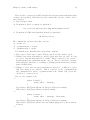
• ESC/Java2 requires that model methods, model constructors and model programs
be defined within one annotation comment. For example, write
/*@ public model int m(int i, int j) {
return i+j;
}
@*/
not
//@ public
//@ model int m(int i, int j) {
//@
return i+j;
//@ }
Chapter 3: Status of JML features
10
• The tool also requires that a Java modifier (e.g. public) be in the same comment
as a JML annotation (e.g. behavior or model method) that it modifies. For
example, write
//@ public behavior
not
//@ public
//@ behavior
• Finally, any in or maps clauses following a ghost or model field declaration must
be within the same annotation comment as the declaration. Thus, write
//@ model T t; in a;
not
//@ model T t;
//@ in a;
Thus, requires and ensures clauses must each be wholly within a single annotation
comment; individual keywords such as pure, normal_behavior, also, {| or implies_
that may be in annotation comments by themselves (with any relevant access modifiers)
if permitted JML.
• Multiple annotations per comment: It is legal JML to include multiple annotations
per comment; in fact it is common practice and good style to include many related
annotations within one multi-line comment. ESC/Java2 supports this practice (though
ESC/Java had some difficulties).
• Terminating semicolons: JML requires annotations to be terminated by semicolons.
The original ESC/Java did not. The absence of semicolons is illegal JML, but is sometimes tolerated by ESC/Java2. ESC/Java2 will warn if a semicolon is missing. Such
warnings can be suppressed with the -noSemicolonWarnings command-line option.
3.3 Compilation unit annotations
Compilation unit annotations are placed prior to the declaration of any type within the
compilation unit.
3.3.1 refine statements
• Description: A JML refine statement indicates that the containing compilation unit
adds additional specifications to those contained in the referenced file. If present,
it must be located after any Java package statement and before any Java or model
import statements. There may be only one refine statement in a compilation unit. It
has the form
//@ refine "filename";
The refine statements define a refinement sequence as described in Section 3.1
[File finding], page 5. Here we focus on the combining of the compilation units in
a refinement sequence to produce a single set of specifications for a type. Each
compilation unit has its own set of declarations and specifications, all of which must
Chapter 3: Status of JML features
11
be consistent. They are subject to the following rules, violations of which provoke
error messages.
• All files of the refinement sequence must belong to the same package (though not
necessarily the same directory); the type names of the declared types must be
identical (including case).
• If a .java or a .class file exists for a type, the specifications may not add any
Java (that is, non-model, non-ghost) declarations to the signature. They may
only repeat declarations. The specification files may declare specifications for a
method that is not implemented in the Java implementation if the declaration
overrides a method in a superclass or superinterface or, for interfaces, a method
in java.lang.Object. This enables the specification writer to write specifications
for a routine in a class or interface that must be obeyed by subtypes, even if the
class or interface itself does not provide a new implementation.
• If a field is redeclared, it must be redeclared with the same type and the same Java
modifiers. An initializer of a java field may be present only in the .java file. An
initializer of a ghost field may be declared in only one file of a refinement sequence.
• These JML modifiers must be consistent across all redeclarations of a field: model,
ghost, instance. The modifiers spec_public, spec_protected, non_null,
nullable and monitored may be added by a refinement file, but may not be
removed.
• If a method or constructor is redeclared, it must be redeclared with the same return
type, the same Java modifiers, and the same names for its formal parameters. An
implementation may be present only in the .java file. (The restriction on the formal
parameter names is to simplify reading and to avoid having the implementation
have to rename variables in specifications.)
• These JML modifiers must be consistent across all method and constructor redeclarations: model. These JML modifiers may be added by a refinement but may
not be removed: spec_public, spec_protected, helper, non_null, pure.
• The Java modifier final, as applied to a formal parameter, must be consistent
across all redeclarations of a method or constructor. The JML modifier non_null
may be added, but not removed.
• If a refinement file redeclares a method or constructor from a previous refinement,
or if the method is overriding a method in a superclass or interface (including the
case where a type redeclares a method with specifications even though there is no
Java declaration), the specification for that redeclared or overriding method must
begin with ‘also’ (and must not begin with ‘also’ when those conditions are not
satisfied).
• A type redeclaration must have the same set of Java modifiers. In addition the
JML modifier model must be consistent; the JML modifiers pure, spec_public,
and spec_protected may be added by a refinement but not removed.
• Status: The refine statement is partly implemented in ESC/Java2; not all the rules
above regarding consistency of modifiers are enforced.
• Comment on combining refinements: There are (at least) 3 ways to carry out the
combining of refinements:
Chapter 3: Status of JML features
12
a. by syntactically combining the relevant text;
b. by typechecking each compilation unit independently and then combining the signatures;
c. by typechecking each compilation unit in turn, in the context of the compilation
units it is refining.
ESC/Java2 uses (a).
3.3.2 model import statements
• Description: A model import statement has the form
//@ model java-import-statement;
Note that simply writing
//@ java-import-statement;
is not legal JML. A model import statement may occur wherever a Java
import statement may be placed. A model import statement introduces types that
are used only by annotations. Annotations may also use types introduced by Java
import statements.
• Status: Model import statements are fully implemented.
• Differences from JML or Java: This feature is implemented in ESC/Java2 as it is in
JML. However, both have the following problem. The model import statements are
parsed by JML tools and by ESC/Java2 as if they were Java import statements. Thus
they may introduce or resolve an ambiguity in class name resolution of names used in
the Java source code in a compilation unit, or cause misinterpretation of a type name.
For example, in
import java.io.*;
//@ model import myclasses.File;
public class C extends File {}
the use of File as the superclass is interpreted as java.io.File by the Java compiler
but as myclasses.File by JML tools and ESC/Java2. Similarly, in
import java.io.*;
//@ model import myclasses.*; // class myclasses.File exists
public class C extends File {}
the use of File is interpreted as java.io.File by a Java compiler but will be deemed
ambiguous between java.io.File and myclasses.File by the JML and ESC/Java2
tools. These are as yet unresolved bugs.
• Comment: This form is also illegal:
/*@ model @*/ import typename;
Either use a Java import statement (without a model keyword) or enclose
the entire model import statement in an annotation comment.
Chapter 3: Status of JML features
13
3.3.3 automatic imports
• Description: In Java programs, the package java.lang.* is automatically imported
into each compilation unit. Similarly, in JML, the package org.jmlspecs.lang.* is
automatically imported, as a model import, into each compilation unit.
• Status: Fully implemented in ESC/Java2.
• Differences: None.
3.4 Access (privacy) modifiers
Java allows the programmer to modify fields, methods, constructors, class and interface
declarations with one of the privacy or access modifiers public, protected, private or to
omit these implying default (or package) access. These modifiers affect the visibility of the
associated declaration in other classes. ESC/Java2 issues compile-time errors for (some)
misuses of access, but the access of any given syntactic entity does not affect the static
checking that is performed.
JML also imposes some rules about access modifiers. Some JML constructs are allowed to be modified by an access modifier: the class-level clauses described in Section 3.6
[Type Annotations], page 16, such as invariant, and the behavior and example keywords (behavior, normal_behavior, exceptional_behavior, example, normal_example,
and exceptional_example). In addition the method-level clauses (e.g. requires, see
Section 3.9 [Routine Annotation clauses], page 25) are assigned the privacy level of the
behavior case of which they are a part (if in a heavyweight specification case) or the privacy
level of the method they modify (if in a lightweight specification case). A specification
clause may not use program entities with tighter access restrictions than it itself has. For
example, a requires clause in a protected normal_behavior specification case may not use
private fields.
Java program constructs that may be modified with an access modifier may also be
modified with one or the other of spec_public and spec_protected. A program construct
modified with spec_public is considered to have public access for any specification and may
be used in any specification clause; a program construct modified with spec_protected may
be used in any specification clause in a derived type. JML constructs may not be modified
with spec_public or spec_protected.
Note that spec_public, but not spec_protected, was present in ESC/Java
Status: Parsing of access modifiers is fully implemented. The access modifiers do not affect
static checking. Checking that access is used consistently is not implemented.
3.5 Type modifiers
A class may be modified with the Java modifiers public, final, abstract and strictfp
and the JML modifiers pure, model, spec_public, and spec_protected. An interface
may be modified with the Java modifiers public, strictfp and the JML modifiers pure,
model, spec_public, and spec_protected. Nested classes and interfaces may have the
additional modifiers static, protected, and private. The access modifiers are described
in Section 3.4 [Access modifiers], page 13. In addition the superclass and superinterfaces
may be modified with the keyword weakly.
Chapter 3: Status of JML features
14
3.5.1 pure (JML)
• Description: The pure modifier, when applied to a class or interface, indicates that
every method and constructor of the class or interface is pure. Thus, no method
may assign to variables other than those declared within the body of the routine.
Constructors may only assign to the instance fields of the object being constructed
(and its superclasses).
• Status: Parsed and fully implemented.
• Differences from JML or Java: None.
• Comment: A method inherits purity from the methods it overrides; that is, if an
overridden method is pure, the overriding method will be pure whether or not it is
declared pure. This is not the case for classes or for interfaces. A subclass may add
non-pure methods, even if it has a pure superclass. Declaring a class pure is precisely
equivalent to declaring all of its methods and constructors pure.
3.5.2 model (JML)
• Description: The model modifier indicates that the class or interface is only to be used
in annotations. It is not part of the Java program.
• Status: Parsed and fully implemented.
• Differences from JML or Java: JML does not yet properly handle model classes, especially those at the top level. Both JML and ESC/Java2 parse model types as if they
were Java types and so will not detected erroneous uses of model types in Java code;
both tools may also have some related name lookup bugs.
3.5.3 weakly (JML)
• Description: This annotation is used to modify superclasses and superinterfaces in a
class or interface declaration. An example of its syntax is this:
public class A extends B /*@ weakly */
implements C /*@ weakly */, D /*@ weakly */ { ... }
The semantics are not described here.
• Status: Parsed and ignored by ESC/Java2.
• Differences from JML or Java: Parsed but ignored by ESC/Java2. This feature was
not present in ESC/Java.
3.5.4 non null by default (JML)
• Description: This annotation is used to denote a non_null default semantics for reference types in a given class. An example of its syntax is this:
public /*@ non_null_by_default @*/ class A { ... }
If a class is labeled with the annotation non_null_by_default then every field, formal
parameter, and method has a default specification of non_null. Local variables do not
have any default specification.
If a class is annotated non_null_by_default and a formal parameter, method, or field
is annotated non_null then the latter spec is redundant and the user is notified of
such.
Chapter 3: Status of JML features
15
If a class is annotated non_null_by_default and a formal parameter, method, or
field is annotated with nullable then this specified annotation overrides the class
annotation and the reference may be null. The scope of this annotation to the class
includes nested (possibly anonymous) classes, but is not inherited by subclasses.
If an interface may be annotated with non_null_by_default, then all constants, formal
parameters, and methods in the interface have a default specification of non_null.
All concrete implementations of this interface must be consistent with these default
specifications.
• Status: The modifier is parsed. Implemented for method return types and parameters,
but class level modifiers are ignored.
Left to do: Fields and bound variables.
• Differences from JML or Java: In the current JML2 implementation the non_null_
by_default annotation is file-scoped rather than class-scoped.
3.5.5 nullable by default (JML)
• Description: This annotation is used to denote a nullable default semantics for reference types in a given class. An example of its syntax is this:
public /*@ nullable_by_default @*/ class A { ... }
If a class is labeled with the annotation nullable_by_default then every field, formal
parameter, and method has a default specification of nullable. Local variables do not
have any default specification.
If a class is annotated nullable_by_default and a formal parameter, method, or field
is annotated nullable then the latter spec is redundant and the user is notified of
such.
If a class is annotated nullable_by_default and a formal parameter, method, or
field is annotated with non_null then this specified annotation overrides the class
annotation and the reference may be null.
[[ The scope of this annotation to the class to which it is applied as well as nested
(possibly anonymous) classes. The class-scoped annotation is not inherited. ]]
[[ An interface may be annotated with nullable_by_default. All constants, formal
parameters, and methods in the interface have a default specification of nullable.
All concrete implementations of this interface must be consistent with these default
specifications. ]]
• Status: The modifier is parsed. Typechecking implementation is underway. This modifier is not yet used by the static checker.
• Differences from JML or Java: In the current JML2 implementation the nullable_
by_default annotation is file-scoped rather than class-scoped.
3.5.6 final (Java)
• Description: A final class may not have subclasses.
• Status: Parsed, typechecked, and used by the static checker.
• Differences from JML or Java: None.
Chapter 3: Status of JML features
16
3.5.7 abstract (Java)
• Description: A class must be declared abstract if it has abstract methods. An abstract
class may not be instantiated; only non-abstract subclasses of an abstract class may be
instantiated. All interfaces are by definition abstract; using the abstract modifier on
an interface has been deprecated.
• Status: This modifier is parsed and checked. It does not need any static checking.
• Differences from JML or Java: None.
3.5.8 strictfp (Java)
• Description: The strictfp modifier determines the semantics of floating point operations within the class so modified.
• Status: This modifier is parsed and typechecked. The static checker does not make use
of this information.
• Differences from JML or Java: None.
3.5.9 static (Java)
• Description: static is a Java modifier that may be applied to classes and interfaces
that are members of enclosing classes.
• Status: Implemented.
• Differences from JML or Java: None.
3.6 Annotations pertinent to a class or interface
These annotations may appear anywhere a declaration within a class or interface may appear. They define specification-only ghost or model fields of the type and state specifications
that apply to the whole object (not just to individual methods).
3.6.1 Ghost fields
• Description: A ghost field is a field of the object that can hold a primitive value or a
reference to an object, but is used only in specifications. Its value is changed using the
set annotation within the body of a method or constructor (see Section 3.14.3 [set],
page 36). A ghost field may have an initializer, just as a Java program field may, but the
ghost field may be initialized in only one compilation unit of a refinement sequence.
A ghost field may have modifiers that a Java field declaration would have (namely,
access modifiers (see Section 3.4 [Access modifiers], page 13), static, final, but not
volatile, transient) as well as the JML modifiers non_null, nullable, monitored
and instance (see Section 3.12 [Field Annotation modifiers], page 33).
An interface may also declare ghost fields; these fields may be referenced by annotations
in the interface or its subtypes. Such ghost fields are by default static, but may be
modified by the JML modifier instance, in which case they are a field of every object
that implements the interface.
• Status: Ghost fields are completely supported.
• Differences from JML or Java: None.
Chapter 3: Status of JML features
17
3.6.2 Model fields
• Description: Model fields are declarations within an annotation prefixed by the modifier
model. They do not represent actual specification fields as do ghost values. Rather,
their values are implied by the concrete representation of the class, either by an explicit
expression in a represents clause or implicitly by a boolean condition in a \such_
that form of the represents clause. They are used to supply values that model the
behavior of the class.
A model field may have these modifiers: access modifiers (see Section 3.4 [Access modifiers], page 13), static, and the JML modifiers non_null, nullable, and instance
(see Section 3.12 [Field Annotation modifiers], page 33). Model fields may not have
initializers.
• Status: Model fields are parsed and used in typechecking, but ESC/Java2 does not find
inconsistencies between multiple represents clauses.
• Differences from JML or Java: None.
3.6.3 Model methods
• Description: Model methods are method declarations within an annotation and modified with the modifier model. They declare methods that may be used in model programs and (if pure) in specifications. Model methods may have these Java modifiers:
public, protected, private, static, abstract, final, synchronized, strictfp;
they may have these JML modifiers: pure, non_null, nullable, and helper.
Model methods may be declared in multiple specification files, but may have an implementation in at most one.
• Status: Model methods are parsed and converted to regular Java methods within
ESC/Java2.
• Differences from JML or Java: Model methods are parsed and converted to regular Java
methods within ESC/Java2. Consequently, ESC/Java2 will not detect their (illegal)
use within the implementation or inheritance of a Java routine.
3.6.4 Model constructors
• Description: Model constructors are constructor declarations within an annotation
and modified with the modifier model. They declare constructors that may be used in
model programs and (if pure) in specifications. A model constructor may have these
Java modifiers: public, protected, private; it may have these JML modifiers: pure,
helper. Constructors may be strictfp only by virtue of the entire class being declared
strictfp.
Model constructors may be declared in multiple specification files, but may have an
implementation in at most one.
• Status: Model constructors are parsed and converted to regular Java constructors
within ESC/Java2.
• Differences from JML or Java: Model constructors are parsed and converted to regular
Java constructors within ESC/Java2. Consequently, ESC/Java2 will not detect their
(illegal) use within the implementation of a Java routine.
Chapter 3: Status of JML features
18
3.6.5 Model class and model interface declarations
• Description: A model type (class or interface) declaration is a conventional type declaration modified by the JML keyword model (and in an annotation comment). The
entire declaration must be within one annotation comment. The model type may be
used within annotation expressions and statements. Model types may have the same
modifiers as top-level and nested java type declarations, as appropriate (see Appendix
A).
• Status: Implemented.
• Differences from JML or Java: Model types are in the same name space as conventional
Java types. Thus in some cases the resolution of a type name in Java code could resolve
to a model type name rather than to the correct Java type. This is a bug in the name
scoping of both JML and ESC/Java2; the workaround is to rename the model type so
that it does not hide a Java type name.
3.6.6 Java initializer blocks
• Description: Java permits blocks of code within braces in the body of a class (but
not interface) declaration. In the process of loading a class, each initializer of a static
field and each initializer code block with a static modifier is executed in textual sequential order. Similarly, when an instance of a class is created, each initializer of a
non-static field and each non-static initializer block is executed in textual sequential
order. Each initializer block may be preceded by a specification, just like a method
specification. The preconditions and postconditions specified must hold just before and
just after the execution of the initializer block. Note that no invariants or other classlevel specifications are required to hold until all static initialization and class loading
is complete (for static invariants) or until a constructor has completed execution (for
instance invariants).
• Status: Most specifications are parsed but not all and no reasoning is implemented.
• Differences from JML or Java: None.
3.6.7 initializer
• Description: The JML initializer and static_initializer keywords are used in
specification files as stand-ins for all of the instance and class initialization that is performed as part of object creation or class loading. Within a class declaration in a compilation unit there may be just one each of the initializer and static_initializer
keywords, each preceded by specifications (like those preceding a routine declaration
or a Java initialization block). If more than one compilation unit of a refinement sequence has these keywords, then the associated specifications are combined just like
routine specifications are combined. The composite specifications associated with an
initializer keyword give preconditions that must hold before any instance initialization and postconditions that must hold after any instance initialization (but before
constructors are executed). Similarly, the specifications of a static_initializer keyword hold before and after the static initialization of the class. Note that these are
different than the specifications for a Java initializer block, which apply only to that
block.
• Status: Not yet parsed or implemented in static checking.
Chapter 3: Status of JML features
19
• Differences from JML or Java: None.
3.6.8 static initializer
• Description: See the description above.
• Status: Not yet parsed or implemented in the static checker.
• Differences from JML or Java: None.
3.6.9 Java method, constructor and field declarations
• Description: These declarations are identical to those defined by Java. An implementation or initialization for such a declaration may appear only in the .java file, not
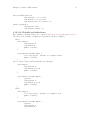
in any repeated declaration in a specification file. The modifiers allowed are listed in
Appendix A.
• Status: Parsed and typechecked fully. Java fields may be used in annotations. JML and
ESC/Java2 also allow pure methods and pure constructors to be used in annotations.
• Differences from JML or Java: None
3.6.10 Nested Java type declarations
• Description: Java allows declarations of classes and interfaces within a class or interface.
These are called nested classes or interfaces. Inner classes or interfaces are nested classes
or interfaces that are not static. The modifiers allowed are listed in Appendix A.
• Status: Implemented.
• Differences from JML or Java: None
3.7 Annotation clauses for a class or interface
These clauses provide a specification of the behavior of the class and of objects of the class.
They may be specified in any order, within annotation comments, anywhere an element of a
type declaration may appear. They may individually have access modifiers (see Section 3.4
[Access modifiers], page 13) public, protected, or private.
3.7.1 invariant, invariant redundantly
• Description: An invariant clause specifies a boolean condition that must hold before
and after any call of a (non-helper) method of the containing type. Invariants must
hold after any (non-helper) constructor call of the containing type. In checking the
implementation of a method, invariants are assumed as part of the preconditions and
must be established as part of the postconditions.
An invariant clause may be declared static, in which case it may only reference
static fields and routines.
• Status: Fully implemented, except that ESC/Java2 does not check the restriction on
static invariants.
• Differences from JML or Java: None
3.7.2 constraint, constraint redundantly
• Description: A constraint clause specifies a relation that must hold between the preand post-conditions of any (non-helper) method of the containing type. If the clause
Chapter 3: Status of JML features
20
is declared static, then all field and routine references within the constraint predicate
must be static.
• Status: Parsed and typechecked. The static checker issues a warning if the constraint
is not true as part of the postconditions of any method (but does not check constraints
in association with constructors).
• Differences from JML or Java: ESC/Java2 does not check the restriction on static
constraints.
3.7.3 represents, represents redundantly
• Description: A represents clause designates how a model field is related to the concrete fields or other model fields of the implementation. The represents clause must be
declared static when and only when the model field for which it is providing a representation is declared static; if the clause is static then all field and routine references
must be static.
• Status: Parsed, typechecked, and used by the static checker.
• Differences from JML or Java: None. ESC/Java2 does not check the restrictions on
static.
3.7.4 axiom
• Description: An axiom is used to specify a mathematical property, independent of the
implementation of classes or objects. Axioms are always considered to be static.
• Status: Implemented.
• Differences from JML or Java: None.
3.7.5 initially, initially redundantly
• Description: This clause specifies a condition that must hold in the post-state of any
(non-helper) constructor (including the default constructor). Within the body of a
constructor, any superclass initially clauses are assumed to hold after the execution
of a (non-helper) super(...) call, including a possible implied call of the default
superclass constructor. A class does not inherit any superclass initially clauses;
initially clauses are not permitted in interfaces. If the clause is declared static, it
may only reference static fields and routines.
• Status: Implemented. Initially clauses are typechecked as additional postconditions
on every constructor of a class. Failures provoke an ‘Initially’ warning.
• Differences from JML or Java: None.
3.7.6 readable and writable
• Description: JML allows class-level clauses of the form
readable field if predicate ;
and
writable field if predicate ;
Chapter 3: Status of JML features
21
These specify a predicate that must be true in the state in which a read or
write access of a class field is attempted. These are useful to specify the access
protocol for a variable shared across threads, but can also be used simply to indicate
under what circumstances a field’s value is defined.
• Status: Implemented. However, the semantics is not well-defined for the situation in
which the field referred to in the clause is declared in a superclass of the class declaration
containing the clause.
• Differences from JML or Java: ESC/Java also allows a readable_if and writable_
if modifier for field declarations (each taking simply a predicate and are positioned
just prior to the field declaration, as, for example, a non_null modifier would be).
readable_if is deprecated in JML and writable_if is not defined at all. Hence these
forms are discouraged in ESC/Java2 as well.
3.7.7 monitors for
• Description: This clause associates a list of expressions with a given field name. The
field identified must be a field of the class containing the declaration. All of the expressions must evaluate to objects (not to primitive values). If the field is static, all of
the objects must be static. The effect is to associate the expression values as monitors
for the given object.
• Status: Implemented.
• Differences from JML or Java: None.
3.8 Annotations for a method or constructor
Specifications of the behavior of an individual method or constructor typically appear
within an annotation comment, just prior to the declaration of the method or constructor. The specifications consist of zero or more lightweight or heavyweight behavior sections,
an optional code_contract section, an optional implies_that section, and an optional
for_example section. Model methods and constructors may also be annotated with these
specifications.
3.8.1 Lightweight and heavyweight specifications
• Description: Lightweight specification cases are simply a series of specification clauses
and correspond to the specification style of ESC/Java. Heavyweight specification cases
are introduced with a behavior, normal_behavior, or exceptional_behavior keyword. Heavyweight specifications may have optional privacy modifiers (see Section 3.4
[Access modifiers], page 13) and have different defaults than do lightweight specifications.
Within a heavyweight specification, if a particular clause type is omitted, the default
for that clause is as follows:
ensures true;
signals (java.lang.Exception) true;
diverges false;
assignable \everything;
accessible \everything;
callable \everything;
Chapter 3: Status of JML features
22
when true;
duration \not_specified;
working_space \not_specified;
The defaults defined by JML for lightweight specifications are \not_specified in each
case. This is interpreted within ESC/Java2 as follows.
ensures true;
signals (java.lang.Exception) true;
diverges true;
assignable \everything;
accessible \everything;
callable \everything;
when true;
duration \not_specified;
working_space \not_specified;
The default for the requires clause is determined as follows:1
• If there are some other clauses explicitly given, but no requires clause, the default
is requires true;
• If there is no specification at all and the routine is a constructor or is a method
that does not override any superclass or superinterface methods, the default is
requires true;
• If there is no specification at all (including no non_null modifier) and the method
does override some superclass or superinterface method, the default is requires
false;
• For the default constructor, if no specifications have been given, the default requires specification is the same as the requires specification of the corresponding
superclass constructor.
The reasons for these defaults are explained in Section 3.19.13 [Specifications and inheritance], page 51.
The modifies clause has this exception to the above rule: For the default constructor, if
no specifications have been given, the default modifies specification is the same as the
modifies specification of the corresponding superclass constructor. (This is not a textual
replication; rather the subclass constructor may modify the same set of locations, under
the same conditions, as the superclass constructor.) Note that the defaults for the
diverges clause are different between the lightweight and heavyweight forms. The
lightweight default, diverges true, puts the least restrictions on the implementation;
it states that the implementation is allowed to be non-terminating (but not required
to be). The heavyweight default, diverges false, requires the implementation to
terminate with either an exception or a normal return, but this is not checked by
ESC/Java2.
• Status: The lightweight and heavyweight specification forms, including nesting using
{| and |} and combination with also, are fully parsed and implemented (though not
all clause types, as described below, are fully implemented or handled by the static
checker).
1
Michael Möller contributed to this formulation of the defaults for requires.
Chapter 3: Status of JML features
23
• Differences from JML or Java: None, except that ESC/Java2 does not constrain the
order of clauses as rigidly as do JML tools. JML requires forall, old and requires
clauses to precede any other clauses; with a warning level of -w2 (not the default),
JML will also warn about deviations from a recommended order of the other clause
types. ESC/Java2 will accept clauses in any order (but note that the scope of forall
and old does not include clauses that precede them). ESC/Java2 does not check the
access modifiers on behavior and example keywords.
• Comment: The ESC/Java2 (and ESC/Java) translator, which produces the verification
conditions to be checked by the static checker, accepts a set of specification clauses in
lightweight form. In order to handle the nested and heavyweight forms and the combination of specifications using also, either within one source file or across a refinement
sequence, ESC/Java2 desugars the more complicated syntax into a simpler form. For
this purpose ESC/Java2 does not need to desugar all clauses of a given type down to
one instance of that clause type. The equivalent but slightly simpler version used in
ESC/Java2 is outlined here. Note that the desugaring process must take care not to
lose the location information that is helpful to the user when warning messages are
issued.
The desugaring process first eliminates nesting by replicating and distributing the
forall, old, and requires clauses across the nested groups of clauses. Any old
clauses are desugared by replacing any references to them by the expression with
which they are initialized (evaluated in the pre-state); any forall clause is desugared
by wrapping any clause within its scope in a \forall quantified expression. Also,
each lightweight specification case, normal_behavior and exceptional_behavior
keyword is desugared into a behavior specification. Specifications from corresponding
methods in the refinement sequence are combined, connected by also. That produces
a series of specification cases, connected by also, each consisting of one group of
clauses (that is, one specification case). ESC/Java2’s static checker will accept a single
specification case. For each specification case, a composite precondition predicate is
formed by taking the conjunction of the predicates in each of the requires clauses
in that specification case, and making that conjunction the argument of an \old
function:
pre-predicate = \old(p1 && p2 ... )
Each clause within the specification case is altered by constraining its action
using that conjunction. Calling that combined predicate pre-predicate, we transform
each clause as follows:
• ensures pred ;
becomes
ensures pre-predicate ==> pred ;
• diverges pred ;
becomes
diverges pre-predicate ==> pred ;
• modifies clauses: Multiple modifies clauses within one specification case are combined into one clause, along with the composite precondition for that specification
case; modifies clauses from different specification cases are not combined.
Chapter 3: Status of JML features
24
• signals (type id ) pred ;
becomes
signals (type id ) pre-predicate ==> pred ;
The requires clauses are desugared by replacing all of the requires clauses in all of the
specification cases with a single requires clause whose predicate is the disjunction of
the conjuctions formed for each specification case, without the enclosing \old. When
the static checker creates a VC to be used as a precondition for calling a method, it
forms a disjunction of the requires clauses for the method and all the declarations that
it overrides.
3.8.2 also
• Description: JML allows multiple specifications for a single method declaration; these
are separated and connected by the also keyword. Furthermore, if the method has
additional declarations (with or without specifications) in an earlier source file in the
refinement sequence or an overridden method in a superclass or interface, then (and only
then) the specification must begin with also to indicate that there are some previous
declarations, with possible specifications, of which the reader should be aware.
• Status: The use of also is completely implemented, with desugaring occurring as
described above.
• Differences from JML or Java: None.
• Comment: This syntax for combining specifications is different than and not backwards
compatible with the syntax used in ESC/Java. That tool did not allow combining multiple specifications using also and did not support refinement sequences. Where there
was inheritance of specification clauses from a superclass or interface, the keywords
also_requires, also_ensures, also_modifies, and also_exsures were required.
These keywords are not supported in ESC/Java2 and such specifications will need to
be rewritten using the new also syntax.
3.8.3 model program
• Description: Model programs are an alternate way to provide specifications for a
method. Rather than stating logical conditions that the pre- and post-states must
satisfy, the behavior is specified by a model program, which specifies the behavior using
typical imperative programming constructs. However, a model program allows some
non-deterministic (and non-executable) constructs as well. Note that there are a number of JML constructs which are only used within model programs. These are described
in Section 3.18 [Statements within model programs], page 46.
• Status: Model programs are parsed and ignored. They are permitted as a specification
case, as defined by JML. Any constructs unique to model programs are simply skipped
over by the parser.
• Differences from JML or Java: None.
3.8.4 code contract
3.8.5 implies that
• Description: The implies_that keyword introduces specification cases that are logical consequences of the usual behavior and lightweight specifications. They could be
Chapter 3: Status of JML features
25
used as specifications to be checked in the same way that the other specifications are.
Alternatively, it could be verified that they are logical consequences of the other specifications; the results could then be used as additional useful statements of behavior;
these in turn could help with proofs involving use of the method or constructor with
which the implies_that specification is associated.
• Status: The specifications in an implies_that section are parsed, but not used within
any static checking.
• Differences from JML or Java: None.
3.8.6 for example specification
• Description: The for_example keyword introduces specification cases that are useful and instructional examples for the reader of the specifications. Hence they must
be logical consequences of the other specifications. Each case may be lightweight or
be introduced by one of the keywords example, normal_example, and exceptional_
example; these keywords may have associated access modifiers (see Section 3.4 [Access
modifiers], page 13).
• Status: The specifications in a for_example section are parsed, including the example,
normal_example, and exceptional_example keywords. However, they are not used
within any static checking, nor is it verified that they follow from the other specifications.
• Differences from JML or Java: None.
3.9 Annotation clauses for a method or constructor
In this section we describe the clause types that may be part of specifications, including
implies_that and for_example sections. Note that some clauses have alternate keywords
reflecting different personal preferences or different usages among ESC/Java2 and other
JML tools. These alternates are complete synonyms.
3.9.1 forall
• Description: The forall declaration declares a universally quantified variable; the
scope of the declaration is all subsequent clauses for the same routine up to the also
or |} marking the end of the specification case containing the forall declaration, or
until end of the behavior, implies that or for example section. No initializer is allowed.
The clause is desugared by wrapping each desugared clause that is in scope in an
appropriate \forall expression.
• Status: Fully implemented. However, the semantics need clarifying and the static
checker objects to quantified expressions.
• Differences from JML or Java: None.
3.9.2 old
• Description: The old declaration is used within a routine specification to define a value
that may be used in subsequent clauses of the specification. The variable declared
must be initialized. The initialization expression is always evaluated in the pre-state,
regardless of how the variable is used in subsequent clauses. The scope of the variable
extends from its declaration (including the initializer), to the ‘also’ or ‘|}’ that marks
Chapter 3: Status of JML features
26
the end of the specification case sequence containing the old declaration, or until the
end of the behavior, implies that or for example section. The uses of old variables
are desugared by substituting the initialization expression, wrapped in an appropriate
\old expression, at the point of use.
• Status: Implemented, but array initializers are not supported.
• Differences from JML or Java: None.
3.9.3 requires, requires redundantly, pre, pre redundantly
• Description: A requires clause specifies a condition that must hold in the pre-state of
the method, in the context where it is called in the program. The remaining clauses
of the specification case must hold whenever the requires clause (or the conjunction
of multiple requires clauses) holds. The expression in the clause may also be \not_
specified, which is equivalent to omitting the clause. The expression must have
boolean type and is evaluated in the pre-state.
• Status: The requires clause is implemented and is utilized by ESC/Java2 in generating
verification conditions.
• Differences from JML or Java: None.
3.9.4 ensures, ensures redundantly, post, post redundantly
• Description: An ensures clause states a condition that must hold in the post-state of
a method or constructor whenever the associated preconditions hold in the pre-state
and the method or constructor exits normally. The expression in the clause may also
be \not_specified, which is equivalent to omitting the clause. The expression must
have boolean type and is evaluated in the post-state.
• Status: Implemented and used by the static checker.
• Differences from JML or Java: None.
3.9.5 signals, signals redundantly,
exsures, exsures redundantly
• Description: A signals clause states a condition that must hold in the post-state of a
method or constructor whenever the associated preconditions hold in the pre-state and
the method or constructor exits with an exception of (or a subclass of) the designated
type. The expression in the clause may also be \not_specified, which is equivalent
to omitting the clause. The expression must have boolean type and is evaluated in the
post-state (though the keyword \result is not valid in a signals clause).
• Status: Implemented and used by the static checker.
• Differences from JML or Java: None.
3.9.6 modifies, modifiable, assignable, modifies redundantly,
modifiable redundantly, assignable redundantly
• Description: The modifies clause indicates which memory locations may be assigned
within the associated routine when the routine is called in a pre-state that satisfies
the associated preconditions. The list of locations in the modifies clause may also
contain the special keywords \nothing, \everything, \not_specified, and the wildcard forms expr .* , typename.* , array[*], and array[expr .. expr ]. Any expressions
in the clause are evaluated in the pre-state.
Chapter 3: Status of JML features
27
Each location listed in the clause implicitly includes all the elements of its datagroup, if
a datagroup is associated with the location. Other memory locations are added to a location’s datagroup using the in and maps clauses (see Section 3.11 [Field Annotations],
page 32).
• Status: Implemented and used by the static checker. ESC/Java2 checks that assignments within a routine are consistent with the routine’s modifies clauses and checks
that the modifies clauses of called routines are consistent with those of the caller.
However, ESC/Java2 is not yet able to properly handle the forms \everything,
array[*] and array[e1..e2] when in the modifies clause of a routine called within
the body of a calling routine (and remember that modifies \everything is the
default). For example, given
public int i;
public int[] a;
//@ modifies \everything;
void m() { ... }
//@ modifies a[*];
void n() { ... }
//@ modifies a[2..10];
void nn() { ... }
//@ modifies \nothing;
void p() {
i = 0;
m();
//@ assert i == 0;
a[3] = 0;
n();
//@ assert a[3] == 0;
a[3] = 0;
nn();
//@ assert a[3] == 0;
}
ESC/Java2 should complain that the first assert statement in routine p is not established, because m, which claims to possibly modify everything, might have modified
field i. It will complain that the modifies clauses of the two routines are in conflict. It
will also complain about the assert statement if m had a modifies clause of modifies
i;. Similarly the forms of array range designators in the modifies clauses of n and
nn are not fully handled, so the second and third assert statements do not provoke
complaints. Store-ref expressions that are specific array elements or the forms expr.*
and typename.* are handled properly.
A second aspect of modifies clauses not being fully handled is the following. Within a
class that has a field named i
//@ modifies this.*;
Chapter 3: Status of JML features
28
public void m() {
n();
}
//@ modifies i;
public void n();
provokes no complaints, since i is recognized as part of this.*. However, in
//@ modifies i;
public void m() {
n();
}
//@ modifies this.*;
public void n();
ESC/Java2 will issue a warning, since it does not check that all possible fields of the
class (any of which might be modified by n) are listed in the modifies clause of m. The
similar situation holds for static members.
3.9.7 diverges, diverges redundantly
• Description: This clause states a predicate that must hold (in the pre-state) if the
method never terminates (given that the associated precondition holds in the prestate). The expression in the clause may also be \not_specified, which is equivalent
to omitting the clause. The expression must have boolean type and is evaluated in the
pre-state.
• Status: Parsed and typechecked, but not used in any static checking.
• Differences from JML or Java: None.
3.9.8 when
• Description: The expression in the clause may also be \not_specified, which is equivalent to omitting the clause. The expression must have boolean type and is evaluated
in the pre-state.
• Status: Parsed and typechecked, but not used in any static checking.
• Differences from JML or Java: None.
3.9.9 duration
• Description: This specification asserts that the execution of the routine (with the
given preconditions) will not exceed the stated number of virtual machine cycles. The
expression in the clause may also be \not_specified, which is equivalent to omitting
the clause. The expression must have long type and is evaluated in the post-state.
• Status: Parsed and typechecked but not used in any static checking.
• Differences from JML or Java: None.
Chapter 3: Status of JML features
29
3.9.10 working space
• Description: This specification asserts that the execution of the routine will not utilize
more than the stated number of bytes of heap space. The expression in the clause may
also be \not_specified, which is equivalent to omitting the clause. The expression
must have long type and is evaluated in the post-state.
• Status: Parsed and typechecked, but not used in any static checking.
• Differences from JML or Java: None.
3.9.11 accessible
• Description: The list of locations in the clause may also contain the special keywords
\nothing, \everything, Any expressions (e.g. array indices) are evaluated in the
pre-state.
• Status: Parsed and ignored.
3.9.12 callable
• Description: The list of locations in the clause may also contain the special keywords
\nothing, \everything, Any expressions (e.g. array indices) are evaluated in the
pre-state.
• Status: Parsed and ignored.
3.9.13 measured by
• Description: The expression in the clause may also be \not_specified, which is equivalent to omitting the clause.
• Status: Parsed and ignored.
3.9.14 Redundancy
• Description: Many clauses have a redundant form, indicated by using a keyword with a
redundantly suffix. The intention of these clauses is to indicate specifications that are
implied by other, nonredundant, specifications. The writer may choose to include the
redundant specifications in order to point out some non-obvious implications of other
specifications, either to facilitate understanding by the reader or to assist the prover in
verifying conclusions.
Note that the implies_that and for_example specifications are additional forms of
redundancy.
• Status: Currently in ESC/Java2 a command-line option selects between using redundant specifications (those with keywords ending in _redundantly) in the same
way as nonredundant specifications (the default) or ignoring them (when the option
-noredundancy is chosen).
3.10 Annotation modifiers for a method or constructor
Annotation modifiers can appear between the last specification clause or javadoc comment
and the type designator or class name that is part of the method or constructor. JML
modifiers and Java modifiers may appear in any order. Though less common and not the
usual style (and discouraged), ESC/Java2 (following ESC/Java) allows JML modifiers to
Chapter 3: Status of JML features
30
appear after the method declaration and before the opening left brace of the body or the
terminating semicolon if there is no body.
Besides the modifiers listed here, methods and constructors may also have the access
modifiers described in Section 3.4 [Access modifiers], page 13.
3.10.1 pure (JML)
• Description: The pure modifier applied to a method indicates that the method does
not assign to any non-local memory location during its execution; it may not even
modify and then restore the original value. It is equivalent to having modifies
\nothing; in the specification. In the case of a constructor, the only fields that may
be modified are, at most, the fields of the object itself, which are initialized as a
result of the action of the constructor. In this case the pure modifier is equivalent to
specifications of the form
modifies this.*;
However, a constructor may have modifies clauses that are more restrictive
than modifies this.*;. Note that if a method is declared pure, then all overriding
methods are also pure, whether or not they have an explicit declaration to that effect.
Note that a pure constructor may not modify static fields.
It is also worth mentioning that it is possible to call non-pure methods from within the
pure ones provided that the changed state is locally allocated in the pure method.
• Status: Fully supported.
• Differences from JML or Java: None.
3.10.2 non null (JML - methods only)
• Description: Modifying a routine with the non_null modifier is valid only for methods
that return objects as return values (and not for constructors). The modifier specifies
that the return value is never null. It is equivalent to a specification of
ensures \result != null;
added to each specification case of the method’s specification in all of the
files of the refinement sequence (but not of a superclass’s specification of that method).
Note that superclass and subclass declarations of a method each independently may
have or not have non_null declarations. A method’s implementation must satisfy the
superclass specification and independently satisfy the subclass specification. There is
a more thorough discussion in Section 3.19.13.3 [Inheritance and non null], page 54.
• Status: Parsed, typechecked and supported by the static checker.
• Differences from JML or Java: None.
3.10.3 nullable (JML - methods only)
• Description: Modifying a routine with the nullable modifier is valid only for methods
that return objects as return values (and not for constructors). The modifier specifies
that the return value may be null.
Chapter 3: Status of JML features
31
Note that this modifier is not the opposite of non_null since the negation of the
equivalent specification would be
ensures !(\result != null);
which is equivalent to
ensures \result == null;
which is not the intent of nullable.
Note that superclass and subclass declarations of a method each independently may
have or not have nullable (and non_null) declarations. A method’s implementation
must satisfy the superclass specification and independently satisfy the subclass specification. There is a more thorough discussion in hundefinedi [Inheritance and non-null],
page hundefinedi.
In short, a nullable method may be overridden by a non_null method but must then
be non_null thereafter.
• Status: The modifier is parsed. Typechecking implementation is underway. This modifier is not yet used by the static checker.
• Differences from JML or Java: None.
3.10.4 helper (JML)
• Description: This modifier indicates that the method or constructor in question is
used as an internal helper routine and that the method or constructor is therefore
not expected to satisfy any of the class-level invariants or constraints, in either its
pre-state or its post-state. The method or constructor is still expected to satisfy any
specifications (e.g. ensures clauses) that are explicitly associated with this method or
constructor.
• Status: Parsed, typechecked and supported by the static checker.
• Differences from JML or Java: JML only allows private methods and constructors to
be helpers. ESC/Java2 also allows any constructors, final methods or methods of final
classes to be helpers. (ESC/Java2’s rule is that only routines that cannot be overridden
may be helpers.)
3.10.5 final (Java - methods only)
• Description: This Java modifier indicates that a method may not be overridden. It
may also be applied to model methods.
• Status: Fully implemented. This feature does not affect the static checking; it simply
produces a typechecking error if a final method is overridden.
• Differences from JML or Java: None.
3.10.6 static (Java - methods only)
• Description: static is a Java modifier (which may be used on JML annotations as
well) that indicates that the declaration in question is a member only of the class and
not of each instance of the class.
Chapter 3: Status of JML features
32
• Status: Fully implemented.
• Differences from JML or Java: None.
3.10.7 synchronized (Java - methods only)
• Description: This modifier indicates that processing must wait until a monitor lock is
available and must obtain that lock before the execution of the method is begun; the
lock is released when the method execution is completed. Each object has, implicitly, a
monitor lock associated with the object. Before executing an instance method, it is the
lock associated with receiver object that is obtained; before executing a static method,
it is the lock associated with the class object (T.class for type T) that is obtained.
• Status: Implemented.
• Differences from JML or Java: None.
3.10.8 native (Java - methods only)
• Description: A native method is one whose implementation is provided outside of the
Java language. Consequently such a method will not have an implementation.
• Status: Fully implemented. The static checker will indicate that the method passes its
checks since there is no body to check.
• Differences from JML or Java: None.
3.10.9 strictfp (Java - methods only)
• Description: This modifier indicates that all of the floating point operations within the
method must hold to strict semantics.
• Status: Parsed and ignored by ESC/Java2. No static checking of floating point semantics is performed. Note that the Java Language Specification stipulates that constructors may be strictfp only by virtue of the entire class being declared strictfp.
• Differences from JML or Java: None.
3.11 Annotation assertions for a field declaration
A field declaration (including ghost and model field declarations) may be followed by field
assertions, which are introduced by the in and maps keywords. These declarations associate
a field or its sub-fields with specific datagroups, which can then be used as items in a modifies
clause.
3.11.1 in (JML)
• Description: This assertion follows a field declaration and lists the datagroups of which
the field is a part. A field is automatically a part of the datagroup with the same name
as itself.
• Status: Implemented.
• Differences from JML or Java: None.
3.11.2 maps, \into (JML)
• Description:
• Status: Parsed, typechecked and static checked using a limited unrolling of any recursive definitions.
Chapter 3: Status of JML features
33
3.12 Annotation modifiers for a field declaration
A field declaration (including ghost and model field declarations) may have both Java and
JML modifiers. In addition to the access modifiers (see Section 3.4 [Access modifiers],
page 13), the following modifiers are relevant to field declarations.
3.12.1 non null (JML)
• Description: This modifier on a field declaration indicates that the field in question
never has a null value, after the object is constructed. It is equivalent to a class
invariant of the form
invariant field != null;
with the same access modifiers as the field itself.
Note that the field is not null after construction. The field may indeed be null after
class initialization and during the execution of constructors or helper methods called
by constructors.
• Status: Fully implemented and supported by the static checker.
• Differences from JML or Java: None.
3.12.2 nullable (JML)
• Description: This modifier on a field declaration indicates that the field in question
may have a null value. It is equivalent to a class invariant of the
invariant field != null || field == null;
with the same access modifiers as the field itself which, since this specification simplifies to true because all references in Java either have null value or they do
not, is not added at all.
• Status: The modifier is parsed. Typechecking implementation is underway. This modifier is not yet used by the static checker.
• Differences from JML or Java: None.
3.12.3 monitored (JML)
• Description: This modifier indicates that the field modified is guarded by the monitor
associated with this if the field is not static and by the monitor associated with the
class object if the field is static. On any write to the field, all monitors guarding the
field must be held by the thread executing the write; on any read of the field, at least
one of the monitors guarding the field must be held by the thread executing the read.
Modifying a field x in class C with monitored is equivalent to the declaration
monitored_by x = C.class;
if x is static, or to
monitored_by x = this;
Chapter 3: Status of JML features
34
if x is not static.
• Status: Implemented. The implementation improves on that in ESC/Java by implementing monitors for static fields and by making the error messages more informative
and accurate.
• Differences from JML or Java: None.
3.12.4 final (Java)
• Description: This Java modifier indicates that the field it modifies may not be assigned
to, after it has been initialized (either by an initializer or in a constructor). Java has
some complex rules about definite-assignment that are relevant but not discussed here.
• Status: It is supported by the ESC/Java2 parser and type checker. It does not have
any effect on the static checking.
• Differences from JML or Java: None.
3.12.5 volatile (Java)
• Description: This Java modifier affects the optimizations that might be applied and
the semantics of the order of writing the values of object fields to memory. It affects
multi-threaded programs only. It is not applicable to a ghost or model declaration.
• Status: Parsed but ignored by the static checker.
• Differences from JML or Java: None.
3.12.6 transient (Java)
• Description: Fields designated transient are not saved as part of an object’s persistent
state. This is not applicable to a ghost or model declaration.
• Status: Parsed but ignored by the static checker. Any implications of this modifier
would be part of the specifications of serialization for the object.
• Differences from JML or Java: None.
3.12.7 static (Java)
• Description: static is a Java modifier (which may be used on JML ghost and model
field declarations as well) that indicates that the declaration in question is a member
of the class and not of each instance of the class.
• Status: Fully implemented.
• Differences from JML or Java: None.
3.12.8 instance (JML)
• Description: instance is a JML modifier that indicates the opposite of static, that is,
that the field in question is a member of each instance of the object, not just of the class.
Within a class declaration, field declarations are non-static by default (and instance
is not needed). However, within an interface, Java field declarations are static and
final by default. Ghost and model field declarations are static by default (but not
final). The instance modifier may be applied to ghost or model field declarations in
an interface, making those fields non-static. (JML allows the modifier instance only
Chapter 3: Status of JML features
35
on ghost and model field declarations, in either classes or interfaces.) As in Java, ghost
and model declarations in a public interface are implicitly public.
• Status: Implemented.
• Differences from JML or Java:
3.13 Annotation modifiers for formal parameters
These modifiers may precede the type name of a formal parameter within the declaration
of the method or constructor.
3.13.1 non null (JML)
• Description: Modifying a formal parameter with a non_null modifier is equivalent to
adding a precondition stating that the parameter is not equal to null and requiring
that any assignment to that variable assign a non-null value. It is only legal for reference types, not for primitive types. The non_null condition is in addition to the
composite specification formed from the complete refinement sequence. Hence it is
equivalent to adding a precondition requiring the parameter be non_null to the desugared specification of the routine (as well as the conditions on subsequent assignments
within the body of the routine).
Note that parameters of superclass and subclass declarations of a method each independently may have or not have non_null declarations. A method’s implementation must
satisfy the superclass specification and independently satisfy the subclass specification.
A more thorough discussion is given in Section 3.19.13.3 [Inheritance and non null],
page 54.
• Status: The modifier is parsed, checked and supported by the static checker.
• Differences from JML or Java: None known.
• Comment: The original ESC/Java did not permit a subclass to modify a formal parameter as non_null in an overriding declaration. The declarations of the top-most
declaration were used for all overriding declarations.
3.13.2 nullable (JML)
• Description: Modifying a formal parameter with a nullable modifier does not modify
a method specification in any way. It is only legal for reference types, not for primitive
types.
Note that parameters of superclass and subclass declarations of a method each independently may have or not have nullable declarations. A method’s implementation must
satisfy the superclass specification and independently satisfy the subclass specification.
A more thorough discussion is given in Section 3.19.13.3 [Inheritance and non null],
page 54.
• Status: The modifier is parsed. Typechecking implementation is underway. This modifier is not yet used by the static checker.
• Differences from JML or Java: None known.
• Comment: The original ESC/Java did not support this annotation at all, as it did not
exist in JML until late 2005.
Chapter 3: Status of JML features
36
3.13.3 final (Java)
• Description: This Java modifier indicates that a formal parameter may not be the
target of an assignment in the body of the routine.
• Status: Fully implemented. This feature does not affect the static checking; it simply
produces a typechecking error if a final parameter is the target of an assignment.
• Differences from JML or Java: None.
3.14 Annotation statements within the body of a method or
constructor
These annotation statements may be intermixed with the statements within the body of a
method or constructor. They may also be used within model programs.
3.14.1 assume, assume redundantly
• Description: This annotation statement (inherited from the original ESC/Java) states
a predicate which is then assumed by the static checker. It is typically used to state
a predicate at some point in the body of a routine that the static checker is unable to
establish. Checking of the remainder of the body can then proceed with this assumption.
• Status: Implemented.
• Differences from JML or Java: None.
3.14.2 assert, assert redundantly
• Description: This statement will generate a static checker warning if a program execution can be found in which the associated predicate is false. Note that this is different
than the Java assert statement, both in syntax and in semantics. The command-line
options -jmlAssertions will cause Java assertions to behave like JML assertions (see
Section 3.19.4 [Java and JML assert statements], page 46).
• Status: Fully implemented.
• Differences from JML or Java: None.
3.14.3 set
• Description: The JML set statement is used as a statement within the body of a routine
to assign a value to a ghost field or variable. ESC/Java allowed only fields to be set.
ESC/Java2 allows in addition the declaration of local ghost variables and the assignment of values to them using set statements. Only assignments (with =) are allowed
and the right-hand-sides of the assignment statements must be pure expressions.
• Status: Implemented.
• Differences from JML or Java: None.
3.14.4 unreachable
• Description: This is a statement that asserts that the command-flow of the program will
never reach this point. If the static checker suspects that there is a program execution
that can do so, it will issue a warning. It is equivalent to an annotation stating assert
Chapter 3: Status of JML features
37
false. There is no conditional unreachable statement but the equivalent can be created
using an assert statement.
• Status: Implemented.
• Differences from JML or Java: There is no unreachable annotation in JML.
3.14.5 hence by, hence by redundantly
• Description: This keyword is followed by a predicate.
• Status: Parsed and type-checked. Ignored by the static checker.
• Differences from JML or Java: None.
3.14.6 loop invariant, loop invariant redundantly,
maintaining, maintaining redundantly
• Description: A loop_invariant pragma is followed by a predicate. The pragma must
appear immediately prior to a loop statement (for, while, do, or Java labeled statement). The predicate must hold at the start of each loop iteration. Details are given
in the ESC/Java User’s Manual. Note that loops are checked only by unrolling them a
few iterations. The number of iterations can be set by the -loop command-line option.
• Status: Implemented.
• Differences from JML or Java: None.
3.14.7 decreases, decreasing, decreases redundantly,
decreasing redundantly
• Description: This pragma specifies a quantity (type int) which must decrease but must
always be non-negative at the start of any loop iteration. Note that loops are checked
only by unrolling them a few iterations. The number of iterations can be set by the
-loop command-line option.
• Status: Implemented.
• Differences from JML or Java: None.
3.14.8 ghost declarations
• Description: JML and ESC/Java2 (but not ESC/Java) allow the declaration of local
ghost variables within the body of a routine, just as Java allows local declarations.
These can then be used in subsequent annotation statements within the body, such
as assert, assume, or set statements. Such declarations may also be declared final,
non_null, or nullable and may have initializers.
• Status: Implemented.
• Differences from JML or Java: None.
3.15 Modifiers that may be applied to local declarations
Declarations within the body of a method, constructor or initialization code introduce local
variables used only during the execution of that body of code. Privacy modifiers, static,
and instance are not applicable to these declarations. JML defines local ghost declarations
as well (but not local model declarations). The following modifiers are allowed.
Chapter 3: Status of JML features
38
3.15.1 non null (JML)
• Description: A local declaration of a variable of reference type within the body of a
method or constructor (including local ghost declarations) may be modified with the
JML annotation non null. This requires that the initial value and any subsequently
assigned value for that variable must not be null.
• Status: Fully implemented (in ESC/Java and ESC/Java2) except that detection of
failure to initialize or initialize with null value, or ghost declarations.
• Differences from JML or Java: None.
3.15.2 nullable (JML)
• Description: A local declaration of a variable of reference type within the body of a
method or constructor (including local ghost declarations) may be modified with the
JML annotation nullable. This places no requirements on the initial value and any
subsequently assigned value for that variable.
• Status: The modifier is parsed. Typechecking implementation is underway. This modifier is not yet used by the static checker.
• Differences from JML or Java: None.
3.15.3 uninitialized (JML)
• Description: This JML modifier may be applied to a local variable declaration within
the body of a block of code. It indicates that although the variable has been initialized
with an initial value, it should be considered as uninitialized. That is, a warning will
be issued if its value is used before having been assigned a new value.
• Status: Implemented (as in ESC/Java).
• Differences from JML or Java: This modifier is not part of JML.
3.15.4 final (Java)
• Description: This Java modifier has the usual meaning that the variable may not be
altered (or even reassigned its same value) after it has been declared and initialized.
• Status: Implemented.
• Differences from JML or Java: ESC/Java2 does not detect invalid assignments to final
variables that are not initialized in the declaration.
3.16 JML functions (extensions to expressions)
JML defines a number of new operators, functions, and other constructions for use within
expressions that are part of annotations.
3.16.1 New operators in JML
JML adds to Java the operators described below. The ==> and <== operators have the
same precedence and they bind less tightly than the Java logical or expression. That is
the expression ( p || q ==> r || s) is equivalent to ( (p || q) ==> (r || s) ) . The <==>
and <=!=> operators have the same precedence and bind less tightly than ==> and <==.
That is, the expression ( p ==> q <==> r <== s) is equivalent to ((p==>q) <==> (r<==s)).
Chapter 3: Status of JML features
39
The equivalence and inequivalence operators bind more tightly than the conditional (?:)
operator.
The subtype operator (<:) has lower precedence than the shift operator <<, the same
precedence as the comparison operators <, >, <=, and >=, and has higher precendence than
the equality (==) and inequality (!=) operators.
• <==> : This operator (equivalence) takes two boolean arguments; it returns a boolean
value of true if the two arguments are both true or both false, and false otherwise.
Status: Implemented.
• <=!=> : This operator (inequivalence) takes two boolean arguments; it returns a
boolean value of false if the two arguments are both true or both false, and true
otherwise. (A <==> B) is equivalent to !(A <=!=> B).
Status: Implemented.
• ==> : This operator (implies) takes two boolean arguments and returns a boolean value
of true if the first is false or the second is true, and returns false if the first is true
and the second is false.
Status: Implemented.
• <== : This operator (reverse implication, or explies) takes two boolean arguments and
returns a boolean value of true if the second is false or the first is true, and returns
false if the second is true and the first is false. (A ==> B) is equivalent to (B <==
A).
Status: Implemented.
• <: : This operator takes two arguments of type \TYPE (or, equivalently, of type
java.lang.Class); it returns true if the left-hand argument is the same type as or a
subtype of the right-hand argument.
Status: Implemented.
• < , <= : In addition to their usual meaning in Java (and corresponding meanings in
JML), the less-than and less-than-or-equal operators are used to compare locks. Any
object that is listed as a monitor (in a monitors_for clause) or is identified implicitly
or explicitly in a Java synchronization statement is a lock, in addition to its declared use
as an object. In order to reason about deadlocks, the user must define a partial order
on locks and have the code acquire the locks only in increasing order. The partial order
may be defined using axiom clauses; the operators are used to compare locks by this
partial order. They take two locks as arguments and return true if the left-hand object
is less than (or less than or equal to, respectively) the right-hand object according to
the partial order axioms, and returns false otherwise. The comparison is independent
of whether the locks have actually been acquired; the \lockset expression supplies
that information. The ESC/Java User’s Manual provides additional information and
examples about Deadlock and Race detection.
Status: Implemented.
Chapter 3: Status of JML features
40
3.16.2 New JML expressions (functions and values)
• \result : This keyword denotes the result of a method that returns a value. It may
be used in an ensures clause (but not a signals clause).
Status: Implemented.
• \old : This pseudo-function takes one argument of any type and returns the value of
its argument. It is used to indicate that the expression which is its argument must be
evaluated in the pre-state. It is used in ensures and signals clauses to distinguish preand post-state values. It may also be used within annotations in the body of a routine
(e.g. assert, assume, set statements).
Status: Implemented. JML does not allow \old in set statements or local ghost
variable initialization.
• \not_modified : This function of an arbitrary number of arguments returns a boolean
value indicating whether all of the arguments are unchanged between pre-state and the
current state. It may be used in an ensures or signals clause and in annotations in the
body of a routine. It is equivalent to boolean AND of x == \old(x) for each argument.
Status: Implemented (not part of the original ESC/Java).
Differences: ESC/Java2 allows arbitrary (pure) expressions as the arguments of \not_
modified; JML only allows store locations.
• \fresh : This function takes a single argument of any reference type and returns a
boolean. The operator may be used in an expression that is evaluated in the post-state.
The result is true if its argument is non-null and was not allocated in the pre-state.
Status: Implemented.
• \reach : - deprecated
• \duration : This function returns a long value giving a maximum number of virtual
machine cycles needed to execute the method or constructor call which is the argument.
The argument is not executed (and so need not be a pure expression).
Status: Parsed. No type checking is performed on the argument nor is any static
checking performed.
• \space : This function returns a long value giving the number of bytes of heap space
allocated to the object referred to by its argument. The argument must have reference
type.
Status: Parsed. No type checking is performed on the argument nor is any static
checking performed.
• \working_space : This function returns a long value giving the number of bytes of
heap space needed to execute the method or constructor call that is the argument. The
argument is not executed (and so need not be a pure expression).
Chapter 3: Status of JML features
41
Status: Parsed. No type checking is performed on the argument nor is any static
checking performed. [
• \nonnullelements : This function returns a boolean and takes an argument of a
reference array type. The result is true if the argument is not null and no element of
the array is null.
Status: Implemented.
• \typeof : This function returns a value of type \TYPE and takes one argument of any
type. The result is the dynamic type of the argument. The result of \typeof applied to
a null expression is not equal to nor a subtype of the type of any reference or primitive
type.
Status: Implemented.
Differences: JML allows arguments of primitive types; ESC/Java2 does also, but the
original ESC/Java did not.
• \elemtype : This function takes an argument of type \TYPE and returns a value of type
\TYPE. If the argument is an array type then the result is the (dynamic) most-specific
type of the elements of the array; if the argument is not an array type, the result is
unspecified.
Status: Implemented.
• \type : This is a syntactic construct used to denote type literals. It denotes the type
constant (of value \TYPE) corresponding to the type name given as the argument.
Status: Implemented.
Differences: None.
• \is_initialized : This construct takes a type name as its argument. It returns true
just in the case that the type named has completed its static initialization.
Status: Parsed and partly typechecked. No static checking is implemented.
• \invariant_for : This function takes one object of reference-type as its argument and
returns a boolean. The result is true just when the object satisfies its class invariants.
Status: Parsed and partly typechecked. No static checking is implemented.
• \lblneg, \lblpos : These syntactic constructs have the unusual form
(\lblpos Identifier Expression)
The enclosing parentheses are required; the middle item is an unquoted
identifier that has no relationship to any other identifiers elsewhere in the program.
The result of the expression is the value of the expression that is within the expression;
Chapter 3: Status of JML features
42
this expression must be a boolean expression. The effect of the operation is as follows.
If the static checker would issue a warning that some condition does not hold, and the
relevant expression contains a lblneg or a lblpos construct, and the expression within
the construct evaluates to false (for lblneg) or true (for lblpos), then the identifier in
the construct is listed as a label encountered in the counterexample context. This
may be useful to the user in identifying which portion of an expression is causing
some condition to hold or not to hold.
• \lockset : This value has type \LockSet. The value is the set of objects whose locks
are held by the current thread.
Status: This feature is fully implemented by ESC/Java2 (as inherited from ESC/Java).
• membership in a \lockset : A \lockset contains objects. Membership in a \lockset is
tested using this syntax, for some object expression o : \lockset[o] . This expression
returns a boolean, which is true if the object is in the lockset.
Status: This feature is fully implemented by ESC/Java2 (as inherited from ESC/Java).
It is not part of JML, but should be.
• \max : This function takes an argument of type \LockSet. It returns an object of type
java.lang.Object. The result is one of the elements of the argument; the function
satisfies the following for any \LockSet s and Object o: s[o] ==> (o <= \max(s)).
Status: This feature is fully implemented by ESC/Java2 (as inherited from ESC/Java).
• Operators for overflow checking : These are under development in JML and are not
yet implemented in ESC/Java2.
• informal predicate : An informal predicate consists of text enclosed within the delimiters (* and *). Informal predicates are interpreted as boolean expressions that are
always true in a positive context and always false in a negative context, and they may
only be used in contexts where a boolean expression is allowed.
Status: This feature is partly implemented in ESC/Java2 (as well as ESC/Java). Informal predicates are currently interpreted as always true, regardless of context, which
may lead to unintended results.
3.16.3 New JML types
JML adds some new types that may be used as type names in declarations of variables
within annotations.
• \TYPE : This is a JML type name used to denote the type of type designations. For
example, \typeof and \type produce results of type \TYPE, and the <: operator takes
arguments of type \TYPE. Values of type \TYPE can also be compared using the == or
!= operators.
Status: This is partly implemented. In JML \TYPE and java.lang.Class are now
equivalent. This is not the case in ESC/Java2.
Chapter 3: Status of JML features
43
• \bigint : This is a new type name used in JML to denote an integral type equivalent
to the mathematical integers. That is, it has infinite range and no underflow or overflow
as a result of a fixed bit depth.
Status: The type name is parsed but is equivalent to long.
• \real : This is a new type name used in JML to denote a type equivalent to the mathematical real numbers. That is, it has infinite range and precision and no underflow,
overflow, or rounding error as do float and double.
Status: The type name is parsed but is equivalent to double.
• \LockSet : This type may not be named (there is no token \LockSet). However the
type is implicitly used as the type of the JML token \lockset, as the type of the
argument of \max, and in the LockSet membership operation.
3.16.4 quantified expressions - \forall, \exists, \num of, \max,
\min, \sum, \product
As described in the JML documentation, quantified expressions take the form
( quantifier-keyword type idlist ; range-expr ; expr )
or
( quantifier-keyword type idlist ; ; expr )
or
( quantifier-keyword type idlist ; expr )
The range-expr is a boolean expression; its default value is true. The idlist is a
comma-separated list of identifiers; these are the bound variables of the quantification. No
side-effects are permitted in the predicate or expression.
Status:
• \forall, \exists: Fully implemented and used in static checking.
• \num_of, \max, \min, \sum, \product: Parsed and typechecked but not used in static
checking.
Comment: The keyword \max is used both as a quantifier and as a function. The parser is
able to distinguish the two usages.
3.16.5 Set comprehension
JML has a syntax for expressions whose value is a set. An example is
new JMLObjectSet { Integer i | o.has(i) && i.intValue() > 0 }
No side-effects are permitted in the predicate.
Chapter 3: Status of JML features
44
Status: ESC/Java2 parses and typechecks set comprehension expressions, with the following
omissions:
• Set comprehension in class-level specifications is not handled.
• Expressions containing set comprehension are not used in static checking
• No restrictions on the type of the set are imposed
• The JML restrictions on the form of the predicate are not checked
• ESC/Java2 should check and forbid Java or JML modifiers in the bound variable declaration
3.16.6 \not specified
This may be used, within the guidelines of the JML grammar, as the predicate or store-ref
expression in an annotation clause. JML allows tools to provide their own behavior for
\not_specified. Escjava2 treats such clauses as if they were not present, making them
equivalent to the default for that clause type.
Status: Fully implemented.
3.16.7 \private data
Status: Not implemented.
3.16.8 \other
Status: Not implemented.
3.16.9 Other Java operators and expression syntax
Java operators and expression syntax are all completely parsed and are typechecked with
varying degrees of rigor. Most features are interpreted and can be reasoned about by the
static checker. Some that are only partially handled by the static checker are these:
• new instance expressions - These are completely handled in program code. In specification expressions, these are interpreted according to their specifications by a procedure
that inlines the specifications, but only to a limited depth of rewriting.
• new array expressions - These are handled adequately in both program code and in
annotations, except for reasoning about the values of array elements when initializers
are provided.
• anonymous classes
3.17 store-ref expressions
Some annotations require a list of store-ref expressions, which are expressions whose value
is a set of references to fields of classes or objects; in particular, the value has type
org.jmlspecs.models.JMLObjectSet. For example, the modifies clause designates a set
(that is, a JMLObjectSet of store-refs that are allowed to be assigned to within a method.
This section describes the syntactic features that designate such sets.
Chapter 3: Status of JML features
45
3.17.1 [ ident | super | this ] . [ ident | this ]
This designates a field of an object.
Status: Implemented within modifies clauses.
3.17.2 [ ident | super | this ] .*
This designates all static and instance fields, of any privacy level, including those inherited
from superclasses and interfaces, of the given object.
Status: Not implemented.
3.17.3 [ ident | super | this ] [expr ]
This designates an element of the given array object.
Status: Implemented within modifies clauses.
3.17.4 [ ident | super | this ] [expr..expr2 ]
This designates a range of elements of the given array object.
Status: Not implemented.
3.17.5 [ ident | super | this ] [*]
This designates all the elements of the given array object.
Status: Not implemented.
3.17.6 classname.*
This designates all static fields, of any privacy level, including those in superclasses and
interfaces, and including ghost and model fields, of the given class.
Status: Not implemented.
3.17.7 \nothing
This designates an empty set of store-refs. It may be used with the modifies, accessible,
and callable clauses. If \nothing appears in a sequence of other store-refs, it is ignored,
since a sequence of store-refs is essentially a union.
Status: Fully implemented.
3.17.8 \everything
This designates a universal set - the set of references to all object and class fields for every
object and class allocated in the current state of the program. It may be used with the
modifies, accessible, and callable clauses.
Status: Fully parsed - refer to the clause descriptions for specific behavior.
Chapter 3: Status of JML features
46
3.18 Statements within model programs
A model program consists of imperative programming statements and control structures,
much like a typical Java program. However, a model program allows some non-deterministic
(and non-Java) statements as well. These are described in this section.
3.19 Other issues
3.19.1 universe type system
JML has recently introduced a universe type system for alias control. This includes type
modifiers \readonly, \rep, \peer. These have not yet been implemented in Esc/Java2, either
in the parser or in the semantics.
3.19.2 infinite-precision arithmetic
JML defines primitive data types \bigint and \real which denote infinite precision integers and reals, for use in specifications. These type names are parsed, but the underlying
semantics and the Simplify prover do not handle the finite-ness of numeric representations.
3.19.3 nowarn annotations
ESC/Java2 allows an annotation to suppress warnings otherwise produced by the static
checker. These are discussed in Section 4.2 [Nowarn annotations and warnings], page 59.
JML parses but ignores these annotations.
3.19.4 Java and JML assert statements
JML has an assert statement of the form
//@ assert predicate;
The static checker will evaluate the predicate in the appropriate context.
If it
cannot establish that the predicate is always true, an ESC/Java warning will be issued.
Java 1.4 also has an assert statement with the syntax
assert predicate: value;
If the predicate is not true, then a java.lang.AssertionError is created, with
the given value as its argument, and the exception is thrown.
In versions of Java before 1.4, assert was a legitimate identifier name; in Java 1.4 it is
a keyword and may not be used as an identifier. To achieve backwards compatibility, Java
compilers have a -source command line option; ESC/Java2 behaves in a way similar to
typical Java compilers:
• specifying -source 1.4 causes ESC/Java2 to interpret assert in Java statements as a
keyword;
• omitting the -source option or specifying an argument other than 1.4 causes
ESC/Java2 to treat assert in Java statements as an identifier and to issue errors on
encountering uses of the word as a keyword (i.e. to interpret assert in Java 1.3 mode).
Chapter 3: Status of JML features
47
There are three options for how ESC/Java2 should treat Java assert statements (when
-source 1.4 is specified). ESC/Java2 provides command-line options to achieve each of
these behaviors.
A. Parse but ignore them.
B. Treat them as Java does, namely, as equivalent to
if ( ! predicate) throw new java.lang.AssertionError(value);
C. Treat them as a JML assert statement, namely, as equivalent to
//@ assert predicate;
The command line options for these three cases are
A. -source 1.4
B. -javaAssertions or -eajava
C. -jmlAssertions or -eajml
Note that there are, internally, three independent conditions:
• The version of Java being recognized. This is controlled by the -source option.
• Whether Java assert statements are enabled (given that Java 1.4 source is being
processed). Java has them disabled by default. This is controlled by the options disableassertions, -enableassertions, -da, -ea. The use, as in Java, of package
names with these assertions or of enabling or disabling system assertions is not implemented in ESC/Java2.
• Whether to treat Java 1.4 assert statements in Java mode or JML mode (given
that Java assertions are enabled). This is controlled by the -javaAssertions
and -jmlAssertions options. -javaAssertions is the default; both options also
effectively do -source 1.4 -ea.
Here are some examples of use:
•
public void m() {
assert false : "Message";
}
Java behavior: ESC/Java2 will issue an Unexpected Exception warning
JML behavior: ESC/Java2 will issue an Assert warning
•
public void m() {
assert false : "Message"; //@ nowarn;
}
Java behavior: ESC/Java2 will issue an Unexpected Exception warning
JML behavior: ESC/Java2 will not issue any warning (suppressed by the nowarn annotation)
•
Chapter 3: Status of JML features
48
public void m() {
assert true : "Message";
}
Java behavior: No warnings - no exception ever thrown
JML behavior: No warnings - predicate is always true
•
//@ exsures (java.lang.AssertionError e) true;
public void m() {
assert false : "Message";
}
Java behavior: ESC/Java2 will issue an Unexpected Exception warning
JML behavior: ESC/Java2 will issue an Assert warning
•
//@ exsures (java.lang.AssertionError e) true;
public void m() throws AssertionError {
assert false : "Message";
}
Java behavior: No warnings - the exsures clause allows the exception.
JML behavior: Assert error.
•
//@ exsures (java.lang.AssertionError e) false;
public void m() throws AssertionError {
assert false : "Message";
}
Java behavior: Postcondition warning - the exsures clause disallows the exception.
JML behavior: Assert error.
3.19.5 Methods and constructors without bodies in Java files
Java requires non-abstract, non-native methods and constructors to have a defined body.
Some tools, such as javadoc, allow the bodies to be stubbed with a semicolon in place of the
usual block statement. ESC/Java2 also allows method and constructor bodies within .java
files to be represented simply by a semicolon. This allows classes to be documented and
specified before the implementation is completed. JML tools (except jmldoc) and ESC/Java
require bodies to be present.
3.19.6 Methods and constructors in annotation expressions
JML allows the use of pure methods and constructors in annotation expressions; the original
ESC/Java did not. ESC/Java2 follows JML.
3.19.7 Original ESC/Java also specifications
The original ESC/Java utilized the keywords also_requires, also_ensures, also_
exsures, and also_modifies to add annotations to subclasses. These annotations were
simply textually conjoined with the annotations from a superclass or interface. The syntax
and semantics in JML are different and ESC/Java2 has changed to match JML. These
Chapter 3: Status of JML features
49
keywords are now deprecated and are translated into the corresponding keyword without
also_. However, the semantics of annotations in the presence of inheritance is now
somewhat different and is described by the desugaring process (see [Desugaring], page 23).
ESC/Java2 issues warnings if the original keywords are used and users are encouraged to
change them.
3.19.8 anonymous classes
Java allows anonymous classes (named classes with some method overrides). An anonymous
class is a subclass of the named class and is nested within the class in which it is defined
(but is not a member of the enclosing class). One can add specifications to the anonymous
class body and the members within it. However, since there are no quantities declared with
the static type of the anonymous type, those specifications are not used in checking any
uses of the routines of the anonymous class. ESC/Java2 does recognize that the anonymous
class is a subclass and not the same class as its superclass.
Status: There is no static checking of the implementation of any of the methods of an
anonymous class.
3.19.9 block-level class declarations
Java allows classes to be declared as local classes within a block statement. These constructs
are parsed and type-checked. However,
• Although such a class (and its routines) may have annotations, the body of the implementation of these routines are not checked against the specifications.
• Any specifications are used when the methods of the class are called.
3.19.10 field, method and constructor keywords
JML is designed to work with any Java code. In particular that code may use JML
keywords as variables and type names. This can create a problem in parsing annotations.
For example, if helper has been declared a class, then an annotation that begins with
//@ helper model ...
could be interpreted as the beginning of a declaration with type helper and
identifier model or as the beginning of a model method declaration with JML modifier
helper. Though in some cases sufficient lookahead could distinguish these different uses,
JML has defined the keywords field, method, and constructor to help disambiguate
such situations. These are used in ghost field and model field, method, and constructor
declarations. They have the effect that any identifiers appearing after these keywords in a
JML annotation are not interpreted as JML keywords (except for non_null and nullable
in formal parameters as described below). For example, in
//@ public model non_null helper method requires ensures() {};
model, non_null, nullable, helper, and method are JML keywords, but
requires is expected to be a Java type name and ensures is interpreted as an identifier,
the name of the method being declared.
The two exceptions to this rule are that non_null and nullable are needed as a JML
modifier within the formal parameter declarations. A parser is capable of distinguishing
Chapter 3: Status of JML features
50
these cases, however. Thus in
//@ public model requires ensures(non_null Object o, non_null oo);
the first occurrence of non_null is a JML modifier, but the second is expected
to be a Java type name. ESC/Java treats non null specially in this case, but the
JML tools do not. For JML you cannot use non_null here and need to write explicit
pre/post-conditions instead.
Status: Fully implemented.
3.19.11 Equivalence of \TYPE and java.lang.Class
In Java, the types of classes can be treated as first class values of type java.lang.Class.
In JML the type \TYPE has been defined as the type of type values. The following table
shows the relationships between Java and JML syntax and quantities. In the following T is
a type name, such as int or java.lang.String, t is an expression of \TYPE type, and e is
an expression of any type.
Type names denoting the type of type
values
Expression that is a type literal corresponding to a given type name
Expression whose value is the type value
corresponding to the name in a String
Expression whose value is the type value
corresponding to the dynamic type of an
expression
subtype relationship between two type
values
Expression has type or is subtype of type
name
A type value corresponding to the element type of an array type
JML
\TYPE
Java
java.lang.Class
\type(T)
T.class
Class.forName(s)
\typeof(e)
e.getClass()
t1 <: t2
t2.isAssignableFrom(t1)
\typeof(t) <:
\type(T)
\elemtype(t)
t instanceof T
t.getComponentType()
In JML and ESC/Java2, \TYPE and java.lang.Class have been made equivalent; thus
the corresponding quantities in each row may be used interchangeably (in annotations).
The one exception in ESC/Java2 is that methods of Class (or Object) may not be invoked
on a value of type \TYPE.
The location where the equivalence is particularly needed is in writing the specifications
for a method such as java.lang.Object.getClass(), which is inherited by every reference
type in Java. The natural specification (in java.lang.Object) is
//@ ensures \result == \typeof(this);
java.lang.Class getClass();
which can only be written if the value on the left-hand side of the ensures predicate, which
has type java.lang.Class, can be compared to the value on the right-hand side, which
has type \TYPE.
Chapter 3: Status of JML features
51
3.19.12 exceptions in annotation expressions
3.19.13 Specifications and inheritance
3.19.13.1 Desugaring in the presence of inheritance
ESC/Java has some limitations and some unsoundness in handling the inheritance of specifications. If a superclass stated a precondition (with a requires clause), then a subclass
could not state an additional precondition. If a superinterface stated a precondition, an implementing class was permitted to state a precondition using the also_requires keyword,
but the discussion in the ESC/Java User’s Manual acknowledged this to be an unsound
construct.
ESC/Java2 has corrected this problem by using the syntax and desugaring approach
outlined by JML. JML allows subclasses to have additional requires clauses, and does
not utilize the also_requires syntax. Consider the following example (the handling of
superinterfaces is the same as the handling of super classes):
public interface Super {
//@
requires P1;
//@
ensures Q1;
public void m();
}
public class D extends Super {
//@ also
//@
requires P3;
//@
requires PP3;
//@
ensures Q3;
public void m();
}
ESC/Java would combine the interface and subclass specifications as follows:
//@ requires P1;
//@ requires P3;
//@ requires PP3;
//@ ensures Q1;
//@ ensures Q3;
This does not satisfy behavior inheritance. The desugaring provided by ESC/Java2 is
correct:
//@ requires P1 || (P3 && PP3);
//@ ensures P1 ==> Q1;
//@ ensures (P3 && PP3) ==> Q3;
Here is a larger example:
public class Super {
//@
requires P1;
//@
ensures Q1;
//@ also
//@
requires P2;
Chapter 3: Status of JML features
52
//@
ensures Q2;
public void m();
}
public class D extends Super {
//@ also
//@
requires P3;
//@
requires PP3;
//@
ensures Q3;
//@ also
//@
requires P4;
//@
ensures Q4;
public void m();
}
The specifications in Super desugar (in ESC/Java2) to
//@ requires P1 || P2;
//@ ensures P1 ==> Q1;
//@ ensures P2 ==> Q2;
The specifications in D desugar to
//@ requires (P3 && PP3) || P4;
//@ ensures (P3 && PP3) ==> Q3;
//@ ensures P4 ==> Q4;
but they are then combined with the superclass specifications to produce the composite
specification:
//@ requires P1 || P2 || (P3 && PP3) || P4;
//@ ensures P1 ==> Q1;
//@ ensures P2 ==> Q2;
//@ ensures (P3 && PP3) ==> Q3;
//@ ensures P4 ==> Q4;
With this approach the unsoundness of requires noted in section C.0.4 of the ESC/Java
User’s Manual is corrected. However, the behavior of some specifications will change, since
specifications of an overriding method are no longer simply textually conjoined with the
specifications of an overridden method. For example in ESC/Java, the specification of m()
in this code
public class Super {
//@ requires i > 0;
public int m(int i) {...}
}
public class D {
//@ ensures \result > 0;
public int m(int i) {...}
}
was interpreted as
//@ requires i > 0;
//@ ensures \result > 0;
Chapter 3: Status of JML features
53
whereas in ESC/Java2 it is
//@ requires i > 0 || true;
//@ ensures i > 0 ==> true;
//@ ensures true ==> \result > 0;
which is equivalent to
//@ requires true;
//@ ensures \result > 0;
3.19.13.2 Defaults and inheritance
The defaults for missing clauses were described in Section 3.8.1 [specifications], page 21.
The effect of the default for requires is demonstrated in these examples.
Given
class Super {
//@ requires P;
//@ ensures Q;
public void m();
}
class Derived extends Super {
// no spec given - default is ’requires false’
public void m();
}
the two classes behave as if they had these specifications
class Super {
//@ requires P;
//@ ensures P ==> Q;
public void m();
}
class Derived extends Super {
//@ also
//@ requires P;
//@ ensures P ==> Q;
public void m();
}
Given
class Super {
// no spec given - default is ’requires true’
public void m();
}
class Derived extends Super {
//@ also
//@ requires P;
//@ ensures Q;
Chapter 3: Status of JML features
54
public void m();
}
the two classes behave as if they had these specifications
class Super {
//@ requires true;
public void m();
}
class Derived extends Super {
//@ also
//@ requires true;
//@ ensures P ==> Q;
public void m();
}
Finally, given
class Super {
// no spec given - default is ’requires true’
public void m();
}
class Derived extends Super {
// no spec given - default is ’requires false’
public void m();
}
the two classes behave as if they had these specifications
class Super {
//@ requires true;
public void m();
}
class Derived extends Super {
//@ also
//@ requires true;
public void m();
}
3.19.13.3 Inheritance and non null
The syntactic rules and semantic meaning of non_null on formal parameters in the presence
of inheritance differ between ESC/Java and ESC/Java2.
The annotation nullable did not exist at all in JML until late 2005, thus it was not
supported at all in ESC/Java.
A non_null annotation on a formal parameter is equivalent to (a) a requirement that
the parameter not be assigned a null value in the body of the implementation of the routine,
and (b) an additional precondition in each of the specification cases of the method’s (or
constructor’s) specifications. Item (b) means that
Chapter 3: Status of JML features
55
... specifications ...
public void m(/*@ non_null */ Object o, Object oo)
is equivalent to
//@ requires o != null;
//@ {|
... specifications ...
//@ |}
Similarly a non_null annotation on the result is equivalent to an additional post-condition:
... specifications ...
public /*@ non_null*/ Object m()
is equivalent to
//@ ensures o != null;
//@ {|
... specifications ...
//@ |}
[ This syntax is not legal JML since an ensures may not appear outside of the nested
specifications, but the intent is evident: the ensures clause is distributed to each specification
case. ]
Confusing situations can arise if formal parameters in a overridden and overiding declaration differ in non_null annotations.
• Case 1: superclass has non_null, subclass has a specification, but no non_null
class Super {
public void nonnull(/*@ non_null */ Object o);
public void m(/*@ non_null */ Object o) {
nonnull(o);
// Line A - OK
o = null;
// Line B - FAILS
}
}
class Derived extends Super {
//@ also
//@ requires true;
public void m(Object o) {
nonnull(o)
// Line C - FAILS
o = null;
// Line D - OK
}
public void mm() {
Object o;
m(o);
(new S()).m(o);
}
// Line E - OK
// Line F - FAILS
}
In this case, ESC/Java has Derived.m inherit the non_null specification from the
overridden method. Hence ESC/Java reports errors for lines B, D, E and F, with A
Chapter 3: Status of JML features
56
and C being OK. In ESC/Java2, however, Derived.m has its own specification and
does not inherit the non_null specification. It must still satisfy the parent spec (which
in this case simply has a trivial postcondition). So Lines B and F are errors and A is
not. However, the combined spec for Derived.m is (ignoring other clause types)
requires o != null;
ensures true;
also
requires true;
ensures true;
which is equivalent to requires true;. Thus lines D and E are OK, and C will provoke
an error.
If the precondition of Derived.m were requires false;, then the combined spec would
be
requires o != null;
ensures true;
also
requires false;
which is equivalent to requires o != null;. Then E would fail, and C and D would
be OK. In otherwords, it would be the same as Case 2 below.
• Case 2: superclass has non_null, subclass has no specification and no non_null
class Super {
public void nonnull(/*@ non_null */ Object o);
public void m(/*@ non_null */ Object o) {
nonnull(o);
// Line A - OK
o = null;
// Line B - FAILS
}
}
class Derived extends Super {
public void m(Object o) {
nonnull(o); // Line C - OK - precondition limits values of o
o = null;
// Line D - OK - no restriction on
//
assignments in this body
}
public void mm() {
Object o;
m(o);
(new S()).m(o);
}
// Line E - FAILS
// Line F - FAILS
}
In this case Derived.m has no specification. Consequently it has a default specification of requires false; and effectively inherits the overridden method’s specification,
Chapter 3: Status of JML features
57
including the non_null. Lines B and F are still errors, and A is not, because of the
specification of Super.m; line E is an error, and C and D are not.
• Case 3: superclass has no non_null, but subclass does
class Super {
public void nonnull(/*@ non_null */ Object o);
public void m(Object o) {
nonnull(o);
// Line A - FAILS
o = null;
// Line B - OK
}
}
class Derived extends Super {
public void m(/*@ non_null */ Object o) {
nonnull(o);
// Line C - FAILS - annotation ignored
o = null;
// Line D - OK - annotation ignored
}
public void mm() {
Object o;
m(o);
(new S()).m(o);
}
// Line E - OK
// Line F - OK
}
In this case, it is the derived class that has the non_null specification, but not the
superclass. This is a problematic case, since the body of the overriding method may
be called through the overridden signature, in which case the actual argument may
not be constrained to be non null. Hence the non null annotation on the overriding
formal paramater can be misleading. Therefore in ESC/Java2, a non_null annotation
is ignored if there is any overridden method that has that formal parameter declared
without a non_null argument. A caution message is provided to warn the user of this
behavior.
Thus, ESC/Java2 will allow lines B and F since the superclass does not limit the
values of the parameter; similarly line A provokes an error. Although the parameter of
Derived.m is declared non_null, the non_null annotation is ignored. Consequently,
there is no limitation on the value of the formal parameter (since it may have been
called through the superclass’s signature), and hence line C fails; similarly, there is no
limitation on what may be assigned to the formal parameter variable, so line D is ok.
Finally, line E is ok since there is no additional precondition created by the ignored
non_null.
Note that behavior equivalent to the non_null declaration on a formal parameter can
be obtained by adding appropriate explicit preconditions requiring the formal parameter to be non_null in the appropriate circumstances. Furthermore, if it is actually
desired to have the formal parameter be non_null within the body, code such as the
following can be written. Instead of
public void m(/*@ non_null */ Object o) {
Chapter 3: Status of JML features
58
...
}
write
public void m(Object oo) {
/*@ non_null */ Object o = oo;
...
}
Finally note that
• the original ESC/Java does not allow overriding methods to have non_null parameters,
whether or not the overridden method does;
• there are no particular issues with respect to non_null on the result type; overriding
and overridden methods may have any combination of non_null annotations or lack
thereof.
Chapter 4: ESC/Java2 features
59
4 ESC/Java2 features
This chapter describes some of the user-interface features and usage of ESC/Java2. A
description of how to run ESC/Java2 is provided in Chapter 2 [Running ESCJava2], page 4.
4.1 Error and warning messages
ESC/Java2 continues ESC/Java’s use of four levels of error messages:
• fatal errors are problems (usually invalid syntax) that prevent ESC/Java from proceeding further in parsing and checking files;
• errors indicate illegally formed input files, though processing may continue to find other
errors or even to attempt static checking of the files (errors or checks subsequent to the
first problem may be erroneous as a result of earlier problems);
• cautions indicate situations that are not illegal, but may be misleading to the user - a
common example is features that are parsed but not checked (also some illegal JML
constructs are reported using cautions if ESC/Java2 can unambiguously correct them);
• warnings indicate situations in which the static checking phase could not determine
that annotation specifications were satisfied, such as an inability to determine that an
object reference is non-Null when it is dereferenced.
The reporting of cautions and warnings can be controlled by command-line options (noCautions, -nowarn, -warn, -nocheck).
4.2 Nowarn annotations and warnings
4.2.1 nowarn annotations
• Description: A nowarn annotation has the form
//@ nowarn comma-separated-list-of-warning-types ;
or simply
//@ nowarn ;
The annotation is associated with the line in the source file on which it is
located, rather than with a grammatical construct. It is used to suppress warnings
from the static checker associated with a construct on that line; the annotation will
suppress the warning either if it is on the line where the offending action took place
or if it is on the line of the associated declaration. If there is no list of warning types,
then all warnings associated with this line are suppressed. The warnings of a given
type can also be suppressed using command-line options. The nowarn annotations
have no effect on errors or cautions, since these are produced by parsing or semantic
errors in the source code itself.
• Status: Implemented.
• Differences from JML or Java: JML supports the parsing of these annotations, but
since JML does no static checking, it ignores them. ESC/Java did not require a ter-
Chapter 4: ESC/Java2 features
60
minating semicolon, but JML does. ESC/Java2 accepts nowarn annotations with or
without a terminating semicolon; it issues a caution if the semicolon is missing.
4.2.2 nowarn warning types
The static checker used in ESC/Java2 (and in ESC/Java) produces warnings (as opposed to
errors or cautions) when it detects source code that might violate the specifications. These
warnings are categorized into types and can be suppressed or enabled by warning type
name, using either the nowarn annotation or the command-line options -nowarn, which
suppresses individual warning types, or -warn, which enables individual warning types, or
-nocheck, which turns off all static checking. The following list of the warning types is
excerpted (except where additions are explicitly noted) and quoted from the "ESC/Java
User’s Manual".
The additional warning pseudo-type name "All" may be used with the -nowarn
command-line option to turn off all warnings; -warn may then be used to selectively turn
on individual warning types. The "All" type may not be used with -warn.
• ArrayStore warns that the control may reach an assignment A[I] = E when the value
of E is not assignment compatible with the actual element type of A.
• Assert warns that control may reach a pragma assert E when the value of E is false.
• Cast warns that control may reach a cast (T)E when the value of E cannot be cast to
the type E.
• Constraint warns that a method does not establish the post-condition stated in a
constraint clause [added in ESC/Java2].
• Deadlock warns that control may reach a synchronized statement that would acquire
a lock in violation of the locking order, or that a synchronized method may start by
acquiring a lock in violation of the locking order.
• Exception warns that a routine may terminate abruptly by throwing an exception that
is not an instance of any type listed explicitly in the routine’s throws clause.
• IndexNegative warns that control may reach an array access A[I] when the value of
the index I is negative.
• IndexTooBig warns that control may reach an array access A[I] when A.length <= I.
• Initially warns that a constructor does not establish the post-condition stated in an
initially clause [added in ESC/Java2].
• Invariant warns that some object invariant may not hold when control reaches a routine
call, or that some object invariant may not hold on exit from the current body.
• LoopInv warns that some loop invariant may not hold when it is supposed to.
• Modifies warns that an assignment or method call violates the assignable (modifies)
clauses of a routine [added in ESC/Java2].
• OwnerNull warns that a constructor may violate the implicit postcondition this.owner
!= null.
• NegSize warns of a possible attempt to allocate an array of negative length.
• NonNull warns of a possible attempt to assign the value null to a variable whose
declaration is modified by a non_null pragma, or to call a routine with an actual
parameter value of null when the declaration of the corresponding formal parameter
is modified by a non_null pragma.
Chapter 4: ESC/Java2 features
61
• NonNullInit warns that a constructor may fail to establish a non-null value for an
instance field of the constructed object when the declaration of that instance field is
modified by a non_null pragma.
• Null warns of a possible attempt to dereference null, for example, by field access O.f, an
array access O[i], a method call O.m(...), a synchronized statement synchronized
(O) ..., or a throw statement throw O, where O evaluates to null.
• Post warns that a routine body may fail to establish some normal postcondition (on terminating normally) or some exceptional postcondition (when terminating by throwing
an exception of a relevant type).
• Pre warns that control may reach a routine call when some precondition of the routine
does not hold.
• Race warns of a possible attempt to access a monitored field while not holding the
requisite lock(s).
• RaceAllNull warns of a possible attempt to access a monitored field at a time when all
of the objects designated as monitors for the field are null.
• Reachable warns that control may reach an unreachable pragma.
• Uninit warns that control may reach a read access to a local variable before execution
of any assignment to the variable other than an initializer in a declaration modified by
an uninitialized pragma.
• Unreadable warns that control may reach a read access of a field or variable x when
the expression in a readable_if pragma modifying x’s declaration is false.
• ZeroDiv warns of a possible attempt to apply the integer division (/) or remainder (%)
operator with zero as the divisor.
4.3 Command-line options
ESC/Java2 has implemented a number of command-line options that are not present in
ESC/Java, as well as documenting some of those in ESC/Java. ESC/Java2 also kept many
experimental (and undocumented) options from ESC/Java. The following is a partial list
of command-line options available in ESC/Java2; some of these have been added to those
available in ESC/Java or had their behavior altered.
Note that in ESC/Java all command-line options and their arguments must precede all
file names. ESC/Java2 allows file names and other input entries to be intermixed with
options.
• -bootclasspath directory-path : specifies the location of system binary files; this directory path is appended to any specification for the classpath in finding class files; the
default is the platform-dependent classpath specified by Java preferences (using the -v
option will show the full classpath being used)
• -class fully-qualified-class-name : the named class will be one of the input entries
upon which the program acts
• -classpath directory-path : specifies the directories in which binary (.class) files for
types are sought; the default is to use the value of the CLASSPATH environment
variable, or to use just the current directory if neither -classpath nor CLASSPATH
is specified
Chapter 4: ESC/Java2 features
62
• -da : synonym for -disableassertions
• -dir directory : providing a directory as an input entry is equivalent to (but much
shorted and more robust than) listing all JML-relevant files within that directory
• -disableassertions : as in Java, causes parsing to read Java 1.4 source but ignores
any Java assert statements
• -ea : synonym for -enableassertions
• -eajava : synonym for -javaAssertions
• -eajml : synonym for -jmlAssertions
• -enableassertions : as in Java, causes parsing to read Java 1.4 source and to use
Java assert statements
• -era : enable reachability analysis
• -erst: enable reachability analysis with specification testing
• -f filename : the text within the named file is inserted at that location in the commandline; this option is typically used to insert standard sets of options or input elements
into the command-line.
• -file filename : the file given is one of the input elements upon which the program
will act
• -gui : this must be the first command-line argument; it causes the GUI version of
ESC/Java2 to start
• -help : causes the program to print information about command-line options and then
to terminate
• -javaAssertions : causes parsing to read Java 1.4 source and to treat Java assert
statements as Java does, as a throw of a java.lang.AssertionError exception
• -jmlAssertions : causes parsing to read Java 1.4 source and to treat Java assert
statements like JML assert statements
• -list filename : the given file must contain a sequence of input entries, one per line;
the option can be used to include a standard set of files, directories, packages, or classes
(see also -f)
• -loop n[ | .0 | .5 ] : ESC/Java analyzes loops by unrolling them. The argument of
the option specifies the number of times the loop is unrolled. The default is 1.5. The
precise meaning of the argument (including the inclusion of the .5) is described in the
ESC/Java User’s Manual.
• -neverBinary : do not use any class files, even if there is no java file for a type
• -neverSource : do not use any java files, even if there is no class file for a type
• -noCautions : suppresses the reporting of any cautions
• -nocheck : will not execute the static checking phase, though does all the parsing,
typechecking and verification condition generation
• -nowarn warning-type : turns off the reporting of warnings of the given type; use a
warning-type of ‘All’ to turn off all warnings
• -package package-name : includes all the source files in the given package in the list
of source files being processed
Chapter 4: ESC/Java2 features
63
• -parsePlus : causes ESC/Java2 to process annotations following the markers //+@
and /*+@ (see Section 3.2 [Format of annotations], page 8).
• -preferBinary : if both java and class files exist on the source and classpath for a
type, then always use the class file
• -preferRecent : if both java and class files exist on the source and classpath for a
type, then always use the one with the most recent modification time
• -preferSource : if both java and class files exist on the source and classpath for a
type, then always use the java file
• -quiet : turns off any informational messages, leaving only reports of errors, warnings
and cautions.
• -simplify filename : used to specify the Simplify executable that should be used by
ESC/Java2. The executable chosen must be the appropriate one for the platform on
which you are running.
• -source version : interprets the source code according to the definition of Java for
the given version. The only implemented effect of this option is the interpretation of
assert as a keyword if the version is 1.4 and as a normal identifier if the version is
not 1.4. The default is version 1.3. In the absence of other options, enabling Java 1.4
will cause Java assertions to be treated as exceptions (the -javaAssertions mode).
See Section 3.19.4 [Java and JML assert statements], page 46.
• -sourcepath directory-path : specifies the directories in which source and specification
files for types are sought; the default is to use the classpath
• -specs directory-path : specifies a directory path of specification files. ESC/Java2 will
not work well without a set of specifications. The jar file constituting a release contains
a current version of the JML specifications; if ESC/Java2 is run from that jar file, those
specification will be the default value of this option.
• -v : verbose output describing the steps of processing (ESC/Java2 has added more
output to that produced by ESC/Java)
• -warn warning-type : turns on the reporting of warnings of the given type. Types of
wanings include: UnsoundIncomplete,
4.4 Environment variables affecting ESC/Java2
There are several environment variables which alter the behavior of ESC/Java2 or Simplify,
which is called by ESC/Java2. These are described in this section.
• ESCTOOLS_RELEASE
• ESCTOOLS_ROOT
• SIMPLIFY - the name of the Simplify executable appropriate to the platform on which
ESC/Java2 is running. Current options are Simplify-1.5.4.linux, Simplify-1.5.5.macosx,
Simplify-1.5.4.solaris, and Simplify-1.5.4.exe (for Windows). Only Mac OS X, Linux
and Windows have been tested
• CLASSPATH
• BOOTCLASSPATH
• ESC_SPECS - sets the default value for -specs
Chapter 4: ESC/Java2 features
64
• ESCJ_VERBOSE - normally not set. When set to some value, then more verbose output is
obtained. This is simply output describing the environment variables used in invoking
the tool.
• ESCJ_STDARGS - the command-line options to be used (in addition to any additional
ones on the command-line for escjava2). (Default: -nowarn Deadlock)
• ESC_REMOTE_DEBUG - normally not set. When set to some value, then the value of JAVA_
VM_DEBUG_FLAGS is included in the options supplied to the virtual machine, intended
to be used to invoke the virtual machine in a debugging mode.
• JAVA - the name of the executable of the Java virtual machine (default: java)
• JAVA_VM_FLAGS - the set of options to be supplied to the Java virtual machine ( the
default is an empty string)
• JAVA_VM_DEBUG_FLAGS - a set of flags to be used when ESC REMOTE DEBUG is set,
intended to be used to invoke the virtual machine in a debugging mode (default is a
set of options appropriate for debugging on my machine!)
The following variables affect the running of the Simplify prover.
• ESCJ_SIMPLIFY_ARGS - the command-line arguments to use in running simplify (default: -noprune -noplunge)
• PROVER_KILL_TIME - the maximum number of seconds to spend on any one proof
attempt (default: 300)
• PROVER_CC_LIMIT - the maximum number of static checker warnings to report for any
given routine (default: 10)
• ... and many others, undocumented, but all beginning with PROVER ...
The following variables are set automatically to match a standard release. For normal
operation they should not be set. They would be set to another value only in debugging or
other unusual circumstances. However, if they are set in the environment to an arbitrary
value, they would cause a malfunction of the tool.
• ESC_CLASSPATH - the classpath needed to run the ESC/Java2 tool (i.e. to find its class
files). This is different than the classpath needed to find the source and class files being
checked; those classpaths are set with the -classpath and -sourcepath command-line
options.
• ESCJ_SIMPLIFY_DIR - the directory in which to find the Simplify executable
Chapter 5: Changes to static checking in ESC/Java2
65
5 Changes to static checking in ESC/Java2
Many of the changes from ESC/Java to ESC/Java2 are changes to the parser so that
ESC/Java2 will parse and typecheck all of current JML, as well as being upgraded to
handle Java 1.3 and 1.4. However, there are several ways in which the static checking has
been modified. They are described in this chapter.
5.1 Handling of specification inheritance
The semantics of the inheritance of specifications has changed from ESC/Java to
ESC/Java2; ESC/Java2 now matches the semantics of JML. The implementation required
changes in the way that translation of specifications into guarded commands is performed.
The change in semantics is described with examples in Section 3.19.13 [Specifications and
inheritance], page 51.
5.2 non null
The semantics of non_null applied to formal parameters in the presence of inheritance
has changed from ESC/Java to ESC/Java2. If an overriding declaration declares a formal
parameter non_null then all overridden declarations must have that formal parameter
declared non_null. This is described in more detail in Section 3.19.13.3 [Inheritance and
non null], page 54.
5.3 Translation of the Java 1.4 assert statement
The handling of the Java 1.4 assert statement is discussed in Section 3.19.4 [Java and JML
assert statements], page 46. The assert statement is translated into equivalent Java or JML
constructs and the static checker is used without modification.
5.4 Semantics of String
Although java.lang.String is a reference type in Java, it has a number of built-in properties
that were not modeled in Esc/Java, but have been added in Esc/Java2. These properties
are the following:
• The built-in + and += String concatentation operators
• Explicit String literals are interned
• The intern method of the String class
5.4.1 Concatentation operators
Note that the += operator is equivalent to an expression using the + operator, namely x
+= y is equivalent to x = x + y.
The key semantic property of the String concatenation property is that it produces a
fresh (newly allocated) object. This is important because within a pure method a fresh
object may be modified, just as a newly constructed object may be modified.
Chapter 5: Changes to static checking in ESC/Java2
66
5.4.2 Explicit String literals
The important semantic property of String literals in Java is that two syntactically identical
String literals also compare equal as objects. Also, the concatenation of two String literals
produces a String literal (at compile time). Thus,
String a,b,c;
a = "sample";
b = "sample";
c = "sam" + "ple";
boolean t = (a==b);
t = (a==c);
b = new String("sample");
t = (a==b);
// This is true
// This is also true
// This is NOT true
The Simplify prover does not have any built-in knowledge of Strings. Consequently,
Esc/Java2 makes a note of all of the String literals in a module, replacing each one by a
unique symbol, but using the same symbol for syntactically identical literals. The concatenation of String literals is performed by the parser.
5.4.3 The intern method
The intern operation maps Strings that compare equal using the equals method to the same
Object. String literals are automatically interned. Thus
boolean t;
String a,b,c;
a = "sample";
b = new String("sample");
c = b.intern();
t = (a==b);
t = (a==c);
// This is NOT true
// This IS true
Interning is not yet implemented in ESC/Java2.
5.5 The \TYPE and java.lang.Class types
In JML and ESC/Java2, uses of \TYPE values and java.lang.Class values are interchangeable, with the exception, in ESC/Java2, that methods of class java.lang.Class cannot be
applied to a \TYPE value.
5.6 The initially clause
JML defines an initially annotation that states a predicate which must be true of an object
after any constructor call. This is implemented in ESC/Java2 by adding these assertions
as additional postconditions on each non-helper constructor,
5.7 The constraint clause
JML defines a constraint annotation that states a predicate which must be true of an
object after any method call. This is implemented in ESC/Java2 by adding constraints as
additional postconditions on each non-helper method,
Chapter 5: Changes to static checking in ESC/Java2
67
5.8 Use of modifies clauses in checking routine bodies
ESC/Java2 mitigates problems caused by errors in modifies clauses by maintaining pre-state
values for any variable mentioned in an \old construct (in addition to those in modifies
clauses). As a result, the static checking of the routine body proceeds correctly despite any
errors in the modifies clauses.
5.9 Defaults for modifies clauses
ESC/Java had an implicit default for a missing modifies clause, namely that nothing was
modified (modifies \nothing; in JML). JML defines the default instead to be modifies
\everything;. ESC/Java2 has implemented this as the default. The implicit use of
modifies \nothing; had the danger of missing or hiding many errors in usage, since unexpected changes to variables caused by calling a routine are a not unusual source of bugs.
However, some outstanding issues are discussed in the following section.
There are three special cases of defaults for the modifies clause:
• Methods annotated as pure (including methods in pure classes) have a default modifies
clause of modifies \nothing;.
• Constructors annotated as pure (including constructors in pure classes) have a defaults
modifies clause of modifies this.*;. It may have non-default modifies clauses, but
these may not allow more fields to be modified than are contained in this.*.
• A default constructor (that is not declared) has a default modifies clause that allows
the same fields to be modified as does its superclass constructor.
5.10 modifies \everything
The use of \nothing, \everything, and \not_specified in a modifies clause are now
implemented. \not_specified is equivalent to \everything, and \everything is the
default. However there are two issues outstanding.
• With this default, any method that has no annotations is assumed to have the behavior
modifies \everything;. There is very little reasoning that can be performed as a
result. Thus any use of the ESC/Java2 tool will require having specification files for
system classes and for many of the other classes in the user’s body of code.
• The logic to reason about routine bodies that contain calls of methods that are specified
with modifies \everything; has not yet been defined or implemented. A caution is
issued in these cases. But to avoid breaking tests, this caution is not yet turned on.
5.11 Checking of modifies
5.12 \typeof
In ESC/Java, the \typeof operator applied only to arguments of reference type. In
ESC/Java2, the arguments may also be primitive types and the static checker correctly
equates the value with the corresponding type literal of the form \type(T), where T is a
primitive type name.
Status: not fully implemented
Chapter 5: Changes to static checking in ESC/Java2
68
5.13 Use of pure routines in annotations
Status: This is allowed in ESC/Java2
5.14 Checking of model fields
The implementation here uses the Java parsing infrastructure to parse a type declaration,
but within a model class ESC keywords are not enclosed in annotation comment symbols.
5.15 \not modified
The \not_modified feature of JML is implemented in ESC/Java2 by replacing it with the
predicate x == \old(x) for each argument x.
Chapter 6: Incompatibilities
69
6 Incompatibilities
6.1 Major features of Java not implemented in ESC/Java2
6.1.1 Java 1.5
ESC/Java2 does not implement any of the new features in Java 1.5 or 1.6. Version 2.0b3
onwards will parse Java 1.5 bytecode using BCEL, so that ESC/Java2 can be run within a
Java 1.5 JVM.
6.1.2 anonymous and block-level classes
These are supported, but the bodies of methods are not checked. See Section 3.19.8 [anonymous classes], page 49 and Section 3.19.9 [block-level class declarations], page 49.
6.1.3 serialization
Status: not implemented
6.1.4 most multi-threading considerations
Status: not implemented
6.1.5 Java generics
Status: Support for generic typing in Java (or any other features of Java 1.5 or 1.6) is not
implemented in ESC/Java2.
6.2 Major features of JML not implemented in ESC/Java2
6.2.1 code contract clauses
Status: Not implemented.
6.2.2 some aspects of store-ref expressions
Status: Not all aspects of store-ref expressions are implemented.
6.2.3 implies that and for example behavior
These sections of a routine’s specification provide specifications that are implied by the
regular specifications. They are parsed and typechecked, but no use of them is made in
static checking; they are not used as an aid to reasoning, nor is it checked that they follow
from the other specifications.
6.2.4 splitting of annotations across comments
JML technically does not permit annotations to be split across comments, though there is
no definition of an unsplittable unit of an annotation. In practice, the JML tools allow some
splitting and ESC/Java2 allows some splitting but they are not consistent. (See Section 3.2
[Format of annotations], page 8). When in doubt, use a multi-line comment.
Chapter 6: Incompatibilities
70
6.3 Limitations of static checking
This is an open reseach question.
6.4 Incompatibilities with ESC/Java
This section describes ESC/Java features that are not present or behave differently in
ESC/Java2; the many additions to ESC/Java provided by ESC/Java2 are not discussed.
6.4.1 Error messages and warnings
ESC/Java2 has added error messages to conform with current JML semantics. Some old
ESC/Java errors and warnings are no longer appropriate and have been removed. The
overall organization of error messages and warnings is unchanged (see Section 4.1 [Error
and warning messages], page 59).
6.4.2 also
The keywords also_requires, also_ensures, also_exsures, and also_modifies are no
longer supported. Use also and note the change in semantics as described in Section 3.19.7
[Original also specifications], page 48.
6.4.3 inheritance of specifications
The combining of specifications of overridden and overriding methods to create a composite
specification has been revised to match the semantics specified for JML, as described in
Section 3.19.13 [Specifications and inheritance], page 51.
6.4.4 non null on formal parameters and results of routines
The rules and meaning of non_null in the presence of inheritance is altered as described
in Section 3.19.13.3 [Inheritance and non null], page 54.
6.4.5 monitored by
ESC/Java2 agrees with ESC/Java in the implementation of monitored_by. However, this
keyword is deprecated in JML in favor of monitors_for. It may at some time be deprecated
in ESC/Java2 as well.
6.4.6 readable if
Status: Not implemented.
6.4.7 initially (old style)
ESC/Java1 had a field declaration annotation that was a modifier of the field declaration
itself. JML has replaced that with a class level declaration (similar to the invariant) clause
that states an assertion that must be true of objects immediately after construction. The
old form is deprecated in JML but supported still in ESC/Java2.
6.4.8 semicolon termination
The original ESC/Java did not allow, and later tolerated, termination of clauses by semicolons. JML requires this. ESC/Java2 issues a caution if a required semicolon is not present
(see [Terminating semicolons], page 10).
Chapter 6: Incompatibilities
71
6.4.9 Routine bodies in spec files
The original ESC/Java allowed routines declared in specification files to have bodies, which
were then checked. ESC/Java2 allows bodies for Java declarations only in .java files. Model
methods, model constructors, and routines in model classes may have bodies in at most one
specification file.
6.5 Non-JML features in ESC/Java2
There are some syntactic constructs accepted by ESC/Java and continue to be accepted by
ESC/Java2 (or are additions in ESC/Java2) that are not part of JML.
6.5.1 annotation comments beginning with //-@ or /*-@
ESC/Java2 allows annotation comments to begin with either //-@ or /*-@ to allow for
experimental or old ESC/Java constructs that are not part of JML.
6.5.2 order of clauses
6.5.3 splitting of annotations
6.5.4 helper annotations
JML and ESC/Java2 differ in which sorts of routines are allowed to be helper routines.
6.5.5 \typeof applied to primitive types
6.5.6 unreachable
There is no unreachable annotation in JML.
6.5.7 \not modified
ESC/Java2 allows arbitrary pure expressions as arguments to \not_modified; JML only
allows store references.
6.5.8 specifications of default constructor
6.5.9 loop predicate
6.5.10 skolem constant
6.5.11 still deferred
6.5.12 writable deferred
6.5.13 writable if
6.5.14 readable if
6.5.15 monitored by
ESC/Java2 still supports the monitored_by field annotation, as in ESC/Java, although this
form has been deprecated in JML.
Chapter 6: Incompatibilities
72
6.5.16 dttfsa
6.5.17 uninitialized
ESC/Java2 and ESC/Java include the uninitialized annotation. This is not present in
JML.
6.5.18 placement of annotations
ESC/Java2 maintains some of ESC/Java’s features with regard to alternate placement of
annotations. The customary location for annotations is just prior to the declaration to
which they apply (with the exception of the in and maps assertions for field declarations).
ESC/Java2 allows in addition the following.
• Annotations may be placed just prior to a routine’s body - either just before the opening
{ or the ; marking an absent body.
Example:
public void m() //@ pure ensures true;
{}
• Annotations on field declarations may be placed between the initializer for the field
and the terminating semicolon. This syntax also applies to local variable declarations
within routine bodies.
Example:
public Object o = new Object() /*@ non_null */;
• Annotations on formal parameters may be placed between the identifier and the following comma or right parenthesis.
Example:
public void m(Object o /*@ non_null*/, Object oo /*@ non_null */);
JML does not recognize this syntax, with the exception of specification clauses (but
not modifiers such as pure, non_null, or nullable) placed just prior to the routine body.
Consequently using this style of annotation writing is discouraged in ESC/Java2. Should
we generate a caution?
6.5.19 semicolon termination
JML requires annotations to be terminated with semicolons. ESC/Java2 will warn about
missing semicolons, but does not require them.
6.5.20 need for the field, method, constructor keywords
ESC/Java2 parses non_null and nullable in method declarations
6.5.21 omission of method bodies
ESC/Java2 does not require bodies of methods and constructors to be present, even in .java
files. The JML checker does require such bodies in .java files, although not in specification
files with other suffixes.
6.5.22 Errors and cautions
Some JML errors are reported as cautions by ESC/Java2. This enables as much checking
to be performed as possible in cases in which the correction to the error seems obvious.
Chapter 6: Incompatibilities
73
6.5.23 membership in lockset
The features associated with locks and the sets of locks associated with an object were part
of the original ESC/Java and only recently added to JML. JML needs documentation of
these features (\lockset, \max, and membership in a lockset); JML does not yet include
the membership in a lockset operation.
6.6 JML features needing clarification
6.6.1 model programs
6.6.2 callable, accessible
6.6.3 when, measured by
6.6.4 initializer, static initializer
6.6.5 desugaring of forall
6.6.6 weakly
6.6.7 hence by
6.6.8 use of \result in duration and working space clauses
6.6.9 instance fields and this in constructor preconditions
6.6.10 rules about splitting annotations across comments
6.6.11 \typeof applied to primitive types
6.7 Desired extensions
This is a list of some discussed but not resolved potential extensions to current JML.
• Changing the order of suffixes so that either jml or spec comes before java.
• Allow modifies clauses outside of {| |} pairs; the clause would be distributed across
the nested specifications just like requires is.
• Allow specifications on statements within a body of a routine.
• Definite definition of \elemtype applied to a non-array.
Appendix A: Modifier Summary
74
Appendix A Modifier Summary
This table summarizes which Java and JML modifiers may be used in various grammatical
contexts.
Grammatical construct
Java modifiers
JML modifiers
All modifiers
public
protected
private
abstract
static final
synchronized
transient
volatile
native
strictfp
spec_public
spec_protected
model ghost
pure instance
helper non_
null nullable
non_null_
by_default
nullable_by_
default
Class declaration
public final
abstract
strictfp
pure model
Interface declaration
public
strictfp
pure model
Nested Class declaration
public
protected
private
static final
abstract
strictfp
spec_public
spec_protected
model pure
Nested interface declaration
public
protected
private
static
strictfp
spec_public
spec_protected
model pure
final
abstract
strictfp
pure model
Local Class
declaration
(and
local
model
class)
Appendix A: Modifier Summary
75
Type specification (e.g. invariant)
public
protected
private
static
-
Field declaration
public
protected
private final
volatile
transient
static
spec_public
spec_protected
non_null
nullable
instance
monitored
Ghost Field declaration
public
protected
private
static final
non_null
nullable
instance
monitored
Model Field declaration
public
protected
private
static
non_null
nullable
instance
Method declaration
public
protected
private
abstract
final static
synchronized
native
strictfp
spec_public
spec_protected
pure non_null
nullable
helper
Constructor declaration
public
protected
private
spec_public
spec_protected
helper pure
Model method
public
protected
private
abstract
static final
synchronized
strictfp
pure non_null
nullable
helper
Appendix A: Modifier Summary
76
Model constructor
public
protected
private
pure helper
Java Initialization block
static ???
???
???
???
Formal parameter
final
non_null
nullable
Local variable and local ghost variable
declaration
final
ghost non_null
nullable
uninitialized
JML
initializer
annotation
and
static initializer
Note that within interfaces, fields are implicitly public, static and final. Ghost and
model fields are implicitly public and static, though they may be declared instance (i.e. not
static).
Bibliography
77
Bibliography
[Flanagan-etal02]
C. Flanagan, K. R. M. Leino, M. Lillibridge, G. Nelson, J. B. Saxe, R. Stata,
“Extended Static Checking for Java”. Proceedings of the ACM SIGPLAN
2002 Conference on Programming Language Design and Implementation. June,
2002.
[LeavensBakerRuby02]
G. T. Leavens, A. L. Baker, C. Ruby. “Preliminary Design of JML: A Behavioral Interface Specification Language for Java”. Iowa State University,
Department of Computer Science, TR 98-06t. December, 2002. Available from
ftp://ftp.cs.iastate.edu/pub/techreports/TR98-06/TR.ps.gz.
[Leavens-etal03]
G. T. Leavens, E. Poll, C. Clifton, Y. Cheon, C. Ruby, D. R. Cok, J. Kiniry.
JML Reference Manual. Available from http://www.jmlspecs.org.
Concept Index
78
Concept Index
(
<
(* . . . . . . . . . . . . . . . . . . . . . . . . . . . . . . . . . . . . . . . . . . . . . 42
< . . . . . . . . . . . . . . . . . . . . . . . . . . . . . . . . . . . . . . . . . . . . . . 39
<: . . . . . . . . . . . . . . . . . . . . . . . . . . . . . . . . . . . . . . . . . . . . . 39
<= . . . . . . . . . . . . . . . . . . . . . . . . . . . . . . . . . . . . . . . . . . . . . 39
<=!=> . . . . . . . . . . . . . . . . . . . . . . . . . . . . . . . . . . . . . . . . . 39
<== . . . . . . . . . . . . . . . . . . . . . . . . . . . . . . . . . . . . . . . . . . . . 39
<==> . . . . . . . . . . . . . . . . . . . . . . . . . . . . . . . . . . . . . . . . . . 39
<esc> . . . . . . . . . . . . . . . . . . . . . . . . . . . . . . . . . . . . . . . . . . 8
<ESC> . . . . . . . . . . . . . . . . . . . . . . . . . . . . . . . . . . . . . . . . . . 8
<jml> . . . . . . . . . . . . . . . . . . . . . . . . . . . . . . . . . . . . . . . . . . 8
<JML> . . . . . . . . . . . . . . . . . . . . . . . . . . . . . . . . . . . . . . . . . . 8
*
*) . . . . . . . . . . . . . . . . . . . . . . . . . . . . . . . . . . . . . . . . . . . . . 42
*/ . . . . . . . . . . . . . . . . . . . . . . . . . . . . . . . . . . . . . . . . . . . . . . 8
-bootclasspath . . . . . . . . . . . . . . . . . . . . . . . . . . . . . . . . .
-class . . . . . . . . . . . . . . . . . . . . . . . . . . . . . . . . . . . . . . . . . .
-classpath . . . . . . . . . . . . . . . . . . . . . . . . . . . . . . . . . . . . .
-da . . . . . . . . . . . . . . . . . . . . . . . . . . . . . . . . . . . . . . . . . . . .
-dir. . . . . . . . . . . . . . . . . . . . . . . . . . . . . . . . . . . . . . . . . . . .
-disableassertions . . . . . . . . . . . . . . . . . . . . . . . . . . . . . .
-ea . . . . . . . . . . . . . . . . . . . . . . . . . . . . . . . . . . . . . . . . . . . .
-eajava . . . . . . . . . . . . . . . . . . . . . . . . . . . . . . . . . . . . . . . .
-eajml . . . . . . . . . . . . . . . . . . . . . . . . . . . . . . . . . . . . . . . . .
-enableassertions. . . . . . . . . . . . . . . . . . . . . . . . . . . . . . .
-era . . . . . . . . . . . . . . . . . . . . . . . . . . . . . . . . . . . . . . . . . . .
-erst . . . . . . . . . . . . . . . . . . . . . . . . . . . . . . . . . . . . . . . . . . .
-f . . . . . . . . . . . . . . . . . . . . . . . . . . . . . . . . . . . . . . . . . . . . . .
-file . . . . . . . . . . . . . . . . . . . . . . . . . . . . . . . . . . . . . . . . . . .
-gui . . . . . . . . . . . . . . . . . . . . . . . . . . . . . . . . . . . . . . . . . . .
-help . . . . . . . . . . . . . . . . . . . . . . . . . . . . . . . . . . . . . . . . . .
-javaAssertions . . . . . . . . . . . . . . . . . . . . . . . . . . . . . . . .
-jmlAssertions . . . . . . . . . . . . . . . . . . . . . . . . . . . . . . . . .
-list . . . . . . . . . . . . . . . . . . . . . . . . . . . . . . . . . . . . . . . . . . .
-loop . . . . . . . . . . . . . . . . . . . . . . . . . . . . . . . . . . . . . . . . . .
-neverBinary . . . . . . . . . . . . . . . . . . . . . . . . . . . . . . . . . .
-neverSource. . . . . . . . . . . . . . . . . . . . . . . . . . . . . . . . . . .
-noCautions . . . . . . . . . . . . . . . . . . . . . . . . . . . . . . . . . . .
-nocheck. . . . . . . . . . . . . . . . . . . . . . . . . . . . . . . . . . . . . . .
-nowarn . . . . . . . . . . . . . . . . . . . . . . . . . . . . . . . . . . . . . . .
-package . . . . . . . . . . . . . . . . . . . . . . . . . . . . . . . . . . . . . . .
-parsePlus . . . . . . . . . . . . . . . . . . . . . . . . . . . . . . . . . . . . .
-preferBinary . . . . . . . . . . . . . . . . . . . . . . . . . . . . . . . . . .
-preferRecent . . . . . . . . . . . . . . . . . . . . . . . . . . . . . . . . . .
-preferSource . . . . . . . . . . . . . . . . . . . . . . . . . . . . . . . . . .
-quiet . . . . . . . . . . . . . . . . . . . . . . . . . . . . . . . . . . . . . . . . .
-simplify. . . . . . . . . . . . . . . . . . . . . . . . . . . . . . . . . . . . . . .
-source . . . . . . . . . . . . . . . . . . . . . . . . . . . . . . . . . . . . . . . .
-sourcepath . . . . . . . . . . . . . . . . . . . . . . . . . . . . . . . . . . . .
-specs . . . . . . . . . . . . . . . . . . . . . . . . . . . . . . . . . . . . . . . . .
-v . . . . . . . . . . . . . . . . . . . . . . . . . . . . . . . . . . . . . . . . . . . . .
-warn . . . . . . . . . . . . . . . . . . . . . . . . . . . . . . . . . . . . . . . . .
61
61
61
61
62
62
62
62
62
62
62
62
62
62
62
62
62
62
62
62
62
62
62
62
62
62
62
63
63
63
63
63
63
63
63
63
63
/
/*+@ . . . . . . . . . . . . . . . . . . . . . . . . . . . . . . . . . . . . . . . . . . . .
/*@ . . . . . . . . . . . . . . . . . . . . . . . . . . . . . . . . . . . . . . . . . . . . .
//+@ . . . . . . . . . . . . . . . . . . . . . . . . . . . . . . . . . . . . . . . . . . . .
//@ . . . . . . . . . . . . . . . . . . . . . . . . . . . . . . . . . . . . . . . . . . . . .
8
8
8
8
=
==> . . . . . . . . . . . . . . . . . . . . . . . . . . . . . . . . . . . . . . . . . . . . 39
@
@*/ . . . . . . . . . . . . . . . . . . . . . . . . . . . . . . . . . . . . . . . . . . . . . 8
@+*/ . . . . . . . . . . . . . . . . . . . . . . . . . . . . . . . . . . . . . . . . . . . . 8
\
\bigint . . . . . . . . . . . . . . . . . . . . . . . . . . . . . . . . . . . . . . .
\duration . . . . . . . . . . . . . . . . . . . . . . . . . . . . . . . . . . . . .
\elemtype . . . . . . . . . . . . . . . . . . . . . . . . . . . . . . . . . . . . .
\everything . . . . . . . . . . . . . . . . . . . . . . . . . . . . . . . . . . . .
\exists . . . . . . . . . . . . . . . . . . . . . . . . . . . . . . . . . . . . . . .
\forall . . . . . . . . . . . . . . . . . . . . . . . . . . . . . . . . . . . . . . .
\fresh . . . . . . . . . . . . . . . . . . . . . . . . . . . . . . . . . . . . . . . .
\invariant_for . . . . . . . . . . . . . . . . . . . . . . . . . . . . . . .
\is_initialized . . . . . . . . . . . . . . . . . . . . . . . . . . . . . .
\lblneg . . . . . . . . . . . . . . . . . . . . . . . . . . . . . . . . . . . . . . .
\lblpos . . . . . . . . . . . . . . . . . . . . . . . . . . . . . . . . . . . . . . .
\lockset . . . . . . . . . . . . . . . . . . . . . . . . . . . . . . . . . . . . . .
\LockSet . . . . . . . . . . . . . . . . . . . . . . . . . . . . . . . . . . . . . .
\lockset membership. . . . . . . . . . . . . . . . . . . . . . . . . . .
\max . . . . . . . . . . . . . . . . . . . . . . . . . . . . . . . . . . . . . . . 42,
\min . . . . . . . . . . . . . . . . . . . . . . . . . . . . . . . . . . . . . . . . . .
\nonnullelements . . . . . . . . . . . . . . . . . . . . . . . . . . . . .
\not_modified . . . . . . . . . . . . . . . . . . . . . . . . . . . . . . . .
\nothing . . . . . . . . . . . . . . . . . . . . . . . . . . . . . . . . . . . . . .
\num_of . . . . . . . . . . . . . . . . . . . . . . . . . . . . . . . . . . . . . . .
\old . . . . . . . . . . . . . . . . . . . . . . . . . . . . . . . . . . . . . . . . . .
\old . . . . . . . . . . . . . . . . . . . . . . . . . . . . . . . . . . . . . . . . . . .
\product . . . . . . . . . . . . . . . . . . . . . . . . . . . . . . . . . . . . . .
\reach . . . . . . . . . . . . . . . . . . . . . . . . . . . . . . . . . . . . . . . .
\real . . . . . . . . . . . . . . . . . . . . . . . . . . . . . . . . . . . . . . . . .
\result . . . . . . . . . . . . . . . . . . . . . . . . . . . . . . . . . . . . . . .
\space . . . . . . . . . . . . . . . . . . . . . . . . . . . . . . . . . . . . . . . .
\sum . . . . . . . . . . . . . . . . . . . . . . . . . . . . . . . . . . . . . . . . . .
\type . . . . . . . . . . . . . . . . . . . . . . . . . . . . . . . . . . . . . . . . .
\TYPE . . . . . . . . . . . . . . . . . . . . . . . . . . . . . . . . . . . . . . . . .
\typeof . . . . . . . . . . . . . . . . . . . . . . . . . . . . . . . . . . . . . . .
42
40
41
45
43
43
40
41
41
41
41
42
43
42
43
43
41
40
45
43
40
66
43
40
43
40
40
43
41
42
41
Concept Index
79
\working_space . . . . . . . . . . . . . . . . . . . . . . . . . . . . . . . 40
J
1
Java 1.5 . . . . . . . . . . . . . . . . . . . . . . . . . . . . . . . . . . . . . . . 69
Javafe . . . . . . . . . . . . . . . . . . . . . . . . . . . . . . . . . . . . . . . . . . 2
JML. . . . . . . . . . . . . . . . . . . . . . . . . . . . . . . . . . . . . . . . . . . . 2
JUnit . . . . . . . . . . . . . . . . . . . . . . . . . . . . . . . . . . . . . . . . . . . 2
1.3 . . . . . . . . . . . . . . . . . . . . . . . . . . . . . . . . . . . . . . . . . . . . 63
1.4 . . . . . . . . . . . . . . . . . . . . . . . . . . . . . . . . . . . . . . . . . . . . 63
M
A
accessible . . . . . . . . . . . . . . . . . . . . . . . . . . . . . . . . . . . . . . 29
also ensures . . . . . . . . . . . . . . . . . . . . . . . . . . . . . . . . . . . 24
also exsures . . . . . . . . . . . . . . . . . . . . . . . . . . . . . . . . . . . 24
also modifies . . . . . . . . . . . . . . . . . . . . . . . . . . . . . . . . . . 24
also requires . . . . . . . . . . . . . . . . . . . . . . . . . . . . . . . . . . . 24
annotation markers . . . . . . . . . . . . . . . . . . . . . . . . . . . . . 8
assert . . . . . . . . . . . . . . . . . . . . . . . . . . . . . . . . . . . . . . 63, 65
assignable . . . . . . . . . . . . . . . . . . . . . . . . . . . . . . . . . . . . . 26
assignable redundantly . . . . . . . . . . . . . . . . . . . . . . . . 26
Mocha . . . . . . . . . . . . . . . . . . . . . . . . . . . . . . . . . . . . . . . . . . 2
model program statements . . . . . . . . . . . . . . . . . . . . . 45
modifiable . . . . . . . . . . . . . . . . . . . . . . . . . . . . . . . . . . . . . 26
modifiable redundantly . . . . . . . . . . . . . . . . . . . . . . . . 26
modifies . . . . . . . . . . . . . . . . . . . . . . . . . . . . . . . . . . . 26, 66
modifies redundantly . . . . . . . . . . . . . . . . . . . . . . . . . . 26
most-refined compilation unit . . . . . . . . . . . . . . . . . . . 6
MRCU . . . . . . . . . . . . . . . . . . . . . . . . . . . . . . . . . . . . . . . . . 6
N
native . . . . . . . . . . . . . . . . . . . . . . . . . . . . . . . . . . . . . . . . . 32
C
callable . . . . . . . . . . . . . . . . . . . . . . . . . . . . . . . . . . . . . . . . 29
cautions . . . . . . . . . . . . . . . . . . . . . . . . . . . . . . . . . . . 59, 62
classpath. . . . . . . . . . . . . . . . . . . . . . . . . . . . . . . . . . . . 5, 61
clause defaults . . . . . . . . . . . . . . . . . . . . . . . . . . . . . . . . . 53
CM3 . . . . . . . . . . . . . . . . . . . . . . . . . . . . . . . . . . . . . . . . . . . 2
comments, annotation . . . . . . . . . . . . . . . . . . . . . . . . . . 8
constraint . . . . . . . . . . . . . . . . . . . . . . . . . . . . . . . . . . . . . 66
P
private . . . . . . . . . . . . . . . . . . . . . . . . . . . . . . . . . . . . . . . . 13
protected . . . . . . . . . . . . . . . . . . . . . . . . . . . . . . . . . . . . . . 13
public . . . . . . . . . . . . . . . . . . . . . . . . . . . . . . . . . . . . . . . . . 13
Q
D
defaults . . . . . . . . . . . . . . . . . . . . . . . . . . . . . . . . . . . . . . .
diverges . . . . . . . . . . . . . . . . . . . . . . . . . . . . . . . . . . . . . . .
diverges redundantly . . . . . . . . . . . . . . . . . . . . . . . . . .
duration . . . . . . . . . . . . . . . . . . . . . . . . . . . . . . . . . . . . . . .
quantified expressions . . . . . . . . . . . . . . . . . . . . . . . . . . 43
53
28
28
28
R
refinement sequence . . . . . . . . . . . . . . . . . . . . . . . . . . 5, 6
E
S
error messages . . . . . . . . . . . . . . . . . . . . . . . . . . . . . . . . . 59
ESC/Java . . . . . . . . . . . . . . . . . . . . . . . . . . . . . . . . . . . . . . 2
exsures . . . . . . . . . . . . . . . . . . . . . . . . . . . . . . . . . . . . . . . . 26
exsures redundantly . . . . . . . . . . . . . . . . . . . . . . . . . . . 26
set comprehension . . . . . . . . . . . . . . . . . . . . . . . . . . . . . 43
signals. . . . . . . . . . . . . . . . . . . . . . . . . . . . . . . . . . . . . . . . . 26
signals redundantly . . . . . . . . . . . . . . . . . . . . . . . . . . . . 26
Simplify . . . . . . . . . . . . . . . . . . . . . . . . . . . . . . . . . . . . . . . . 2
sourcepath . . . . . . . . . . . . . . . . . . . . . . . . . . . . . . . . . . 5, 63
spec protected . . . . . . . . . . . . . . . . . . . . . . . . . . . . . . . . . 13
spec public . . . . . . . . . . . . . . . . . . . . . . . . . . . . . . . . . . . . 13
static . . . . . . . . . . . . . . . . . . . . . . . . . . . . . . . . . . . . . . . . . . 31
strictfp . . . . . . . . . . . . . . . . . . . . . . . . . . . . . . . . . . . . . . . . 32
String . . . . . . . . . . . . . . . . . . . . . . . . . . . . . . . . . . . . . . . . . 65
suffixes . . . . . . . . . . . . . . . . . . . . . . . . . . . . . . . . . . . . . . . . . 5
synchronized . . . . . . . . . . . . . . . . . . . . . . . . . . . . . . . . . . 32
F
fatal errors . . . . . . . . . . . . . . . . . . . . . . . . . . . . . . . . . . . . 59
file names . . . . . . . . . . . . . . . . . . . . . . . . . . . . . . . . . . . . . . 5
filenames . . . . . . . . . . . . . . . . . . . . . . . . . . . . . . . . . . . . . . . 5
final-routine . . . . . . . . . . . . . . . . . . . . . . . . . . . . . . . . . . . 31
for example . . . . . . . . . . . . . . . . . . . . . . . . . . . . . . . . . . . 69
format of annotations . . . . . . . . . . . . . . . . . . . . . . . . . . . 8
V
I
implies that . . . . . . . . . . . . . . . . . . . . . . . . . . . . . . . . . . .
informal predicate . . . . . . . . . . . . . . . . . . . . . . . . . . . . .
inheritance of specifications . . . . . . . . . . . . . . . . . . . .
initially . . . . . . . . . . . . . . . . . . . . . . . . . . . . . . . . . . . . . . .
verbose . . . . . . . . . . . . . . . . . . . . . . . . . . . . . . . . . . . . . . . . 63
69
42
53
66
W
warnings . . . . . . . . . . . . . . . . . . . . . . . . . . . . . . . . . . . . . . 59
Concept Index
when . . . . . . . . . . . . . . . . . . . . . . . . . . . . . . . . . . . . . . . . . . 28
working space . . . . . . . . . . . . . . . . . . . . . . . . . . . . . . . . . 28
80