1
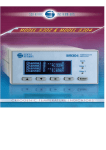
Flexibility: The Model 14 has four independent and Accuracy: Measurement accuracy is obtained by identical multi-purpose sensor inputs whereas the Model 12 has two. Each can be easily configured to support virtually any cryogenic temperature sensor. Configuration is performed from the instrument’s front panel or a remote interface. There are no jumpers, trim pots or switches. using a 24-bit analog to digital conversion. Accuracy is further enhanced by extensive use of Digital Signal Processing (DSP) techniques. Silicon Diode sensors from Cryo-con or any other manufacturer are directly supported over their full 1.4 to 500K range using built-in calibration curves and sensor data. Plus, non-volatile Flash memory is available for several custom or calibrated sensors. Platinum RTD sensors can use built-in DIN 43760 (IEC 750) standard setups for 100Ω or 1,000Ω devices. The Model 12/14 uses the DIN standard for temperatures from 70K to 1020K and extends it down to 30K for cryogenic use. Operation down to about 14K is available using user supplied curves. A unique feature of these monitors is the use of a ratiometric resistance bridge technique to measure Platinum RTD sensors. This significantly reduces low frequency noise and drift to provide rock-solid measurements. These monitors provide robust support for the Negative Temperature Coefficient (NTC) sensors commonly used by cryogenic applications. They include Ruthenium-oxide, Cernox, CarbonGlass, Germanium and several others. Since they have a negative temperature coefficient, the constantvoltage measurement method will reduce, rather than increase, power dissipation in the sensor as temperature decreases. By maintaining the lowest possible power level, sensor self-heating is minimized and useful temperature range is greatly increased. An additional advantage to constant-voltage biasing is that NTC resistors lose sensitivity in the upper part of their range. By auto-ranging excitation current to maintain a constant voltage, sensitivity and noise immunity in that range is greatly improved. Sensor excitation used in conjunction with the constant-voltage feature is a 2.5Hz bipolar square wave. This effectively cancels thermal EMF induced offset errors that sometimes occur in cryogenic systems. The maximum and minimum sensor resistance Resistance Range Table that can be Voltage Min. Max. read is a Bias Resistance Resistance function of 10.0mV 10Ω 1.0MΩ the selected 3.33mV 3.3Ω 430KΩ voltage bias. 1.0mV 1Ω 100KΩ The Model 12/14 include built-in curves that support most industry standard temperature sensors. Additionally, four user calibration curves are available for custom or calibrated sensors. Each curve may have up to 200 entries. The accuracy of any sensor can be greatly improved by the use of Cryo-con’s CalGen feature. This will fit a Diode, Platinum RTD or NTC resistor sensor’s calibration curve at up to three user specified temperature points. It is a built-in, easy to use method for obtaining higher accuracy temperature measurements without expensive sensor calibrations. Lowest Noise: These monitors were designed for use in extremely low noise environments that cryogenic systems often require. Linear-mode power supplies are used throughout and sensor excitation current sources are not multiplexed. The enclosure is all Aluminum with wide conductive overlaps on all mating metal surfaces so that radiated RFI noise is virtually eliminated. An effective shielding and grounding scheme further allows the user to minimize both conducted and radiated noise. Easy to use: The Model 12/14 front panels consists of a large, bright Vacuum Fluorescent display and a 5-key keypad. Most features and functions can be accessed via this simple and intuitive menu driven interface. Two temperature readings can be displayed in a large, easy to read 10mm two-line font. Underlying menus switch to a 5mm high four-line font for more content. Additionally, the Model 14 can display all four inputs plus alarm and relay status in this smaller font. Temperature displays are autoranged to show the most number of significant digits. Built-in digital filters can be used to smooth temperature data. Displays are in units of K, oC, oF, Volts or Ohms. The status of built-in alarms and relays are indicated by LEDs located to the right of the display. Complex operations such as installing a new sensor require a remote interface connection. Outputs: The Model 12/14 each have two drycontact relay outputs. Either may be independently programmed to assert or clear based on a high or low temperature condition. Normally-open contacts are available on the rear panel.