1
A further difficulty is that most hygrometers sense relative humidity rather than the absolute amount
of water present, but relative humidity is a function of both temperature and absolute moisture content,
so small temperature variations within the air in a test chamber will translate into relative humidity
variations.
4.3 Hygrometer Calibration
All hygrometers are preset at the factory but may require recalibration due to shipping and storage.
To calibrate the sensor, compare the humidity against a known source or perform the following
procedure.
Soak a folded cloth or dish cloth with water and place the cloth on a plate, saucer or another relatively
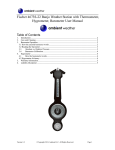
flat container. Remove the hygrometer from the weather station plaque by simply placing your hand
against the back plate and pushing the instrument out of the mounting hole. Carefully lay the back
edge of the hygrometer flat on a damp cloth. Allow 30-45 minutes for the hygrometer to read
approximately 95% humidity. If this reading is not indicated, carefully rotate the coil by using a small
screwdriver counter clockwise until the reading hand is 95%.
Remount the hygrometer into the wood plaque. The hygrometer will gradually return to indicate the
ambient humidity in 30-45 minutes. IMPORTANT NOTE: Any other method that has not been
described here to adjust the hygrometer could damage the instrument.
5. Aneroid Barometer
5.1 How the aneroid barometer works
An aneroid barometer uses a small, flexible metal box called an aneroid cell. This aneroid capsule
(cell) is made from an alloy of beryllium and copper. The evacuated capsule (or usually more
capsules) is prevented from collapsing by a strong spring. Small changes in external air pressure cause
the cell to expand or contract. This expansion and contraction drives mechanical levers such that the
tiny movements of the capsule are amplified and displayed on the face of the aneroid barometer. Many
models include a manually set needle which is used to mark the current measurement so a change can
be seen. It was invented by Blaise Pascal.
5.2 Reading the barometer
It is highly advisable to lightly tap the glass near the center brass knob with your fingers before taking
a barometer reading. The light tap will overcome any friction that may affect accurate hand readings,
especially during periods of slow atmospheric changes. The Coast Guard has informed us that tapping
the barometer is even required on the most expensive aneroid barometers, because the mechanism is
made deliberately “stiff”.
The ability if the barometer to indicate changes in barometric pressure makes it a useful instrument in
weather forecasting.
The weather forecast or pressure tendency is based on the rate of change of barometric pressure. In
general, when the pressure increases, the weather improves (sunny to partly cloudy) and when the
pressure decreases, the weather degrades (cloudy to rain).
The weather forecast is an estimation or generalization of weather changes in the next 24 to 48 hours,
and varies from location to location. The tendency is simply a tool for projecting weather conditions
and is never to be relied upon as an accurate method to predict the weather.
Version 1.0
©Copyright 2010, Ambient LLC. All Rights Reserved.
Page 3