1
Redundant Controller
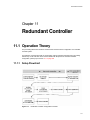
The controller firmware recognizes the two controllers used in a redundant configuration as Primary or
Secondary. Two controllers behave as one Primary controller.
Once the redundant configuration takes effect, user's configurations and settings can only be done on the
Primary controller. The Secondary controller then synchronizes with the configuration of the Primary
controller, making the configurations of two controllers exactly the same.
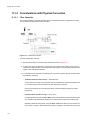
The two controllers continuously monitor each other. When a controller detects that the other controller
is not responding, the working controller will immediately take over and disable the failed controller.
However, it is not predictable which one of the controllers should fail. It is necessary to connect all other
interfaces to both controllers so that a surviving controller can readily continue all the services provided
for the RAID system.
11.2.3.2
Active-to-Active Configuration
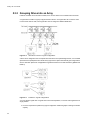
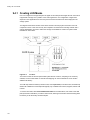
Users can freely assign any logical configuration of drives to both or either of the controllers, then map
the logical configurations to the host channel IDs/LUNs. I/O requests from host computer will then be
directed to the Primary or the Secondary controller accordingly. The total drive capacity can be divided
and equally serviced by both controllers.
The active-to-active configuration engages all system resources to performance. Users may also assign
all logical configurations to one controller and let the other act as a standby.
11.2.3.3
Active-to-Standby Configuration
By assigning all the logical configurations of drives to one controller, the other controller will stay idle and
becomes active only when its counterpart fails.
11.2.3.4
Cache Synchronization
The Write-Back caching significantly enhances controller performance. However, if one controller fails in
the redundant controller configuration, data cached in its memory will be lost and data inconsistency
might occur when the existing controller attempts to complete the writes.
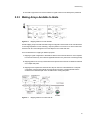
Data inconsistency can be avoided using one or several of the I/O channels as the communications path
between the controllers. The cached data is always synchronized in each other's memory. Each
controller saves an exact replica of the cache content on its counterpart. In the event of controller or
power failure, the unfinished writes will be completed by the existing controller.
11.2.3.5
Battery Support
Unfinished writes will be cached in memory in write-back mode. If power to the system is discontinued,
data stored in the cache memory will be lost. Battery modules can support cache memory for a period of
several days allowing the controller to keep the cached data. When two controllers are operating in writeback mode, it is recommended to install a battery module to each controller.
11.3 Configuration
Listed below are steps necessary for configuring a redundant controller system:
1
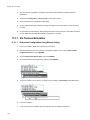
Configure, separately, each controller in the Autoconfig mode. When two controllers are powered on
later, firmware will determine which is the Primary controller.
189