1
Automated carbon masking and particle picking
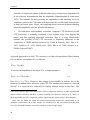
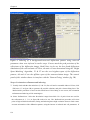
zero. This leaves most of the points in a carbon region, whereas the sparse points in
regions with just vitreous ice are erased.
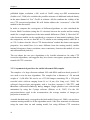
Subsequently, the regions near every none-zero pixel are searched in the map resulting
from the edge detection result of the second step using a lower threshold in order to
construct a new binary map. This allows the regions already masked to grow and holes
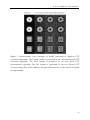
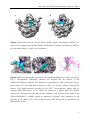
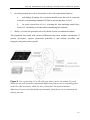
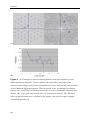
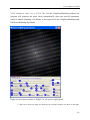
in the mask to be filled leading to better segmentation (Fig. 1c). Next, an initial mask
image is created by binning the binary map by a large factor (10 × 10 pixels) (Fig.
1d ).
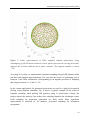
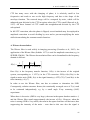
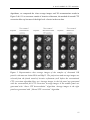
In the last step, a closing process for the mask image is performed. In the primary mask
image some holes are present in carbon regions, and some false positive points in
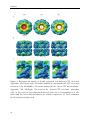
non-carbon regions. A new algorithm is used to close and smooth the image (Fig. 1e-h).
The basic idea is that the edge of the carbon region is continuous and smooth and
doesn’t have sharp turns. A masked point on the edge of a carbon region should have at
least four masked neighbors or the mask at this pixel will be removed. A similar rule
for unmasked points is applied. After several, normally 5–6, of these iterative closing
operations, the mask map will converge to a nice map with smooth edges. By default
five iterations are performed, but this value may be changed by the user.
The plug-in produces mask images for carbon regions of the EM micrographs, but
large ice aggregates and over-crowded blocks are masked out as well.
In our experience, the module works well for most EM images, producing adequate
masks in ~95% of cases.
2.2.2 Even sampling of 3D rotation space
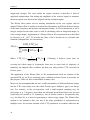
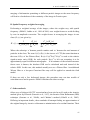
We define the angular distance to be the angle about a common rotation axis that maps
one object onto another. The centres of mass of both objects are superimposed, and the
rotation axis goes through this joint centre of mass. Orientation space is sampled by a
discrete set of 3D orientations with a precision of ∆ if the angular distance between any
orientation from the continuum of possibilities and at least one orientation from the
sampled set, is smaller than ∆.
25