1
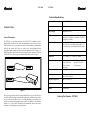
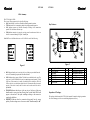
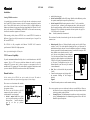
ETP 1010 ETP 1010 Installation Locating ETP1010 transceivers It is generally more convenient to run an AUI cable from the work-station or network device to the ETP1010 but not necessary, as the AUI connector can plug directly into the device. The two RJ45 cables can be up to 100 meters (328 ft.) in length. Adherence to Ethernet specifications for aggregate twisted pair length should be followed if the AUI cable is more than a few feet. EtherCom’s EMC02 RJ45 to Fiber media converters may be utilized to extend these segments to 2 kilometers. When running cables from an ETP1010 to a second ETP1010 it makes no difference if port A on the first transceiver is connected to port A or port B on the second ETP1010. The ETP1010 is fully compatible with Ethernet V2.0/IEEE 802.3 transceiver specifications for CSMA/CD 10 Mbps operation. makes B the primary port Switch 2, marked SQE, Enables SQE testing. Should be in the off (down) position for operation (normal position upon receipt from factory). Switch 3, marked 2.5-10, Sets timing intervals to either 2.5 or 10 second as the “quiet period” prior to ‘hunting’ to the alternate port, and as “valid carrier period” prior to stopping switching search for data. This switch establishes the delays for both ports as well as for both the quiet and the valid carrier periods. On (up) is for 2.5 & Off (down) for 10 seconds. Note: Switch 4, (unmarked) is disconnected. The second set of 4 switches, located on the right side front (closer to the RJ45 connectors) are: Power is provided through the AUI interface. UTP Crossover Capability: To provide maximum installation flexibility, there is a switch located next to each RJ45 connector. This is a UTP crossover switch that eliminates the need for a specially configured UTP crossover cable. It allows a repeater or a non-repeater device to be attached to the UTP segment side. This switch should be toggled in both directions until you can see that the LINK LED (located next to the A or B) is illuminated. Manual Switches All the switches for the ETP1010 are on the outside of the unit. This makes it unnecessary to take the unit apart and reconfigure jumpers for any changes. There are two sets of miniature slide switches on the front of the unit. Each set consists of four separate switches. The first set, on the left (closer to the AUI connector) only utilizes switches 1, 2 & 3. (switch number 4 is non functional): Switch 1, marked A/B, Selects either port A or port B as primary port. Off (the down position) makes A the primary port & on (the up position) Figure 3 Reduced squelch There are 2 Reduced Squelch switches: one for each RJ45 port (switches 1 and 3). The switch should be normally off for up to 100m meters of unshielded twisted pair to the port. Turn on for shielded twisted pair or for obtaining distance greater than 100 meter transmission range for unshielded twisted pair. This latter condition occurs when the network is “out of spec” (for max. wiring distances); network integrity is at risk when greater than 100 meter unshielded twisted pair segment lengths are used, although the ETP1010 will typically accommodate distances up to 150 meters of unshielded twisted pair if the Reduced Squelch is on. This out of spec condition is not recommended. Link, There is a link switch for each port (switches 2 and 4). Turn on for testing purposes only, during which the automatic searching for link integrity is disabled. Figure 4 Turn off for normal operation to enable automatic switching. There are two-position cross-over switches on the side next to each RJ45 port. These are the Normal or Crossover wiring polarity switches for each port and are labeled with wiring symbols on the top surface. Normal/Crossover The Crossover position enables use with reversed polarity wiring. The Normal position is for standard wiring pin-outs. Refer to the Users Manual for pin-out descriptions.