1
1.39
1.65
Q2
Q0
1.77
Q3
2.18
Q1
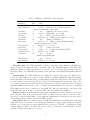
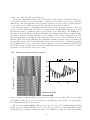
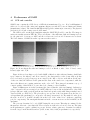
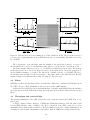
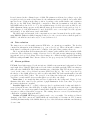
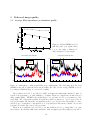
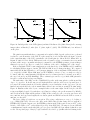
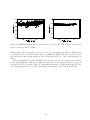
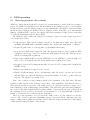
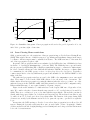
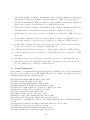
Figure 11: Bias and its noise in 2x2 binning mode (data of March 2, 2013). The plots show averaged
power spectra of signal fluctuations along CCD lines in each of four quadrants, the numbers are noise
floor in ADU.
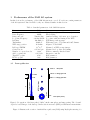
The readout time of the full frame with 2x2 binning is 10 s (pixel time 2.320 µs). A region of
interest (ROI) can be selected, but this functionality has not been used in the observations so far.
The charge transfer efficiency is very good, > 0.999997 per transfer (laboratory data). The linearity
in the fast readout mode was tested in the laboratory (better than 0.5%), but in the normal mode
used in SAMI it remains to be verified. The full well is > 200 kiloelectrons or > 95 kADU. Therefore,
the linearity range is limited by the 16-bit signal coding rather than by the CCD full well. Heavily
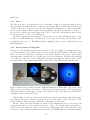
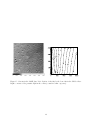
saturated images of bright stars show charge bleeding (see Fig. 12 below).
4.2
Filters
SAMI has one filter wheel holding 7 filters of 3x3 inch size. This wheel contains the BV RI filters from
the CTIO collection. Their transmission curves are given in the SAMI manual.
A filter wheel from SOI (4 positions, 4x4-inch filters) is compatible with SAMI. In fact the SOI filter
wheel #1 was used in the SAM runs in June and September 2013, with the SDSS and narrow-band
filters.
4.3
Throughput and scattered light
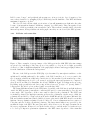
The internal transmission of the SAM optics in the science path at 632 nm is 90% (SDN 7108, acceptance tests).
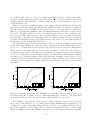
L. Fraga compared relative efficiency of SAMI and SOAR Optical Imager, SOI. The gain of SOI
is 2.0 el/ADU, similar to that of SAMI, so the direct comparison of the ADU counts per second is
meaningful. The results are listed in Table 3. Its last column gives the ratio of filter transmissions, as
determined by the measured transmission curves (the I filter in SAMI was not fully characterized).
24