1
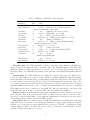
Table 3: Efficiency of SAMI relative to SOI
Filter
B
V
R
I
Rel. eff.
0.71 ± 0.03
1.01 ± 0.02
1.58 ± 0.05
1.16 ± 0.02
Filter ratio
0.77
0.85
1.15
–
We see that lower efficiency of SAMI in the B band is mostly explained by the lower filter transmission, while in other filters SAMI is more efficient than SOI. The gap in the CCDs of SOI further
increases the effective exposure time of the latter by the need to do mosaicing.
Another way of expressing the SAMI throughput is by giving the zero points: magnitude of stars
that give counts of 1 ADU/s. Calibration with photometric standards (Fraga et al. 2013) leads to
the zero points of [25.06, 25.48, 25.79, 25.16] in the B, V, R, I bands, respectively. Zero points in the
SDSS filters will be determined from the data of the September 2013 run.
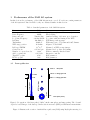
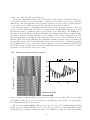
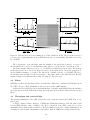
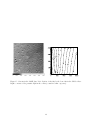
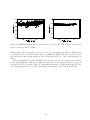
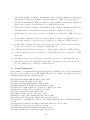
Figure 12: Characterization of scattered light in SAMI. The 40-s exposure of HIP 6712 (Sep. 26,
2013, image #131, i′ filter) contains the heavily saturated image of the bright primary component and
the secondary component at 24.4′′ separation, 7.5m fainter. The plot on the right shows vertical cuts
through both components, scaled to the measured or estimated central intensity.
The scattered light in the SAMI images is dominated by the usual effects (reflections from the
dewar window and filters, diffraction on the SOAR spiders). The optics of SAM does not add any
ghosts and may only contribute extra faint “rays” comparable to the intensity of the diffraction spikes.
In Fig. 12, we plot vertical cuts through two components of a wide binary. The image of the primary
component (IC = 7.38) is heavily saturated and bleeding. The secondary is estimated to be 7.5m
or 1000 times fainter than the primary in the SDSS i′ band. It is located at 24.4′′ separation. The
background around the secondary (dashed line) is 10−2 of its central intensity, or 10−5 of the primary
intensity, in agreement with the scaled profile of the primary itself. The profile of the PSF at levels
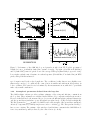
above 1% of the maximum corresponds to the Moffat function with β = 2 (see below).
25