1
3.3
Tip-tilt loop
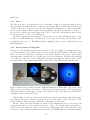
SAM has two guide probes (GPs) at the input (un-corrected) focal plane. Each GP is a 2x2 array
of 0.5-mm lenslets that collect square areas of the stellar image and direct the light to the photoncounting detectors (APDs) via fibers. The size of the GP field is therefore 3′′ . Two GPs are used to
provide a better uniformity of correction over the field, and for redundancy. The APD detectors are
fragile, they are switched on only when the telescope is pointed (a hardware overlight protection is
provided as well).
3.3.1
Acquisition of guide stars
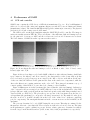
Owing to the small field of GPs, acquisition of guide stars is not trivial. The SOAR telescope can
have pointing errors up to 30′′ .1 This error is determined by pre-imaging of the field with SAMI. A
procedure was developed where a star with known coordinates is selected in GMAP, then measured in
the IRAF display of the SAMI image. Once the field offset (FO) is found, the GPs can be positioned
on the selected stars (using the GMAP software).
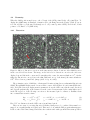
If the flux of a guide star is not detected after positioning activating the probe, a tool findGP
is used for searching around. It modulates the filed on circles of progressively increasing radius by
applying signals to the SOAR M3 mirror. If a modulation of the flux in GP is found, the star is
detected and the GP is moved towards the star, otherwise it is better to select another star or to
revise the FO.
The GS acquisition procedure critically depends on SAMI and takes most of the overhead time
when pointing a target. The experience shows that it works reliably.
3.3.2
Flux and sensitivity
On a dark sky, the total count of 4 detectors is about 2 and 6 ke/s [check] for GP1 and GP2,
respectively (the APDs in GP2 have a larger dark current compared to GP1). It is calibrated and
subtracted from the signal to allow correct measurement of star flux and error signals. The bias is
higher under bright Moon, then it can be re-calibrated frequently during the night.
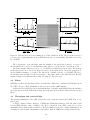
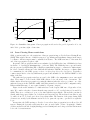
The performance of the SAM tt guider is studied in the SDN 7110, based on the results collected
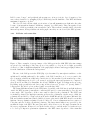
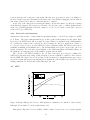
during the NGS commissioning. The stellar magnitudes given in the USNO catalog appear to be very
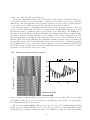
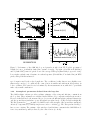
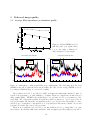
inaccurate: the relation between the actual flux in the GP (sum of 4 APD count rates, backgroundsubtracted) and magnitudes of the guide stars has a scatter of about 1m rms (Fig. 7). The flux F in
ke/s is related to the stellar magnitude as
F [kel/s] = 100.4(V0 −V ) ,
(1)
with the zero points V0 of 19.9 and 19.7 for GP1 and GP2, respectively. These zero points match the
estimated sensitivity. A star of V = 18m would give a flux of 5.75 ke/s (or 57 events per 10 ms loop
cycle) in GP1. A Gaussian star of 1′′ FWHM (rms width 0.42′′ ) will have a centroid error on the order
of 0.02′′ in the 10-Hz servo bandwidth. Guiding on V = 18m stars was actually done.
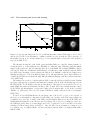
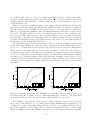
The tip-tilt errors are measured by the quad-cell algorithm in dimensionless units ex and ey ranging
between −1 and +1. Their translation into arcseconds depends on the seeing. In the linear part of
the response curve, the star displacement X = ex /R, where the seeing-dependent response coefficient
1
According to S. Heatchote, efforts to improve the pointing model were made, but the problem is in coupling between
the active optics and the mount which is not yet modeled.
19