1
Technical Data
Douglas LonWorks Products
APPLICATION (continued)
INSTALLATION
Integrated Systems
System ID's and Configuration
The nodes used in either self-configured or integrated systems
each have a unique ID. Self-configured systems use the facilities
of one of the nodes to assign ID#s. This node is called the
network manager and has the network manager switch set to
"ON". Once assigned, ID#s are permanently stored in the node
and can only be changed with a special procedure.
When a WNX-2624 or WNS-2308 Node is first used it does not
have a system ID. When it is connected to a self-configured
system the system will recognize that the node is present and has
no ID. The network manager node will then assign to the node an
available ID (a number from 1 to 24).
If all of the nodes of a self-configured system need network IDs,
the ID numbering process may take a few minutes. Once
assigned, the ID numbers are retained indefinitely. Adding new
nodes in the future causes the auto ID process to occur for the
added nodes.
Integrated systems assign ID numbers with the system manager
used by the integrated system. When a node is configured by an
outside, integrated system, the network manager switch of the
node is automatically disabled to prevent any network
management conflicts with the integrated system manager.
n
The LonWorks technology used by the Douglas Scanner/Node
combination is a non-proprietary, open-architecture standard for
building control networks. Other LonWorks based systems can
incorporate a Douglas lighting control panel as a part of the other
system provided the other system supports lighting controls.
n
LonWorks® TECHNOLOGY
n
To integrate different manufacturers devices and systems at a
network level demands that common standards are in place today
and in the future. The LonWorks technology provides a stable,
common and open networking standard.
Douglas Lighting Controls is a LonMark
partner and we have developed our LonWorks
products to comply to the LonMark certification
standards for open systems. This ensures our
customers reliable and predictable
performance when integrating Douglas product
with other systems.
n
n
n
n
n
Basics for Systems Integrators
n
n
For building control designs that wish to take advantage of
integrated systems, Douglas products can be integrated as a part
of a greater system that uses the LonWorks network platform.
LNS plugins are available for control and configuration of the
objects listed in the table below. The LNS plug-ins are written in
Visual Basic and are designed to plug-in to the LNS software
engine used by many LonWorks Integrators.
For more information visit: www.DouglasLightingControls.com
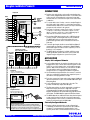
LonWorks Data Signal Wiring
The Douglas network nodes use FTT-10 transceivers to carry the
LonWorks Data Signal. The FTT-10 transceiver is well suited for
a building environment. It is robust, has a great deal of noise
immunity and supports free topology installation.
The FTT-10 transceivers (FTT = Free Topology Transceiver)
support "free topology" wiring. Free topology allows the installer
to branch and "T" the data signal as required. In addition, the data
signal has no polarity and connections can be made to devices in
either direction. As a comparison, RS-485 transceiver systems
can only be wired as a bus (nodes wired in succession with no
branches in wire) and the wire pair is polarity sensitive.
Data Signal total wire lengths:
- Free topology connections: 1650 feet (500meters) maximum.
- Serial bus connections: 7000 feet (2700 meters) maximum.
(FTT-10 wired as a bus has improved range)
Data Signal Polarity: None
Douglas nodes can be connected to the wire pair in either way.
Wire Type: #16 AWG, twisted pair, no shield, solid or stranded.
(Example: Belden #8471)
Other wire types can be used, however results will vary depending
upon the wire type and gauge. Please contact factory for
information about different wire types.
Do not install the data signal in close proximity (less than 3") to
higher voltage cables and conduit.
If longer data signal wiring lengths are needed, use a repeater
(contact factory).
LonMarked Variables used by Douglas Products
n
n
Functional Profile (Object)
Network Variable & Type
Lighting Panel Controller (LPC)
nviGroup/nvoGroupFb
SNVT_Scene
(This object receives group commands,
activates relay groups and returns
status on relay groups.
The trigger would be from a Scene Panel Object.)
n
Scene Panel
n
n
nvoScene/nviScenFb
(This object issues group commands
SNVT_Scene
and receives the relay group status.
The typical destination would be an LPC Object)
Actuator (24 objects per node)
n
nviLampValue/nvoLampValueFb
(This object receives commands from a
SNVT_Switch
switch to activate a relay and returns status.
The typical trigger would be from a Switch Object.)
Switch (5 objects per node)
(This object issues commands to activate
a relay or other On/Off devices. The typical
destination would be an Actuator Object).
Note:
n
n
nvoSwitch
SNVT_Switch
WLP-2999 Termination Unit
n
Self-managed systems only use the Lighting Panel Controller Object and
the Scene Panel Object. The Actuator and Switch Object are provided to
permit outside systems to operate individual relays.
Interfaces 3.4
C-3-1,2,3,4 -Systems, LonWorks Products
The WLP-2999 Terminator unit helps provide additional noise
immunity for the Data Signal wiring. The device is recommended,
but is optional and lack of use will not affect warranty. Best results
are obtained if the terminator can be installed at approximately the
physical center of the network wiring.
www.DouglasLightingControls.com