1
2: With the accelerator fully depressed (pedal to the floor, throttle fully open), click
Get Current beside Full Throttle ADC Count
Note: If you have calibrated the TPS correctly, the blue bar beneath the two ADC count
windows. As the pedal is depressed and released, this blue bar should progress smoothly
along it’s full travel.
3: Click “Accept”, the dialog box closes, and returns you to the dashboard.
Main Table of
Contents
Introduction
Initial Setup
The TunerStudio
User Interface
Using Tune Files
Setting Engine
Constants
Ignition and VE
Tables
Startup and Idle
Settings
Accel Enrich
Datalogging and
VE Analyze Live
Further Resources
MAP Sensor
The Manifold Air Pressure sensor also feeds vital information to the ECU that is
used in the fueling calculation. The MAP sensor detects the pressure or vacuum of
the air entering the engine. MegaSquirt uses an onboard MAP sensor, and there are
three choices; a standard 3-bar sensor, and upgraded 4 bar sensor for individuals
running high boost levels, and a dual 4 bar sensor, with one sensor detecting engine conditions,
and the other used for barometric corrections. The
latter is extremely useful for those who drive their
vehicles in both low elevations and mountainous
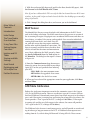
areas. Begin calibrating the MAP sensor by choosing Sensor Calibration from the Tools option in
the Menu Bar. The dialog box that opens is shown
in Figure 4.4.
1: From the Common Sensors drop down menu,
choose the sensor that you installed in your MegaSquirt ECU or that you specified when ordering
your ECU.
-GM 3-BAR is the most common sensor.
-MPX 4250 is the upgraded 4-bar sensor.
-MPXH 6400 is the dual 4-bar sensor.
Figure 4.4: MAP Calibration
2: When you have selected the appropriate sensor for your application, click Burn
and then Close.
AFR Table Calibration
Perhaps the single most important sensor for the automotive tuner is the Oxygen
(O2), or Air/Fuel Ratio sensor. There are two distinct types of O2 sensors: Narrowband and Wideband. Narrowband sensors detect how much oxygen is in the exhaust
gases, and if the engine is running lean and leaving lots of oxygen in the exhaust, the
sensor provides a “lean” signal to the ECU (a voltage of 100-200mv). If the engine
is running rich and has very little oxygen in the exhaust, the sensor will provide a
“rich” signal to the ECU (a voltage of 650-800mv).
The Wideband style of sensor is much more precise, and will provide an actual reading of exhaust gas oxygen content to the ECU. A Wideband sensor operates on a
reading from 0v-5v, with 0v being full lean and 5v being full rich. These sensors
8