1
INSTALLATION
These units require approximately two (2) horsepower
for every 1000 watts of generator output. Theoretically
you should be able to produce 1000 watts with 1.4
Horsepower, but this is only possible with 100%
efficiencies in both the engine and the generator.
Between engine and generator efficiencies of only 80%
to 90% and the losses through the drive system the two
horsepower requirement is more realistic.
together with the natural "voltage drop" within the
generator itself due to load current and heating of the
windings, results in a slightly lower voltage than when
the generator is running idle.
The normal, slight variations in speed also directly affect
the frequency of the output current. This frequency
variation has no appreciable effect in the operation of
most loads (such as motors, lights and most small
appliances). However, timing devices and clocks will
not keep perfect time unless the engine can keep the
generator running at exactly 3600 rpm at all times.
Since this is not usually possible, minor time errors in
clocks occur.
For example, this 1,500 watt generator output will
require a 3 or 4 h.p. Engine for full output, good speed I
voltage regulation, and satisfactory load performance.
2. When determining the prime mover Igenerator pulley
ratio to drive the generator at the correct operating
speed, bear in mind that the power rating of most prime
movers (usually an engine) varies with the speed-that
is, it produces more power at higher speeds, less when
slowed. The prime mover must be run fast enough to
reach the desired horsepower for good generator set
operation.
The speed of the engine is usually adjusted so that the
generator produces proper voltage. If the adjustment is
made "cold", set the voltage a little higher than normal
since it will drop a few volts as the generator warms up.
**" CAUTION ****
When operating continuously at full load the generator
shell becomes very warm. It will be uncomfortable to
the touch-this is normal for any high performance
inherently regulated generator.
The drive belt system must be of adequate size and
must be tight enough to power the generator without
slippage. Be careful not to overtighten to the extent that
it puts excessive strain on the bearings--doing so can
cause bearing failure and other possible damage to the
generator.
Output voltage should be checked periodically to
insure proper operation of the generating plant and
appliances.
Alignment of the generator to the prime mover is
important. Misalignment of the pullies will cause
excessive belt and pulley wear and unnecessary stress
on the prime mover.
**** CAUTION "**
Although individual units and models may vary slightly,
the normal voltage and frequency of typical 60 cycle
generators described in this book are approximately as
follows when powered by a typical prime mover (engine)
run first with no load applied, then at half the generator
capacity and finally when loaded to its full capacity as
rated on the nameplate:
Required generator speed must be maintained at 3600
+I- 90 rpm under all load conditions.
4.All engines have a tendency to slow down when a load
is applied. The governor on the engine is designed to
hold the engine speed nearly constant. When the
electrical load connected to the generator is increased,
the engine is more heavily loaded and as a result the
speed drops slightly. This slight decrease in speed
TB SERIES
PLAN THE INSTALLATION
Plans for installation should be prepared with proper
attention to mechanical and electrical engineering detail
to assure a satisfactory system installation. The
information in this manual is offered as a guide to
finalizing your installation plans. The installation
sequence is summarized below:
VOLTAGE
129VOLTS
120VOLTS
115VOLTS
**** CAUTION ****
-
Low voltage may damage any motors or appliances
connected to it. Running the generator at excessively
high speeds results in too high voltage which will also
damage electrical devices connected to it. Excessively
high speed may also cause damage to the generator
stator windings.
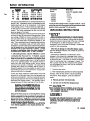
3. The following table shows the effect of various operating
speeds and electrical loads on a typical generator when
matched and mounted to an adequate prime mover
GENERATOR
LOAD
SPEED FREQUENCY
NONE 3690 RPM
61 112 HZ
HALF 3600RPM
60HZ
FULL 3510 RPM
58 112 HZ
--
Generally these two bearing generators are used on
portable equipment. For best service consider the
following :
1.All electrical equipment should be protected from
excessive moisture. Failure to do so will result in
deterioration of the insulation and will result in short
circuits and grounds.
2. The generator should be installed in a sheltered area. If
the unit must be left in the open, it should always be
protected with a weather cover such as a tarp or large
piece of canvas after each use to keep out water and
dust.
P'age 4
60706-098
-