1
7.3
Frequently Asked Questions
7.3.25
137
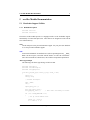
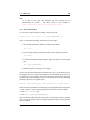
Why are (many) interrupt flags cleared by writing a logical 1?
Usually, each interrupt has its own interrupt flag bit in some control register, indicating
the specified interrupt condition has been met by representing a logical 1 in the respective bit position. When working with interrupt handlers, this interrupt flag bit usually
gets cleared automatically in the course of processing the interrupt, sometimes by just
calling the handler at all, sometimes (e. g. for the U[S]ART) by reading a particular
hardware register that will normally happen anyway when processing the interrupt.
From the hardware’s point of view, an interrupt is asserted as long as the respective bit
is set, while global interrupts are enabled. Thus, it is essential to have the bit cleared
before interrupts get re-enabled again (which usually happens when returning from an
interrupt handler).
Only few subsystems require an explicit action to clear the interrupt request when using
interrupt handlers. (The notable exception is the TWI interface, where clearing the
interrupt indicates to proceed with the TWI bus hardware handshake, so it’s never done
automatically.)
However, if no normal interrupt handlers are to be used, or in order to make extra
sure any pending interrupt gets cleared before re-activating global interrupts (e. g.
an external edge-triggered one), it can be necessary to explicitly clear the respective
hardware interrupt bit by software. This is usually done by writing a logical 1 into this
bit position. This seems to be illogical at first, the bit position already carries a logical
1 when reading it, so why does writing a logical 1 to it clear the interrupt bit?
The solution is simple: writing a logical 1 to it requires only a single OUT instruction,
and it is clear that only this single interrupt request bit will be cleared. There is no need
to perform a read-modify-write cycle (like, an SBI instruction), since all bits in these
control registers are interrupt bits, and writing a logical 0 to the remaining bits (as it
is done by the simple OUT instruction) will not alter them, so there is no risk of any
race condition that might accidentally clear another interrupt request bit. So instead of
writing
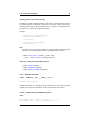
TIFR |= _BV(TOV0); /* wrong! */
simply use
TIFR = _BV(TOV0);
Back to FAQ Index.
7.3.26
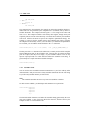
Why have "programmed" fuses the bit value 0?
Basically, fuses are just a bit in a special EEPROM area. For technical reasons, erased
E[E]PROM cells have all bits set to the value 1, so unprogrammed fuses also have a
logical 1. Conversely, programmed fuse cells read out as bit value 0.
Generated on Tue Feb 15 16:09:56 2005 for avr-libc by Doxygen