1
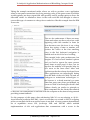
X-Analysis 8 Application Modernization and Rebuilding Concepts Guide Improved performance as IBM’s data retrieval efforts have been concentrated on SQL access rather than file based access for many years now Reduced dependency on System i specific skills such as DDS, which may led to cost savings and reduced risk. Data Integrity - Journaling is available for SQL access just as it has always been for file-based access. Constraints and referential integrity can be implemented directly at the database level where they are unavoidable rather than at the program level. Databases triggers allow code to be run before or after records are added, updated or deleted providing an easy way of enforcing compliance, audits, validations and applying business rules. We’ve now looked at some of the advantages of Database Modernization but how is it actually achieved and how can X-Analysis help the process along? As previously mentioned historically System i applications have used Data Description Specifications (DDS) to define physical files and associated logical files or access paths. Whilst the files created can of course be accessed using SQL syntax from programs or via JDBC/ODBC the actual definitions bear no relation to SQL. What the process of XAnalysis database modernization does is to replace the DDS definitions with SQL create scripts that build tables and indexes. As we have seen X-Analysis has a complete crossreference of all files and fields and their relationships and can build the table creation scripts together with the required indexes to optimize the system, your existing programs all still work after this process and without any re-compilation or alteration. By using X-Analysis to do this automatically, no existing programs need be recompiled or impacted in any way. With the data copying facilities built in to the tool, the transition can be seamless. From this point onwards legacy programs can continue to use native I/ O techniques, or be automatically reengineered using Databorough’s X-Ternalize, to use externalized SQL I/O. X-Analysis can also generate an entire set of CRUD1 RPG stateless I/O modules to be used as web services for any web or SOA type development. For IBM’s take on the relative merits of DDS and SQL and the advantages of an SQL created database over one created with DDS see the IBM Redbook “Modernizing IBM eServer iSeries Application Data Access - A Roadmap Cornerstone” which is an excellent reference on this subject. Modern Data I/O & Persistence – Modern Object Oriented (OO) type development does not mean that relational databases need be abandoned. Indeed, it would be a fairly unwise strategy for a company to throw away its database and the information stored in it, for the sake of OO development. Java is an Object Oriented or OO language. System i databases are relational. Though Java Database Connectivity or, JDBC provides an easy method for accessing relational databases, it is basically a low level API providing only a CRUD Create, Read, Update, Delete - a tongue in cheek acronym coined to cover the key table operations any system has have. 1 © Databorough Limited 2009 Page 33 of 53