1
Frame3DD User Manual
http://frame3dd.svn.sourceforge.net/viewvc/frame3...
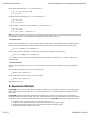
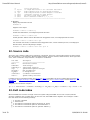
moments super-imposed upon the structural mesh.
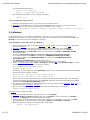
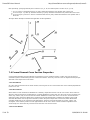
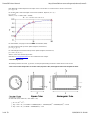
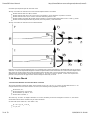
The sign convention for internal forces and transverse displacements is as follows:
Positive
Positive
Positive
Positive
Positive
internal axial force (Nx) is tensile.
internal shear forces (Vy and Vz) are in the positive y and z directions on positive x surfaces.
internal torsion (Tx) is counter-clockwise about the positive x-axis.
bending moments (My and Mz) produce positive curvature bending deformation in the x-z and x-y planes.
transverse displacements (Dy and Dz) are in the positive y and z directions.
The sign convention for internal forces is illustrated below:
Internal forces and transverse displacements are computed using numerical integration of the distributed loads on the frame
elements. A corrected trapezoidal integration method is implemented so that the internal force and transverse displacement
data match the known internal forces and joint displacements at both ends of each frame element. Internal forces and
displacements computed with a smaller increment length, dx, are more accurate. In general, a value of dx equal to one
percent to ten percent of the typical frame element length is sufficiently accurate.
7.14 Stress Check
7.14.1 Section Modulus and Torsion Shear Constant
The section properties required for elastic frame analysis are Ax, Asy, Asz, Jxx, Iyy, and Izz, as described section 7.4. To
compute stresses from the frame element end forces, the following section properties are required:
Section Area, Ax ,
Section Shear Area, Asy and Asz ,
Section Modulus, Sy and Sz , and
Torsion Shear Constant, C .
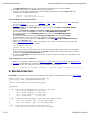
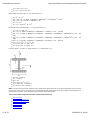
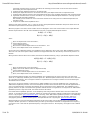
The units of Sy, Sz and C are length-cubed (like in3 or mm3). Referring to the text and figures of section 7.4, the section
moduli and torsional shear constants may be found as follows:
Circular Tube (outer radius= R o, inner radius = R i):
Sy = Sz = Iyy / R o = Izz / R o
C = Jxx / R o
21 of 33
11/09/2010 11:18 AM