1
Engine Combustion Pressure
Analysis Package
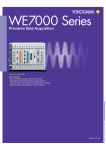
FOR DL700, DL750 & WE7000
New feature: Analyze and display multiple data simultaneously
Yokogawa is pleased to introduce version4.00 which accomplished
the further evolution
●Various types of engine analysis included as standard
●Analyze and display multiple data simultaneously NEW
●Analysis of waveform data from the DL750, DL708E/DL716, and WE7000
●Support for transient operations as well as normal operations
●USB 1.1 added for real-time monitor interface of DL750 NEW
●Gasoline, natural gas, and diesel versions available
●Saving and recalling of analysis conditions NEW
●Saving of analysis results in CSV format
●Support for 2-cycle and 4-cycle engines
●Support for 0.1° crank angle resolution (select 0.1, 0.25, 0.5, or 1.0)
●Support for both all-cycle-average and cycle-by-cycle absolute pressure correction methods
●Greater scope of analysis (LNV, misfire rate, and cylinder-to-cylinder average value) NEW
www.yokogawa.com/tm/
... and subscribe to “Newswave,”
our free e-mail newsletter
Bulletin 7018-90E
Turn Your General-Purpose Measuring Instrument into an
Engine Combustion Pressure Analysis System
This software package lets you turn general-purpose measuring instruments used primarily
in field experiments into an engine combustion pressure analysis system.
The Engine Combustion Pressure Analysis Package enables engine
combustion pressure to be analyzed using measurement data from the
WE7000 as well as the DL750 and other Yokogawa DL700 series
instruments, which are widely used throughout the auto industry. The
package also allows you to monitor analysis data during measurement by
connecting your DL750 or WE7000 to a PC through an Ethernet connection
or through USB 1.1 NEW (only for DL750).
Now that these general-purpose measuring instruments can be used for
engine combustion pressure analysis, setting up engine data analysis
equipment is much easier.
Analyze and display multiple data simultaneously
●Recommended module for each measuring instrument
Maximum
number of
cylinders
Recommended
module (card)
Real-time
monitoring
capability
DL708E
6
701853
(100 kS/s, 16-bit, 1 channel)
No
DL716
8
701853
(100 kS/s, 16-bit, 1 channel)
No
DL750
8
701251
(1 MS/s, 16-bit, 2 channels)
Yes
NEW
Multiple analysis data can be checked simultaneously while performing online monitoring and analysis.
Greater scope of analysis NEW
WE7000
8
707272
(100 kS/s, 16-bit, 4 channels)
*1 Reference measurement ranges for each sampling rate
100 kS/s: 0.5 CA-approximately 8000 rpms
1 MS/s: 0.1 CA-approximately 16,000 rpms
The number of arbitrary setting points for combustion mass rate has been
increased from one to three. In addition, LNV, misfire rate and cylinder-tocylinder average value can now also be analyzed.
Transient combustion pressure analysis
Analysis of transient combustion pressure is possible thanks to the addition of intake pipe pressure, intake pipe
temperature, engine rpm, and fuel consumption as measurement items. This type of analysis is invaluable for developing
clean, high-efficiency engines for which there is strong demand.
Configuration of Engine Combustion Pressure Analysis System
EXT-CLK signal
Ethernet
Crank angle pulse
1.0 CA
0.5 CA
0.25 CA
0.1 CA
Engine Combustion Pressure Analysis Package
Real-Time Monitor
WE7000
◆P-V graph
Trigger signal
Engine Combustion
Pressure Analysis Package
USB
◆Crank angle graph
Cylinder internal pressure
(maximum 8 cylinders)
DL708E
DL716
Intake pipe pressure
:
:
Other signals
PC system recommended
Windows XP, Windows 2000 pro,
OS:
Windows NT Workstation 4.0,
Windows 95, Windows 98
CPU:
Pentium III 1 GHz or higher
HDD:
2 GB or more
Memory:128 MB or more
Offline
WVF files
Actual vehicle operation
◆Numerical analysis
DL750
TDC pulse
Sensor signal
◆Cycle graph
Normal operation
CSV files
Engine
4-cycle/2-cycle
Gasoline/diesel/LPG, LNG
Dynamo
Yes
707275
(1 MS/s, 14-bit, 4 channels)
◆3D graph display
◆Numerical analysis
◆Crank angle graph
◆Cycle graph
◆All-cycle crank angle graph
PC System Requirements OS:Windows XP, Windows
2000 Pro, Windows NT 4.0, Windows 98However,
Windows NT 4.0 is not supported when using
USB.CPU:Pentium III, 1 GHz or higherMemory:256 MB
or moreHard disk:2 GB or more of free spac
Specifications
Engine Combustion Pressure Analysis Package
(1) Analysis procedure
1Motoring
No fuel injection/no firing
2Firing
With fuel injection/with firing
Measure cylinder internal
pressure by motoring
Measure cylinder internal
pressure by firing
WVF file
WVF file
Calculate TDC
correction angle
Set manually
input parameters
Set physical
conversion coefficient
Analyze
(9) TDC correction
The cylinder internal pressure data on the first channel (first firing) during
motoring are averaged over all cycles. The maximum value in the data is
detected, and this value, together with the ten points on both sides (21
points in total), are approximated in a second-order equation to determine
the maximum value. The corresponding angle position (in increments of
0.01) is used as the Top Dead Center (TDC). Or, the TDC position may be
set by manual input.
TDC correction value
(in angle resolution increments)
Volume calculation correction value
(in increments of 0.01 CA)
Cylinder internal
pressure
Calculated peak point (in increments of 0.01 CA)
Calculated by second-order approximation of
detected peak and 20 surrounding points
TDC pulse
Interval for correcting
TDC correction value
conversion coefficient
Set crank angle range in
absolute pressure
correction interval
Save CSV file
(2) Supported engine types
Gasoline/diesel/natural gas, and 2-cycle/4-cycle
(3) Measurement channels Maximum 16 channels (analog signals)
• Cylinder internal pressure: Maximum 8 channels
• Other signals:
Maximum 15 channels
When the following measurements are taken, they can be used in
analysis calculations.
> Gasoline engine
Intake pipe pressure, intake pipe temperature, fuel consumption, engine
rpms
> Natural gas engine
Intake pipe pressure, intake pipe temperature, fuel consumption, engine
rpms, residual oxygen concentration in exhaust gas
> Diesel engine
Intake pipe pressure, intake pipe temperature, fuel consumption, engine
rpms, exhaust gas pressure, exhaust gas temperature, supercharger
entrance pressure, supercharger entrance temperature
(4) Maximum number of analyzed cycles
User-defined intervals (up to 800 cycles) in the following valid cycle data are
extracted and analyzed.
• At 1.0 CA: 25,000 cycles
• At 0.5 CA: 12,500 cycles
• At 0.25 CA: 6250 cycles
• At 0.1 CA: 2500 cycles
(5) Angle resolution: 1.0/0.5/0.25/0.1 CA
(6) Conversion to physical values
Physical value = A × Voltage value + B
(7) Filter processes
• Filter types: None, low-pass, band-pass, high-pass
• Characteristics: 4th Order (24 dB/oct) Butterworth
• Cutoff frequencies
At 1.0 CA: Rpms 7.2-order (times) (2%) to 72nd order (times) (20%)
At 0.5 CA: Rpms 14.4-order (times) (2%) to 144th order (times) (20%)
At 0.25 CA: Rpms 28.8-order (times) (2%) to 288th order (times) (20%)
At 0.1 CA: Rpms 72nd order (times) (2%) to 720th order (times) (20%)
(8) Rotation error correction
If the cylinder internal pressure peak is less than –180 C or greater than
+180 CA, then a rotation error is recognized and a shift of 360 CA is made.
TDC
pulse
Measurement start point
Data discarded
Cylinder internal
pressure data
Explosion
Exhaust
Intake
Compression Explosion
Exhaust
Intake Compression Explosion Exhaust
Rotation error: Yes (peaks at exhaust and intake strokes)
Intake Compression Explosion
Exhaust
Intake
Compression Explosion Exhaust
Rotation error: No (peaks at compression and explosion strokes)
Angle pulse
(10) Absolute pressure correction
The measured cylinder internal pressure is converted to absolute pressure.
Measured cylinder
internal pressure
deg1
deg2
Padj1
deg1
deg2
Padj2
Average for angle interval
(user specified)
Average
deg1
deg2
Padj3
Method 1: Uses Padj for each cycle
Pn=Pinn – Padjn + Pxn
Method 2: Uses Padj averaged for all cycles
Pn=Pinn – Padj + Pxn
Px: Intake pipe pressure (measurement) or
atmospheric pressure plus supercharging
pressure (manually input value)
deg1
deg2
Padj
(11) Crank angle graph display for measurement data
• Motoring and firing displays
• Displays before and after TDC correction
• Display for each channel and all-channel overlapping display
• Display for each cycle, display for cycle average, and all-cycle overlapping
display
• Direct reading of values using cursor
(12) Analysis
(12-1) Manually input parameters
• Parameters for all engine types (gasoline, natural gas, and diesel)
Con rod length, bore diameter, piston offset, stroke length, gap volume or
compression ratio, absolute pressure correction method, number of data
points for determining start/end of explosion, fuel consumption,
atmospheric temperature, atmospheric pressure, engine rpms,
supercharging pressure, Starting angle of correction interval, Ending
angle of correction interval, Search range of maximum rate of heat
release, Ratio for judging angle of combustion mass rate (3 locations),
Value for judging misfire
• Parameters for gasoline engines
Gas constant, intake volume efficiency, fuel specific gravity, specific heat ratio
• Parameters for natural gas engines
Engine output, number of engine cylinders, methane composition ratio,
ethane composition ratio, propane composition ratio, isobutane
composition ratio, normal butane composition ratio, residual oxygen
concentration in exhaust gas, lower calorific value of gas fuel
• Parameters for diesel engines
Gas constant, intake volume efficiency, fuel specific gravity, exhaust
pressure, exhaust gas temperature, supercharger entrance temperature,
boost temperature, supercharger entrance pressure, piston head ratio,
cylinder wall temperature, cylinder head wall temperature, piston head
wall temperature, lower calorific value
(12-2) Numerical results
• Results for all engine types (gasoline, natural gas, and diesel)
Average start point of combustion (point a), Average end point of
combustion (point b), Averaged maximum cylinder pressure of all cycles
and cylinders, Averaged maximum rate of cylinder pressure rise of all
cycles and cylinders, Averaged NMEP of all cycles and cylinders,
Averaged IMEP of all cycles and cylinders, Averaged PMEP of all cycles
and cylinders, Minimum IMEP of all cycles and cylinders, LNV of IMEP of
all cycles and cylinders, Averaged PMEP of all cycles and cylinders,
Minimum IMEP of all cycles and cylinders, LNV of IMEP of all cycles and
cylinders
Average values, standard deviations, and fluctuation rates for the
following: cylinder internal pressure maximum value, pressure rise rate
maximum value, output mean effective pressure, indicated mean effective
pressure, pump mean effective pressure, cylinder internal gas
temperature maximum value, heat release rate maximum value, heat
release amount maximum value, fuel consumption ratio N% angle,
average combustion start position (point a), average combustion end
position (point b)
• Results for natural gas engines
Required oxygen amount, exhaust gas amount, theoretical air amount,
theoretical exhaust gas amount, produced water amount, theoretical dry
exhaust gas amount, air excess rate, intake air amount, intake amount
(fuel + air), volume efficiency, fuel gas specific gravity, intake air weight,
intake fuel weight, intake mixed gas weight, mixed gas constant, gas fuel
lower calorific value, cooling loss, cooling loss rate, net heat efficiency,
friction loss, combustion efficiency, isochoric degree, indicated efficiency
• Results for diesel engines
Intake fuel weight, intake air weight, air excess rate, corrected gas
constant, residual gas weight
(12-3) Crank angle graph
Cylinder internal pressure, pressure rise rate, heat release amount, heat
release rate, heat release rate (heat obtained from gasoline combustion)
(diesel only), heat release rate (heat loss) (diesel only), combustion mass
ratio, cylinder internal gas temperature, polytropic index, specific heat ratio
(excluding gasoline), other signals, graph of cylinder internal pressure
versus stroke volume, graph of logarithmic cylinder internal pressure versus
logarithmic stroke volume
(12-4) Cycle Graph
Crank angle at maximum cylinder pressure, Crank angle at maximum rate
of cylinder pressure rise, Crank angle at maximum amount of heat release,
Crank angle at maximum rate of heat release, Crank angle at combustion
mass rate N % (3 points), NMEP, IMEP, PMEP, Averaged maximum cylinder
pressure of all cylinders, Averaged crank angle at maximum cylinder
pressure of all cylinders, Averaged maximum rate of cylinder pressure rise
of all cylinders, Averaged angle at maximum rate of cylinder pressure rise of
all cylinders, Averaged NMEP of all cylinders, Averaged IMEP of all
cylinders, Averaged PMEP of all cylinders, Crank angle at maximum rate of
heat release, Other signals
(12-5) Graph features
• Display for each channel and all-channel overlapping display
• Display for each cycle, display for cycle average, and all-cycle overlapping
display (when crank angle graph is displayed)
• Direct reading of values using cursor
• Automatic/manual scale settings for X and Y axes
(12-6) Analysis results file saving (CSV format)
• Comments
Measurement data saving date, data name, tester, department, test
name, engine model, serial number, test location, test bench type,
comments
• Manual input fields
TDC correction value, physical value conversion coefficients (A, B), crank
angle range for absolute pressure correction, channel names, and manual
input fields during analysis
• Numerical results data
Numerical results during analysis
• Crank angle graph data (cycle average values)
Crank angle graph data during analysis and measurement data used in
analysis
• Cycle graph data
Cycle graph data during analysis and measurement data used in analysis
• Crank angle graph data for specified cycle range
During analysis: Cylinder internal pressure, cylinder internal pressure rise
rate, cylinder internal gas temperature, heat release rate, heat release
amount, combustion mass ratio
Measurement data used in analysis
(12-7) Saving Analysis Conditions
You can save conditions required for analysis in text format (as .ecp or
.ecm files)..ecp: When running the Engine Combustion Pressure Analysis
only.ecm: When running the Monitor Function of Engine Combustion
Pressure Analysis
• TDC correction value
• Number of cylinders
• Interval of absolute pressure correction
• Coefficients for conversion to physical values (calibration factors)
• Filter setting conditions
• Calculation parameters
• Calculation execution items
• Analysis graph display conditions
• Screen layout
Engine Combustion Pressure Analysis Package Real-time Monitor
(1) Flow chart
Start measurement
Correct rotation error
Collect measurements
for 3 cycles
Correct TDC
End measurement
Correct absolute pressure
Calculations
Crank angle graph
numerical results
(2) Numerical results for all engine types (gasoline, natural gas, and diesel)
Crank angle at combustion mass rate N % (3 points) Cylinder internal
pressure maximum value and crank angle, pressure rise rate maximum
value and crank angle, output mean effective pressure, indicated mean
effective pressure, pump mean effective pressure, heat release amount
maximum value and crank angle, heat release rate maximum value and
crank angle, combustion mass ratio N% crank angle, other signals
(3) Crank angle graph for all engine types (gasoline, natural gas, and diesel)
Cylinder internal pressure, pressure rise rate, heat release amount, heat
release rate, combustion mass ratio, cylinder internal gas temperature,
other signals, graph of cylinder internal pressure versus stroke volume
(4) Graph features
• Display for each channel and all-channel overlapping display
• Direct reading of values using cursor
• Automatic/manual scale settings for X and Y axes
(5) File saving
(5-1) Collection conditions
An amount of data, calculated from the angle resolution (1.0/0.5/0.25/0.1
CA) and the number of saving cycles (up to 800 cycles), is collected
continuously, with the TDC signal serving as a trigger.
(5-2) File format
WVF format (binary files conforming to Yokogawa’s standard)
Product list
Product
Model
Engine Combustion Pressure Analysis Package
• Gasoline engine version
• Natural gas engine version
• Diesel engine version
707764
707765
707766
Engine Combustion Pressure Analysis Package
Real-time Monitor (*1)
• Gasoline engine version
• Natural gas engine version
• Diesel engine version
707767
707768
707769
(*1) Real Time Monitor (models 707767, 707768, and 707769) is an add-on software program that adds the real
time monitor function to the Engine Combustion Pressure Analysis Package. The models above can not run
independently and must be used together with the package.
NOTICE
● Before operating the product, read the instruction manual thoroughly for
proper and safe operation.
● If this product is for use with a system requiring safeguards that directly
involve personnel safety, please contact the Yokogawa sales offices.
YOKOGAWA ELECTRIC CORPORATION
Test and Measurement Business Div./Phone: (81)-55-243-0313, Fax: (81)-55-243-0396
E-mail: [email protected]
YOKOGAWA CORPORATION OF AMERICA Phone: (1)-770-253-7000, Fax: (1)-770-251-2088
YOKOGAWA EUROPE B.V.
Phone: (31)-33-4641806, Fax: (31)-33-4641807
YOKOGAWA ENGINEERING ASIA PTE. LTD Phone: (65)-62419933, Fax: (65)-62412606
Subject to change without notice.
[Ed : 04/b] Copyright ©2002
Printed in Japan, 404(KP)
MS-13E