1
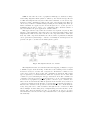
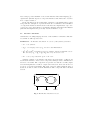
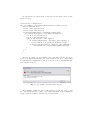
tion developer. The routing block itself is a composite component, which uses
the MultiHopSend, MultiHopRoute and MultiHopRouteSelect sub-components.
At the top level the participating components are Main, the standard entry
point of all applications in TinyOS, TimerC, the abstraction layer of hardware
timers, Photo, the photo sensor driver, MultiHop, the previously mentioned communication service provider, Leds, the hardware LED driver, and SurgeM, the
sole application specific module. Module and configuration components are depicited in dark and light colors, respectively. The ports of components are the
provided and used interfaces. This example will be used throughout the paper.
The only information captured textually in Gratis is the procedural code of
module implementations. The model interpreter generates all the nesC files containing interface, module and configuration specifications automatically. Keeping
the graphical models and the corresponding nesC files in synch is a challenge,
especially because a large code base of TinyOS components exists in text form
only. Therefore, the Gratis model interpreter is bi-directional; not only does it
generate the nesC files from graphical models, but it is also capable of parsing existing source files and building the corresponding models automatically.
The main use of this parsing feature is to automatically generate the graphical
equivalent of the TinyOS system components and to provide them as a library
to the user in the Gratis environment. This library can then be refreshed when
new TinyOS releases become available without any modifications to existing
graphical application models.
4
Temporal Models of Component Interfaces
Traditional programming languages and interface description methods—such as
CORBA or COM IDL—capture only the type aspects of software components.
The access points of a given component are enumerated along with their accepted
and returned parameter types in terms of values and domains. TinyOS and its
implementation language nesC [5] is no exception to this: component interfaces
are defined by a set of function declarations. Compatibility checking provided by
compilers guarantees that the user of a function provides the required parameters
and handles the returned value in a type-safe manner.
Even in trivial applications, the access points of a software component are
not isolated, dependencies and complex relationships might impose additional
constraints on the use of their services. Typical patterns—such as initialization
before use—can be found in almost every component. A component providing
communication services may have more sophisticated restrictions that are inherent in the communication protocol. Even if the legal order and dependencies of
the function calls are described in the documentation of the component as informal rules, automatic tools and formal methods cannot verify these constraints.
Graphical models of traditional interfaces enable us to understand and build
complex applications, however, they do not extend the information captured
in the textual representation. Effective composition and reuse of software components demands deeper understanding and specification of component inter-