1
184
2 Graphs and Functions
f(a) f(b)
2a 1 2b 1
2a 2b
ab
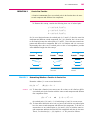
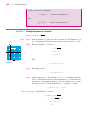
Assume second components are equal.
Evaluate f (a) and f(b).
Simplify.
Conclusion: f is one-to-one
Thus, by Definition 1, f is a one-to-one function.
Matched Problem 1
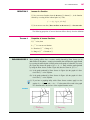
Determine whether f is a one-to-one function for:
(A) f (x) 4 x2
(B) f (x) 4 2x
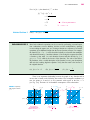
The methods used in the solution of Example 1 can be stated as a theorem.
Theorem 1
One-to-One Functions
1. If f (a) f(b) for at least one pair of domain values a and b, a b, then f
is not one-to-one.
2. If the assumption f(a) f (b) always implies that the domain values a and
b are equal, then f is one-to-one.
Applying Theorem 1 is not always easy—try testing f(x) x3 2x 3, for
example. However, if we are given the graph of a function, then there is a simple
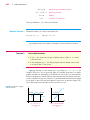
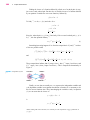
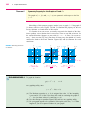
graphic procedure for determining if the function is one-to-one. If a horizontal line
intersects the graph of a function in more than one point, then the function is not oneto-one, as shown in Figure 1(a). However, if each horizontal line intersects the graph
in one point, or not at all, then the function is one-to-one, as shown in Figure 1(b).
These observations form the basis for the horizontal line test.
FIGURE 1 Intersections of graphs
and horizontal lines.
y
y
y f (x)
(a, f (a))
(b, f (b))
(a, f (a))
y f (x)
a
b
f (a) f(b) for a b
f is not one-to-one
(a)
x
a
Only one point has ordinate
f (a); f is one-to-one
(b)
x