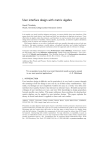
1
10
8
6
4
2
-3
-2
-1
1
2
3
Figure 1. Squaring, a simple symmetric function
about x = 0.
and in safety critical systems, users (and designers) would
be well-advised to put different labels or markers or other
symmetry-breaking features over the switches to reduce
confusion. (See the section below, on ambiguity.)
BACKGROUND CONCEPTS
Affordance was introduced by James Gibson [7] to describe
invariant properties objects have that encourage particular
use. His ideas were part of a larger ecological psychology
programme, but were picked up by Don Norman in his
Psychology of Everyday Things [13] and applied to the
design of physical artefacts, such as switches. In turn Bill
Gaver [5] extended the ideas to user interfaces, and raised
issues such as the affordances of buttons. In this form, the
concept of affordance entered HCI lore, though it raises
certain issues: a picture of a button on a screen can’t
successfully be pressed (unless it is a touch screen), so in
what sense does it have an affordance to be pressed? What
is important is that an observer readily perceives the
affordances, and therefore believes that certain actions can
be undertaken with the object. In the real world, typical
affordances are represented by concepts such as ‘graspable’
and ‘throwable.’ In most user interfaces, objects look like
they have affordances, and the user has to rely on many
learned conventions. The affordances of an object are
invariant over a wide range of observation conditions, and
this is what interested Gibson. Even when objects are at
strange angles, partly occluded, moving, and so forth,
humans are very good at recognising their affordances.
Norman later revisited affordance and made some finer
distinctions that had been glossed by practitioners [14].
Affordance is a controversial and sophisticated concept in
psychology; here we are interested in it as an abstract
concept. Whether Gibson had the right psychological
explanation is irrelevant here; we need concepts that work
for design.
Symmetry is a well-known concept [23], and often applied
to visual pictures and patterns. An object or picture having
mirror symmetry, for instance, means it looks the same if it
is reflected in a mirror. Most generally, symmetry is an
algebraic concept: objects have symmetries if they can be
transformed and yet preserve certain properties. A simple
example is a symmetric function f, where f(x) = f(–x). Here
the transformation of reflecting the coordinate system (x
goes to –x) leaves the property f unchanged. If we draw the
graph of such a function (e.g., the square function) it looks
symmetrical: see Figure 1; however, in general symmetries
need not have simple visual forms. In particular, in this
paper we are interested in symmetries that apply to
interaction, the transformation is therefore something the
user does through interaction over time, and the preserved
property or properties is something the user wants out of
the interaction.
We will use the term natural computation to refer to
whatever the brain and body (perceptual, motor, cognitive
functions) do most effectively. Humans are clearly very
flexible and powerful computers, but some things we do
effortlessly — particularly in problems involving
perception, visual recognition [4], spatial location — and
affordance. For example, our perceptual system readily
identifies pictures of buttons in large screens of other
information, particularly if the pictures have depth features
such as shading.
Natural computation is technically the term used for
computation “in the world” [1] — such as the computation
soap bubbles do in finding shapes of minimum energy. This
use of the term is consistent with ours, although we are
obviously more interested in how humans interact with
computers than how soap bubbles might. So, in this paper,
by natural computation we mean computation as is
achieved by humans, and we are not committed to whether
the computation occurs in brains, retinas, or anatomy or
otherwise.
Natural computation does not make all things equally easy.
Human natural computation is very specialised, and this
must be borne in mind if design is to be effective. Friedhoff
and Peercy [4] give some persuasive examples both of the
power of natural computation and the ease with which
apparently trivial changes in representation can defeat it.
Reeves and Nass [16] gives some examples of how natural
computation applies also to certain social situations; see
also [6]. Byrne [3] gives an excellent account of cognitive
models applied to conventional HCI.
SYMMETRY, AFFORDANCE AND INTERACTION
Elsewhere I pointed out [21,22] that symmetry captures a
key concept in affordance. Specifically, humans recognise
symmetries in objects (in the general algebraic sense, not
just simple mirror and rotational symmetries), and
particular symmetries define affordances.
A simple example will illustrate these ideas: a knob that has
an affordance for turning has rotational symmetry. Indeed,
if the knob had no rotational symmetry it would be
impossible to turn (though it might be attached to an axle