1
putations to perform as well as when to perform them. For
example, aop in AspectJ [10] makes it easy to implement a
profiler that records statistics concerning the number of calls
to each method. The what in this example is the computation that does the recording and the when is the instant of
time just prior to execution of each method body. In aop
terminology, the specification of what to do is called advice
and the specification of when to do it is called a pointcut designator. A set of pointcut designators and advice organized
to perform a coherent task is called an aspect.
We, with with Daniel S. Dantas and David Walker, developed Aspectml as part of our research on extending aop to
functional languages with parametric polymorphism [5]. In
a language with parametric polymorphism, it is difficult to
write advice when a function may be used at many types.
It is also common to simultaneously advise functions with
disparate types. To address both of these issues, we found
runtime type analysis necessary for writing expressive advice.
However, we began writing more complex examples in
Aspectml, and we found that not only was runtime type
analysis necessary for expressive advice, but that advice
was necessary for expressive type-directed functions. In
particular, aspects enable openly extensible tdp. We use
advice to specify what the behavior of a specific type-directed
function should be for a newly defined type, or combination
of types, and when a type-directed function should use the
case provided for the new type.
Furthermore, we believe that our entirely dynamic mechanism for aop is critical to this expressiveness. Nearly all
other statically typed aop languages have a compile-time
step called “weaving” that fixes the when. In contrast, decisions concerning when are made entirely at runtime in
Aspectml. Consequently, not only does tdp in Aspectml
improve extensibility when writing programs, but also while
the programs are running. For example, it is possible to
safely patch Aspectml programs at runtime or manipulate
data types that did not exist at “compile-time”.
Our contributions in this paper include:
• examples of tdp in Aspectml.
• examples of how runtime advising is essential to the
expressiveness of type-directed functions.
• a comparison of our technique with other approaches
to openly extensible tdp.
In the next section, we introduce aop in Aspectml via
examples. In Section 3, we explain and show examples of tdp
in Aspectml. In Section 4, we show how aop in Aspectml
can be used to openly extend type-directed functions. In
Section 5, we provide a more detailed comparison with related
research. Finally, in Section 6, we discuss future directions
and summarize our results.
2.
THE ASPECTML LANGUAGE
We begin by introducing the general design of Aspectml.
Aspectml is a polymorphic functional, aspect-oriented language descended from the ml family of languages. The syntax
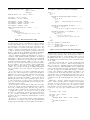
for a fragment of Aspectml is given Figure 1. It is most
similar to Standard ml [19], but occasionally uses OCaml or
Haskell syntax and conventions [15, 21].
We use over-bars to denote lists or sequences of syntactic
objects: x refers to a sequence x1 . . . xn , and xi stands for
k ::= *
| k1 -> k2
(polytypes)
s ::= <a[:k]> r
(ρ-types)
r ::= t
| s -> s
| pc pt
(pointcut type) pt ::= (<a[:k]> s1 ~> s2 )
(monotypes)
t ::= a
| T
| Unit
| String
| Int
| t1 -> t2
| (t1 , . . . ,tn )
| [t]
| t1 t2
(terms)
e ::= x
| C
| ()
| "..."
| i
| e1 e2
| let d in e end
| (fn p=>e)
| case e of p=>e
| typecase t of t=>e
| #f[:pt]#
| any
| (e1 , . . . ,en )
| [e1 , . . . ,en ]
| e:s
(patterns)
p ::= _
| x
| C
| ()
| "..."
| i
| p1 p2
| [p1 , . . . ,pn ]
| (p1 , . . . ,pn )
| p:s
(trigger time) tm ::= before
| after
| around
(kinds)
kind of types
function kinds
monotypes
higher-rank function
pointcut
type variables
type constructors
unit
strings
integers
functions
tuples
lists
type application
term variables
data constructors
unit
strings
integers
application
let declarations
abstraction
pattern matching
typecase
pointcut set
any poincut
tuples
lists
annotation
wildcard
variable binding
data constructors
unit
strings
integers
application
tuples
lists
annotation
(declarations)
d ::= val p = e
value binding
recursive functions
| fun f <a[:k]> (p)[: s] = e
| datatype T [: k] = C:s
data type def
| advice tm e1 <a[:k]> (p1 ,p1 ,p3 )[: s] = e2
advice def
| case-advice tm e1 (x:t1 ,p1 ,p2 )[:t2 ] = e2
Figure 1: AspectML syntax. Optional annotations are in
math brackets.
an arbitrary member of this sequence. We use a typewriter
font to indicate Aspectml programs or fragments. Italicized
text is used to denote meta-variables. We assume the usual
conventions for variable binding and α-equivalence of types
and terms.
The type structure of Aspectml has three layers: polytypes,
ρ-types, and monotypes. Unless, otherwise stated when we
refer to “types” in Aspectml we mean monotypes. Polytypes
are normally written <a:k> r where a:k is a list of binding
type variables with their kinds and r is a ρ-type. We often
abbreviate a:* as a. When a:k is empty, we abbreviate <> r
as r. This three-way partitioning of types is used as part of
Aspectml’s treatment of higher-rank polymorphism [22].