1
PID Summary
The preceding sections have been concerned principally with the integrity of DVB and ATSC
tables: that is, PSI and PSIP. This section describes monitoring of elementary streams such as
video and audio.
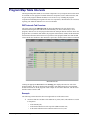
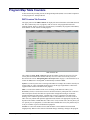
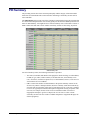
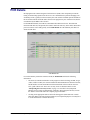
The PID Summary tab provides a list of the elementary streams that belong to the programs that
are carried in the Transport Stream. You would typically use this tab if the Summary tab shows an
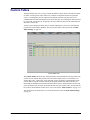
alarm for PID Summary. You might also have noticed continuity errors on the Table Counters or
PMT Counters tabs and want to check whether elementary streams are also losing TS packets.
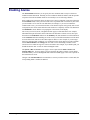
PID Summary Tab
For each elementary stream, the following information is provided:
•
The name (if available) and number of the program to which it belongs; its Alarm Status;
its PID; its type (Video, Audio or Other), its measured bit rate; and continuity errors
(CE). All of these, with the exception of CE, are informational; however, a non-zero CE
value indicates an error condition.
•
CE is a count of the number of discontinuities in the packet continuity counter for the
stream. Every PID in a Transport Stream (TS) has a continuity count that increments by
one with each new TS packet. If this does not increment correctly, a CE error is counted.
CE errors are typically an indication that upstream equipment is losing TS packets. This
can occur, for example, because of bit errors on a transmission link or because of
inappropriate attempts to groom or compress the TS. CE errors in video or audio
elementary streams will cause visible or audible disruptions in equipment that plays the
affected program(s).
5–14 • Transport Stream Monitoring
TSM-100 User Manual (Iss. 03)