1
Thank you for purchasing this Esco Ductless Fume Hood. Please read
this manual thoroughly to familiarize yourself with the many unique
features and exciting innovations we have built into your new
equipment. Esco provides many other resources at our website,
www.escoglobal.com, to complement this manual and help you
enjoy many years of productive and safe use of your Esco products.
For Technical Service, contact
North America
Esco Technologies, Inc.
2940 Turnpike Drive, Units 15-16 • Hatboro, PA 19040, USA
Toll-Free USA and Canada 1-877-479-3726
Tel 215-441-9661 • Fax 215-441-9660
us.escoglobal.com • [email protected]
Rest of World
Esco Micro Pte. Ltd.
21 Changi South Street 1 • Singapore 486 777
Tel +65 6542 0833 • Fax +65 6542 6920
www.escoglobal.com • [email protected]
Esco SPD/SPB User Manual
Version A - Released May 2011
User
Manual
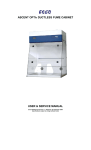
Ascent•OPTI
Ductless Fume Hood
Copyright Information
© Copyright 2011 Esco Micro Pte. Ltd. All rights reserved.
The information contained in this manual and the accompanying product is copyrighted and all rights are
reservedby Esco.
Esco reserves the right to make periodic minor design changes without obligation to notify any
person or entity of such change.
Sentinel® and Ascent® are registered trademarks of Esco.
“Material in this manual is provided for informational purposes only. The contents and the product described in
this manual (including any appendix, addendum, attachment or inclusion), are subject to change without
notice. Esco makes no representations or warranties as to the accuracy of the information contained in this
manual. In no event shall Esco be held liable for any damages, direct or consequential, arising out of or related
to the use of this manual.”
i
i
iii
v
v
v
v
vi
vii
1
Table of Contents
Warranty Terms and Conditions
Introduction
1. Products Covered
2. Safety Warning
3. Limitation of Liability
4. European Union Directives on WEEE and RoHS
Declaration of Conformity
Chapter 1 – Product Information
1
2
1.1 Quick View
1.2 Filtracheck
3
Chapter 2 – SPD Control System
3
4
4
5
5
7
7
9
11
11
11
11
11
11
11
12
13
13
14
2.1 Sentinel Control System
2.2 Menu Options
2.2.1 Settings
2.2.2 Calibration
2.2.3 Admin
2.2.4 Setting Mode
2.3 Alarm and Warnings
Chapter 3– SPB Control System
Chapter 4 - Basic Hood Operation
4.1 Using Front Cover
4.2 Starting and Shutting Down the Ductless Fume Hood
4.2.1 Turning on the Hood
4.2.2 Turning off the Hood
4.3 Operating the Ductless Fume Hood
3.3.1 Working in the Hood
3.3.2 Working Ergonomics
Chapter 5 – Service and Maintenance
5.1 Scheduled Maintenance
5.2 Maintenance/Service Log
Appendix
Ductless Fume Hoods
ii
Ascent•OPTI
iii
Esco products come with either a 1, 2 or 3 year limited warranty, depending on the product purchased,
beginning on the date of shipment from any Esco international warehousing location. To determine which
warranty applies to your product, refer to the appendix below.
Esco's limited warranty covers defects in materials and workmanship. Esco's liability under this limited
warranty shall be, at our option, to repair or replace any defective parts of the equipment, provided if proven
to the satisfaction of Esco that these parts were defective at the time of being sold, and that all defective parts
shall be returned, properly identified with a Return Authorization.
This limited warranty covers parts only, and not transportation/insurance charges.
This limited warranty does not cover:
Freight or installation (inside delivery handling) damage. If your product was damaged in transit, you
must file a claim directly with the freight carrier.
Products with missing or defaced serial numbers.
Products for which Esco has not received payment.
Problems that result from:
o External causes such as accident, abuse, misuse, problems with electrical power, improper
operating environmental conditions.
o Servicing not authorized by Esco.
o Usage that is not in accordance with product instructions.
o Failure to follow the product instructions.
o Failure to perform preventive maintenance.
o Problems caused by using accessories, parts, or components not supplied by Esco.
o Damage by fire, floods, or acts of God.
o Customer modifications to the product
Consumables such as filters (HEPA, ULPA, carbon, pre-filters) and fluorescent / UV bulbs.
Esco is not liable for any damage incurred on the objects used on or stored in Esco equipment. If the
objects are highly valuable, user is advised to have in place independent external preventive
measures such as connection to a centralized alarm system.
Factory installed, customer specified equipment or accessories are warranted only to the extent guaranteed by
the original manufacturer. The customer agrees that in relation to these products purchased through Esco, our
limited warranty shall not apply and the original manufacturer's warranty shall be the sole warranty in respect
of these products. The customer shall utilize that warranty for the support of such products and in any event
not look to Esco for such warranty support.
Esco encourages all users to register their equipment online at www.escoglobal.com/warranty or complete the
warranty registration form included with each product.
ALL EXPRESS AND IMPLIED WARRANTIES FOR THE PRODUCT, INCLUDING BUT NOT LIMITED TO ANY IMPLIED
WARRANTIES AND CONDITIONS OF MERCHANTABILITY AND FITNESS FOR A PARTICULAR PURPOSE ARE
LIMITED IN TIME TO THE TERM OF THIS LIMITED WARRANTY. NO WARRANTIES, WHETHER EXPRESS OR
IMPLIED, WILL APPLY AFTER THE LIMITED WARRANTY PERIOD HAS EXPIRED. ESCO DOES NOT ACCEPT LIABILITY
BEYOND THE REMEDIES PROVIDED FOR IN THIS LIMITED WARRANTY OR FOR SPECIAL, INDIRECT,
CONSEQUENTIAL OR INCIDENTAL DAMAGES, INCLUDING, WITHOUT LIMITATION, ANY LIABILITY FOR THIRDPARTY CLAIMS AGAINST YOU FOR DAMAGES, FOR PRODUCTS NOT BEING AVAILABLE FOR USE, OR FOR LOST
WORK. ESCO'S LIABILITY WILL BE NO MORE THAN THE AMOUNT YOU PAID FOR THE PRODUCT THAT IS THE
SUBJECT OF A CLAIM. THIS IS THE MAXIMUM AMOUNT FOR WHICH ESCO IS RESPONSIBLE.
Ductless Fume Hoods
iv
These Terms and Conditions shall be governed by and construed in accordance with the laws of Singapore and
shall be subject to the exclusive jurisdiction of the courts of Singapore.
Technical Support, Warranty Service Contacts
USA: 1-877-479-3726
Singapore: +65 65420833
Global Email Helpdesk: [email protected]
Visit http://www.escoglobal.com/ to talk to a Live Support Representative
Distributors are encouraged to visit the Distributor Intranet for self-help materials.
Product Appendix, Warranty Listings
Biological Safety Cabinets, Laminar Flow Cabinets,
HEPA-Filtered Cabinets (except Streamline brand)
Laboratory Fume Hoods
Ductless Fume Hoods
Cleanroom Equipment
Laboratory Ovens and Incubators
CO2 Incubators
Containment/Pharma Products
Ultralow Temperature Freezer
The warranty periods for BSC may vary by country. Contact
your local distributor for specific warranty details.
1 year limited.
3 years limited for Ascent Opti's, 5 years for Ascent Max's.
1 year limited.
1 year limited.
2 years limited.
2 years limited.
3 years limited. 60 months on Compressor.
The warranty period starts two months from the date your equipment is shipped from Esco facility for
international distributors. This allows shipping time so the warranty will go into effect at approximately the
same time the equipment is delivered to the user. The warranty protection extends to any subsequent owner
during the warranty period. Distributors who stock Esco equipment are allowed an additional four months for
delivery and installation, providing the product is registered with Esco. User can register product online at
www.escoglobal.com/warranty or complete the warranty registration form included with each product.
th
Policy updated on 12 Apr 2011 (This limited warranty policy does not apply to products purchased before 12
Apr 2011)
Ascent•OPTI
th
v
1. Products Covered
Electrical Rating
220-240 V AC, 50Hz, 1Φ
220-240 V AC, 60Hz, 1Φ
Esco Ductless Fume Hood – Ascent Opti
0.6 meters (2 feet)
0.9 meters (3 feet)
SPD-3A1
SPB-2A1
SPD-3B1
SPD-3A3
SPB-2A3
SPD-3B3
1.2 meters (4 feet)
SPD-4A1
SPD-4B1
SPD-4A3
SPD-4B3
2. Safety Warning
Anyone working with, on or around this equipment should read this manual. Failure to read,
understand and follow the instructions given in this documentation may result in damage to the unit,
injury to operating personnel, and / or poor equipment performance.
Any internal adjustment, modification or maintenance to this equipment must be undertaken by
qualified service personnel.
The use of any hazardous materials in this equipment must be monitored by an industrial hygienist,
safety officer or some other suitably qualified individual.
Before you process, you should thoroughly understand the installation procedures and take note of
the environmental / electrical requirements.
In this manual, important safety related points will be marked with the symbol.
If the equipment is used in a manner not specified by this manual, the protection provided by this
equipment may be impaired.
3. Limitation of Liability
The disposal and / or emission of substances used in connection with this equipment may be governed by
various local regulations. Familiarization and compliance with any such regulations are the sole responsibility
of the users. Esco’s liability is limited with respect to user compliance with such regulations.
4. European Union Directive on WEEE and RoHS
The European Union has issued two directives:
• Directive 2002/96/EC on Waste Electrical and Electronic Equipment (WEEE)
This product is required to comply with the European Union’s Waste Electrical &
Electronic Equipment (WEEE) Directive 2002/96/EC. It is marked with the following
symbol:
Esco sells products through distributors throughout Europe. Contact your local Esco
distributor for recycling/disposal.
• Directive 2002/95/EC on Restriction on the use of Hazardous Substances (RoHS)
With respect to the directive on RoHS, please note that this hood falls under category 8 (medical devices) and
category 9 (monitoring and control instruments) and is therefore exempted from requirement to comply with
the provisions of this directive.
Ductless Fume Hoods
vi
Ascent•OPTI
vii
Declaration of Conformation
In accordance to EN ISO/IEC 17050-1:2010
We,
of
Esco Micro Pte. Ltd.
21 Changi South Street 1
Singapore, 486777
Tel: +65 6542 0833
Fax: +65 6542 6920
declare on our sole responsibility that the product:
Category
: Ductless Fume Hoods
Brand
: Ascent Opti
Model
: SPB-2A1, SPD-3A1, SPD-3B1, SPD-4A1, SPD-4B1
in accordance with the following directives:
2006/95/EEC
: The Low Voltage Directive and its amending directives
92/31/EEC
: The Electromagnetic Compatibility Directive and its amending
directives
has been designed to comply with the requirement of the following Harmonized Standard:
Low Voltage
: EN 61010-1:2010
EMC
: EN 61326-1:2006 Class B
More information may be obtained from Esco’s authorized distributors located within the European Union. A
list of these parties and their contact information is available on request from Esco .
_______________________________
XQ Lin
Group CEO, Esco
This Declaration of Conformity is only applicable for 230V AC 50Hz units
Ductless Fume Hoods
viii
Ascent•OPTI
1
1.1 Quick View
5
6
7
8
1
2
9
3
4
1.
2.
3.
4.
5.
6.
7.
8.
Front cover
Front cover opening
Worktray
Mobile base cabinet
Blower
Electrical panel
Carbon filter
Sentinel Control System
9. Electrical cable opening
Ductless Fume Hoods
2
1.2 Filtracheck
FiltraCheck is a trademark service provided by Esco’s fume filtration division. Customers who intend to
purchase a ductless fume hood but are unsure whether the cabinet is suitable for their application, can
forward a list of chemicals that they will be handling and their pattern of usage to Esco's FiltraCheck service
team.
A PDF Questionnaire form is available at http://ductless.escoglobal.com/. This questionnaire can be
downloaded and either forwarded by email or by fax to Esco. After careful analysis of the provided chemicals
list and pattern of usage, a proper advice document will be generated and provided to the customer in 3 days
period.
This document will recommend the appropriate laboratory equipment; ducted fume hood or ductless fume
hood or neither based on the investigation done by the FiltraCheck team. Depending on the type of chemicals
used, the document may also contain a list of procedures, warnings, etc. that will help in ensuring a safer
laboratory working environment. In the case of a recommendation of a ductless cabinet, appropriate grade
and type of activated carbon also becomes a factor that has to be taken into consideration.
Ascent•OPTI
3
–
2.1 Sentinel Control System
Menu
Button
Set/Mute
Button
Fan
Button
Lamp
Button
Up
Button
Socket
Button
Down
Button
LCD
Display
UV
Button
Fan Button
o Turns on and turn off the fan.
Lamp Button
o Turns on and turn off the lamp.
Socket Button
o Although present, this feature is not applicable.
UV Button
o Although present, this feature is not applicable.
Up (▲) and Down (▼) Arrow Button
o Move upwards and downwards the menu options.
o Increase and decrease corresponding value inside one of the menu options.
Set or Mute Button
o Choose the menu or sub-menu currently displayed on the LCD screen.
o Proceed to the next step or sequence inside one of the menu options.
Menu Button
Alarm is disabled when you enter menu options
o
o
To enter and exit from the menu options.
To go back to the previous level of the menu options.
Ductless Fume Hoods
4
2.2 Menu Options
Please refer to the following diagram for complete reference to all menu options available.
SETTINGS
SET TIME
HH:MM (24 HRS)
WARM UP
XX MINUTES (3 ≤ XX ≤ 15)
POST PURGE
XX MINUTES (0 ≤ XX ≤ 15)
VELOCITY UNIT
FPM | M/S
TEMP UNIT
CELSIUS | FAHRENHEIT
SET CONSTANT
CALIBRATION
MENU
ZERO CONSTANT
CALIB SENSOR
NEW ADMIN PIN
XXXX
NEW FAN PIN
XXXX
A/F MONITOR
ENABLE | DISABLE
FILTER TYPE
STANDARD
ACID FILTER
ALDEHYDE CPD.
AMMONIA/AMINES
HALOGEN CPD.
MERCURY CPD.
SULPHUR CPD.
ADMIN
RESET B/H/M
RESET DEFAULT
NORMAL
SET MODE
MAINTENANCE
2.2.1 Settings
The user may use the settings menu function to customize the operation of the BSC to meet specific
application requirements.
2.2.1.1 Set Time
Users can set the time by increasing/decreasing the hour and minute values. The correct time will be
maintained even after the unit is turned off.
MENU
SETTINGS
SET TIME
HH:MM (24HRS)
2.2.1.2 Warm Up
There will be a period of warm-up, before the fan is fully functioning. This is to ensure that the sensors, the
blower, and the control system are stabilized, as well as purging the work zone of contaminants. The default
setting is 3 minutes and the user can set it between 3 to 15 minutes.
MENU
SETTINGS
Ascent•OPTI
WARM UP
XX MINUTES (3 ≤ XX ≤ 15)
5
2.2.1.3 Post Purge
After the user switches off the hood’s fan, there will be a post-purge period. This feature is to ensure that all
residual contaminants are purged from the work zone. The default setting is 0 minute and user can set it
between 0 to 15 minutes. Setting it to 0 minute will disable this feature. However, it is recommended to purge
the fume hood by leaving the fan on for around 3 minutes after the work is complete.
MENU
SETTINGS
POST PURGE
XX MINUTES (0 ≤ XX ≤ 15)
2.2.1.4 Velocity Unit
Using this option, the user can select the unit in which air velocity is measured and displayed.
FPM
MENU
SETTINGS
VELOCITY UNIT
M/S
2.2.1.5 Temperature Unit
Using this option, the user can select the unit in which air velocity is measured and displayed.
CELCIUS
MENU
SETTINGS
TEMP UNIT
FAHRENHEIT
2.2.2 Calibration
The purpose of calibration is to ensure the accuracy of the airflow display and alarm (if present). This involves
measuring airflow with reference instrumentation and establishing reference between airflow sensor(s) on the
hood to the standard reference. Calibration should only be carried out by trained personnel. This section is
presents a brief overview of the calibration menu function. For more information, refer to test report.
SET CONSTANT
MENU
CALIBRATION
ZERO CONSTANT
CALIB SENSOR
2.2.2.1 Set Constant
Every sensor manufactured by Esco has a specific Sensor Constant which is used for temperature
compensation performed by the temperature sensor.
2.2.2.2 Zero Sensor
This option let the controller record the specific sensor output voltage and correspond it to 0 m/s or 0 fpm.
2.2.2.3 Calib Sensor
This option allows proper calibration and operation of the airflow sensor alarm. There will be three points to
be calibrated, namely inflow fail point, inflow nominal point, and downflow nominal point.
2.2.3 Admin
The admin menu allows you to change both fan and Admin. PIN, also to disable it (not recommended). The
reset blower hour meter is usually used after you change the blower (or filter) and it can easily give you the
indication on when to do maintenance. While the reset default function will return the options in the settings
menu to their factory settings.
Ductless Fume Hoods
6
2.2.3.1 New Admin. PIN
ADMIN PIN restricts access to MENU functions, including service functions, like calibration. User must enter
four digits PIN before accessing MENU. ADMIN PIN has higher priority and can be used to control the fan
(override Fan PIN).
ADMIN PIN can also be used to switch to maintenance mode from ERR.MSWITCH and AIR FAIL! errors
condition.
The default PIN is 0009. Setting PIN to 0000 will disable this feature.
MENU
ADMIN
NEW ADMIN PIN
XXXX
2.2.3.2 New Fan PIN
Fan PIN restricts access to fan control. User must enter four-digit PIN before switching fan on or off. As such, it
can restrict access to operating the hood by unauthorized personnel. Fan PIN is also needed to disable the
alarm when the sash is fully raised and cleaning needs to be performed. It is recommended that the Fan PIN be
issued only to personnel authorized to use the hood.
The default PIN is 0001. Setting the PIN to 0000 will disable this feature.
MENU
ADMIN
NEW FAN PIN
XXXX
2.2.3.3 A/F Monitor
Whenever the air velocity falls below the fail point, the air fail alarm will be triggered. This option is used to
enable/disable alarm.
ENABLE
MENU
ADMIN
A/F MONITOR
DISABLE
2.2.3.4 Filter Type
To set the type of main carbon filter(s) used in the hood. The options include standard, acid filter, aldehyde
compound, ammonia/amines, halogen compound, mercury compound and sulphur compound.
STANDARD
ACID FILTER
ALDEHYDE CPD.
MENU
ADMIN
TEMP UNIT
AMMONIA/AMINES
HALOGEN CPD.
MERCURY CPD.
SULPHUR CPD.
2.2.3.5 Reset Blower Hour Meter
This option is used to reset the blower hour meter. The blower hour meter indicates how long the blower has
been in operation. Maximum counter is set at 9999 hours. The counter value can be checked while in
maintenance mode.
MENU
ADMIN
Ascent•OPTI
RESET B/H/M
7
2.2.3.6 Reset Default
User can reset the default setting by choosing this option. The features being reset are warm-up period (3
minutes), post-purge period (0 minute), velocity unit (Metric), temperature unit (Celsius), Admin. PIN (0009),
and Fan PIN (0001).
Note that the calibration settings cannot be reset as it may cause the BSC to operate in an unsafe manner. The
hour meters cannot be reset either.
MENU
ADMIN
RESET DEFAULT
2.2.4 Set Mode
Ductless fume hood has two working mode, the default normal mode which is used in a day to day activity,
and maintenance mode.
NORMAL
MENU
SET MODE
MAINTENANCE
2.2.4.1 Normal Mode
Every time the hood is restarted, this mode will be activated by default. In this mode, all alarms and interlocks
are enabled.
2.2.4.2 Maintenance Mode
Maintenance mode should only be accessed by qualified personnel during maintenance. In this mode, all
alarms are disabled and all interlocks are defeated.
2.3 Alarm and Warnings
The warning AIR FAIL! indicates that there is airflow failure. The operator should check if there is any
obstruction to the airflow, and correct it if possible. However, if the problem continues, the operator should
stop working as the hood’s protection may have been compromised. Call service or Esco’s local distributor.
Other alarms that indicate a failure or an error in the BSC system:
ERR.AIRFAIL will be displayed if the blower is turned off while there is an airflow failure.
ERR.CALIB will be displayed if the airflow velocity sensor is not yet calibrated.
Ductless Fume Hoods
8
Ascent•OPTI
9
–
SPB only uses one ON/OFF switch to control the fan.
Ductless Fume Hoods
10
Ascent•OPTI
11
–
4.1 Using Front Cover
The front cover should be fully closed when the hood is not in use. This helps keep the work zone
interior clean.
The front cover should always be in the operating height at all times when the hood is in use. Even if
the hood is left unattended, but the blower is on, the cover should never be moved from the normal
operating height, unless during loading or unloading of materials/apparatus into the hood.
The cover may be opened to its maximum position for the purpose of loading/unloading of
materials/apparatus into the hood.
4.2 Starting and Shutting Down the Ductless Fume Hood
4.2.1 Turning on the Hood
1.
Turn on the fan by pressing the FAN button. Input the Fan PIN if asked (default: 0001). This will start
the warm up procedure (default: 3 minutes). All buttons are disabled during warm up period.
Note: SPB doesn’t have warm up period, but it is recommended to allow 3 minute warm up before using the hood
2.
The hood is ready for work.
4.2.2 Turning off the Hood
1.
Turn off the fan by pressing the FAN button. Input the Fan PIN if asked (default: 0001). This will start
the post purge procedure (default: 0 minute). All buttons are disabled during post purge period.
4.3 Operating the Ductless Fume Hood
4.3.1 Working in the Hood
Check the label on the ductless fume hood to see what chemicals the hood is intended for – and only
use the hood for any procedure involving such chemicals.
Ensure the exhaust is operating before commencing work.
After all the apparatuses/items have been arranged, allow the blower to run for another 3 minutes in
order to purge work zone of contaminants.
Minimize room activity since these external airflow disturbances may adversely affect the hood’s
internal airflow, impairing the containment capabilities of the fume hood.
Keep your head outside of the hood.
Work as far into the hood as possible and with slow, deliberate movements, to minimize airflow
disturbances.
Work with the sash as fully lowered as possible, utilizing the sash as a natural barrier.
Do not use this hood as a storage area. Items can block airflow and interfere with containment.
If performance is suspected, or an airflow alarm is triggered (if installed), terminate usage, close the
sash completely, and cease work.
Do not let organic chemicals evaporate in the hood – use a proper waste bottle. Do not leave
uncapped bottles of chemicals or waste in a hood.
Certify this hood annually to verify airflow velocity, smoke patterns and containment.
Perform routine maintenance in accordance with the manufacturer’s instructions.
Ductless Fume Hoods
12
4.3.2 Working Ergonomics
On most occasions, you would most likely be operating the fume hood in sitting rather than standing posture.
There are some obvious advantages of the sitting posture:
The physiological energy cost and fatigue involved in sitting are relatively less
Sitting posture provides the body with a stable support
However, sitting position has some drawbacks too:
The working area available is fairly limited
There is a potential risk of being constrained in the same posture for a long time
Sitting posture is one of the most stressful postures for one’s back
Therefore you should pay careful attention to the following guidelines in order to achieve comfortable and
healthy working conditions:
1. Always ensure that your legs have enough legroom.
2. Keep your lower back comfortably supported by your chair. Adjust the chair or use a pillow behind your
back whenever necessary.
3. You should place your feet flat on the floor or on a footrest. Don’t dangle your feet and compress your
thighs.
4. You should keep varying your sitting position throughout the day at regular intervals so that you are
never in the same posture for too long.
5. Observe the following precautions with respect to your eyes:
Give your eyes frequent breaks. Periodically look away from the work area and focus at a distant
point.
Keep your glasses clean.
6. Arrange the items/apparatus frequently used in your work in such a way that you can minimize the
physical strain involved in handling them.
7. Exercise regularly
Ergonomics accessories available with Esco include:
a. Armrest padding
b. Lab chair
c. Footrest
Please contact your local distributor or Esco for more information.
Ascent•OPTI
13
–
5.1 Scheduled Maintenance
Proper and timely maintenance is crucial for trouble free functioning of any device and your Esco ductless
fume hood is no exception to this rule. We strongly recommend that you follow the maintenance schedule
suggested hereunder in order to obtain optimal performance from your Esco ductless fume hood.
No.
1
2
3
4
5
6
7
8
9
10
11
12
13
Description of Task to Perform
Check the alarm and measure the basic airflow
Clean the interior work surface and walls with soap water
Wipe down cover with appropriate cleaner
Clean the exterior surfaces of the ductless fume hood
Measure the ductless fume hood face velocity
Check fans, motors, drives and bearings for proper operation
Check fluorescent tubes for proper operation
Test the operation of airflow alarm
Repair defect and lubricate as necessary
Clean the stainless steel surface using MEK
Re-certification
Change the fluorescent lamps
Check filter saturation
Week
√
√
√
Maintenance to be carried out every
Month
Quarter
1 Year
2 Years
√
√
√
√
√
√
√
√
√
(check according to Filtracheck recommendation)
Cleaning the Hood
Clean the work surface and walls with soap water
Clean the cover using an appropriate cleaner
Use a damp cloth to clean the exterior surface of the fume hood, particularly on the front and top in
order to remove dust that accumulated there
Use clean water to finish the cleaning and wash away any residue from the soap water and glass
cleaner
For removing stubborn stains or spots on the stainless steel surface, make use of MEK (Methyl-EthylKetone). In such cases, make sure that you wash the steel surface immediately afterwards with clean
water and some liquid detergent. Use a polyurethane cloth or sponge for washing. Regularly cleaning
the stainless steel surface can help you retain the attractive factory finish.
Test the audible and visual alarm (only for SPD)
If possible, cover the airflow sensor; otherwise cover the perforations on the back wall – this should disrupt
the airflow of the hood enough to activate the alarm
Check the hoods functionality
Check the hood’s mechanical functionality
Check the hood’s electrical functionality
Check the hood for any defect, repair immediately
Check filter saturation
Check for filter saturation often. The saturation level of a filter is directly affected by the amount of chemical
fume generated by the experiment conducted inside the fume hood. Use particle counter below and above
the main (and backup) filter and compare the results to check the saturation level of the carbon filter.
Re-certification
All ductless fume hoods must be re-certified annually by a certified engineer.
Ductless Fume Hoods
14
5.2 Maintenance/Service Log
It is good practice (and in some cases regulatory requirement) to maintain a log of all maintenance work
carried out on your hood.
Ascent•OPTI
APPENDIX
INTRODUCTION
Electronic detectors for monitoring filter saturation (efficiency) have not been shown to be sufficiently reliable
for the range of gases used in school/lab and over a reasonable time scale; therefore chemical tests are
needed.
As there are strict limits to the concentrations of hazardous gases in air which can be breathed, it is necessary
to test the efficiency of the filter regularly. Further, it is prudent to conduct an initial test to ensure that the
filter is seated properly and that its contents have not been displaced in transit. It is advisable to test for this
every time the filter is replaced.
There are 3 methods according to the COSHH regulation to test for filter saturation by chemical (acid gases).
Propan-2-ol challenge test (BS 7989:2001 Standard)
Method using a canister (cease to be practicable)
Method using the burning sulphur (BS 7989:2001 Standard)
Test for saturation by organic gases (limited usage)
For our purpose, Esco will be using the propan-2-ol challenge and burning sulphur test method.
PROPAN-2-OL CHALLENGE TEST
The rate of release of propan-2-ol vapor is calculated by evaporating a weighted quantity of propan-2-ol for a
measured time. The filter challenge concentration and filter efficiency are then calculated as shown.
APPARATUS
Gas detection kit
Propan-2-ol
Anti-bumping granules
Balance, weighting to 0.1 gram or less
Stop clock
250 ml conical flask, with a stopper.
Hotplate
PROCEDURE
1.
2.
3.
4.
5.
6.
3
Determine the air volume flow rate through the fume cupboard and record the value as Fa in m /min.
Pour about 100 ml of propan-2-ol into a preweighted, stoppered, conical flask containing a few antibump granules. Record the weight of solvent added as M 1 in gram.
Set up the hotplate in the fume cupboard. Switch on the fume cupboard, remove the stopper from
the flask and place the flask in on the hotplate.
As the propan-2-ol begins to boils, the vapour condenses on the cooler parts of the flask forming a
boundary line. When the boundary reaches the top of the flask, start the stop clock.
After 60s, take a reading of the concentration of propan-2-ol in the exhaust gas emitted by the fume
cupboard using a gas detection kit with a suitable tube. Repeat the measurement at 5 min. record the
3
highest concentration in ppm. Convert the concentration from ppm to mg/m using the formula
below and record as Ce in mg/m3.
When the last of the propan-2-ol has evaporated, stop the clock, noting the time of the run as t in
second.
CALCULATION
3
Calculate the total volume Va in m of air passed through the fume cupboard during test: Va = Fa t / 60
3
Calculate the challenge concentration in mg/m : Co = 1000 M1 / Va
Calculate the filter efficiency (%): Filter efficiency = 100 (Co - Ce) / Co
3
3
Conversion from ppm to mg/m : Concentration in mg/m = Concentration in ppm x 60.1 / 24
METHODS USING BURNING SULPHUR
The rate of release of sulphur dioxide is calculated by weighing the vessel containing the sulphur dioxide
before and after it has burning for a measured time. It is satisfactory provided
a) the Bunsen burner is turned off once the burning of sulphur starts and
b) the apparatus is sited as far forward in the fume cabinet as possible to obtain complete combustion.
The item required are powered roll sulphur (150-200 g), a flat-bottom porcelain evaporating basin, a gas
detection kit, a balance weighting to 0.1g or less, a stop clock, Bunsen burner, two gauze squares both with
ceramic circular centres, a tripod, a heat-proof mat and a ruler. Wear eye protection. Sulphur dioxide is a toxic
gas, so do not breathe it in.
1.
2.
3.
4.
Powder the roll sulphur in a mortar with a pestle.
Fill a flat-bottom porcelain evaporating basin with the sulphur so that it is level with the rim.
Weigh the porcelain basin, the sulphur and one of the gauzes (M 1 grams).
Set up the Bunsen burner, tripod, the other gauze and the evaporating basin on a heat-proof mat so
that the centre of the basin is 5cm inside the upper rim of the aperture (This places the sulphur in the
maximum incoming draught and encourages complete combustion).
5. Switch on the fume cabinet.
6. Light the Bunsen burner with the gas tap half-open and the collar open enough so that the flame is
non-luminous.
7. The sulphur melts slowly to a pale amber liquid. Remove the Bunsen burner from under the gauze
and adjust the collar so that it is half-open. Place it back under the gauze very carefully (The liquid will
quickly darken. Changes in the appearance of the liquid surface indicate that burning is about to start.
Sulphur catches light with a blue flame).
8. Start the stop-clock when half of the surface of sulphur has caught alight. Immediately turn off the
Bunsen burner at the gas tap.
9. After 60 seconds, take reading of the concentration of the sulphur dioxide being emitted through the
exhaust with a gas detection kit. A slight smell of sulphur dioxide should be ignored but, if the exhaust
gas causes breathing difficulties, stop the test.
10. Place the other gauze (which was used in the weighing) on top of the basin and stop the clock, noting
the time (t seconds)
11. When the sulphur has cooled down for about 20 minutes and solidified, reweigh the basin, the
remaining sulphur and the gauze (M2 grams).
The sulphur and dish may be kept and used the next time the test is carried out. A little more powdered roll
sulphur may need to be added to make up for any lost in the previous burning.
CALCULATION
-3 -1
Rate of release of sulphur dioxide = (M1-M2) x 750 / t cm s
Now check your result with the table below.
-3 -1
Rate of sulphur dioxide relesed (cm s )
05
10
15
20
25
30
Maximum permitted concentration of sulphur dioxide in the exhaust gas (ppm)
1
2
3
4
5
6
Fume Hood
Serial Number
Person in Charge
1.
2.
Date
:
:
:
_______________________________________________________________
_______________________________________________________________
_______________________________________________________________
This log record should be used by the operator to record any new chemicals that has been introduced
to the fume hood during its operation, problems encountered, etc.
Please also record any major maintenance procedure performed by the service technician, for
example: parts replacement, recertification, etc.
Event
User Signature
Supervisor Signature
In case of emergencies, please call:
Name
: _______________________________________________________________
Cell Phone Number : _______________________________________________________________
E-mail
: _______________________________________________________________