1
US00518422OA
United States Patent [191
[11]
[451
Kinghorn et al.
[54] _TELETEXT DECODER APPARATUS
INCLUDING FEATURE OF INHIBITING
GENERATION OF AN END-OF-PAGE
SIGNAL
[75] Inventors: John R. Kinghorn, Brockenhurst;
Jeremy R. Stevens, Lymington, both
of United Kingdom
[73] Assignee: US. Philips Corp., New York, NY.
[21] Appl. No.: 647,620
[22] Filed:
[30]
Jan. 28, 1991
United Kingdom ............... .. 9002118
[51]
Int. Cl.5 ..................... .. H04N 7/087; H04N 7/04;
[52]
US. Cl. ................................... .. 358/147; 358/146
[58]
Field of Search ................ .. 358/147, 146, 142, 86
1'104N 7/08
[56]
References Cited
OTHER PUBLICATIONS
“Speci?cation of Standards for Broadcast Teletext Sig
nals”, Teletext Speci?cation, IBA Technical Reviews,
pp. 76-89, Sep. 1976.
“Computer Controlled Teletext User’s Manual”, Mul
lard Application Laboratory, 1983 Nov. 01.
Primary Examiner-James J. Groody
Assistant Examiner-Safet Metjahic
Attorney, Agent, or Firm-David Schreiber
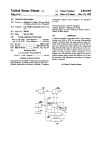
is set by the page header of a required teletext page and
reset by the next following page header, a “page end”
flip-flop (15) generates a page end output (17) in re
sponse to the receipt of the next following page header,
a “row received” flip-?op (11) detects at least one row
of the required teletext page, a gate (14) inhibits the
generation of an end of page output ‘(21) for a predeter
mined period, typically corresponding to three ?eld
U.S. PATENT DOCUMENTS
4,991,018
4,701,794 10/1987
2/1991
Date of Patent:
5,184,220
Feb. 2, 1993
[57]
ABSTRACT
A “correct page header received" (CPI-IR) ?ip-?op (3)
Foreign Application Priority Data
Jan. 31, 1990 [GB]
Patent Number:
Friiling ...............................
Davies
et al. ........ ..
.. 358/147
intervals, and an AND gate (18) further'inhibits the
generation of an end of page output (21) if there has
been a subsequent detection of a further page header of
FOREIGN PATENT DOCUMENTS
3622308
1/1988 Fed. Rep. of Germany .
60-196084 10/1985
2240697
8/1991
the required teletext page within the predetermined
period.
'
Japan ................................. .. 358/147
14 Claims, 3 Drawing Sheets
United Kingdom .
\
PAGE NUIIBER
CDIPARATOR
BISTABLE
DEVICE
PH
INHIBIT
on Al
‘ mm
§ ‘19
US. Patent
Feb. 2, 1993
1\
Sheet 1 of 3
5,184,220
Fig. 7.
\
PAGE NUMBER
.
2
COMPARATOR
rs
3
BISTABLE CPHR lo
/7
10
rgglsmw DEVICE
RR
\D‘LY
/13
0
JR
INHIBIT
‘
I
1h
19
DELAY
TIMER
i-j
20
A ‘J
BISTABLE
DEVICE
15
IDT
B
S :16
Q
PE
.
18
d
‘
17I
{
21
EPF
22
i
RFG
23
US. Patent
Feb. 2, 1993
Sheet 3 of 3
5,184,220
u
_
mu||_
__
D
>IQxIaNIQE.
-:._C| i:
E
_n
22.5xzamg31ammNa
mInU
rlL
mm
.3
H[ .|F _
5:
% >am
“Km QUE
1
5,184,220
2
quired teletext page to be cleared from memory. If this
does not occur naturally in the transmission sequence
the conventional approach is to repeat the same page
header or ?ll with other information until the next ?eld
TELETEXT DECODER APPARATUS INCLUDING
FEATURE OF INHIBITING GENERATION OF AN
END-OF-PAGE SIGNAL
interval. However this can waste a signi?cant propor
FIELD OF THE INVENTION
This invention relates to a teletext decoder compris
tion of the transmission capacity if a large number of
lines in the vertical blanking interval are being used. A
way of minimizing this wastage is to use the “advanced
header” technique whereby at the start of each page the
current page header is preceded by the header for the
ing means for detecting the page header of a required
teletext page, means for detecting the next following
page header, and means responsive to the detection‘ of
said next following page header for generating an end of
page signal, and to a method of operating such a teletext
decoder.
next page in sequence. When the current page is com
pleted, the page header for the next page is transmitted,
and this can be followed immediately with the rows
corresponding to that page, without the need to wait
BACKGROUND OF THE INVENTION
the one ?eld period normally required for page clear
ing, since the “advanced header" has already given the
warning necessary to ful?l the required page clearing
Decoders of this type can conform to the “World
System Teletext and Data Broadcasting System-Tech
nical Speci?cation”, December 1987, published by the
UK. Department of Trade and Industry.
requirements. Again, however, a simple “end of page”
signal derived using the arrival of the next page header
It is frequently necessary to determine when the 20 would result in an incorrect “end of page” signal being
transmission of a teletext page has been completed. For
example, it may be desired to reallocate an acquisition
generated.
In order to overcome these problems and to take
account of the “worst case” situation it has been found
necessary to introduce a software delay, typically in the
order of 0.5 seconds in order to determine whether an
“end of page” signal is a true signal or not.‘
circuit to a different page memory, or to commence
processing of, so-called, extension packets. If these ac
tions are commenced before a page has been completed
an incorrect display may result. Conversely, if these
actions are delayed by a signi?cant amount a poorer
performance will result; e.g. a delay in capturing a
group of pages or a delay in generating the correct
display.
Unfortunately there is nothing in the World System
Teletext Technical Speci?cation which guarantees the
completion of the page. With the normal transmission
sequence, a page commences with a page header, fol
lowed by the rows for the page. It might be though that
detection of the following page header would be suf?
cient to indicate the completion of the page. However
there are circumstances when this method cannot be
relied upon.
For example, a problem can arise with the transmis
sion of subtitles. Teletext subtitles for the deaf or in
other languages are closely related to the accompany
30
SUMMARY OF THE INVENTION
It is an object of the present invention to provide a
teletext decoder having an improved “end of page"
detection arrangement which overcomes the aforesaid
problems.
According to one aspect of the present invention
there is provided a teletext decoder comprising means
for detecting the page header of a required teletext
page, means for detecting the next following page
header, and means responsive to the detection of the
next following page header for generating an end of
40 page signal, characterised by means for detecting at
least one row of the required teletext page, and means
for inhibiting the generation of the end of page signal if
at least one row of the required teletext page has not
been
detected, or if there has been a subsequent detec
to appear and disappear in an appropriate way. It is
therefore common practice for the transmission net 45 tion of a further page header of the required teletext
page within a predetermined period.
work to give a high priority for subtitles, in such a way
By arranging that the end of page signal is inhibited
that they can interrupt the transmission of a normal full
for a predetermined period, typically corresponding to
teletext page. Thus, a page header for a normal teletext
three ?eld blanking intervals, and is further inhibited if
page may be transmitted followed by the rows of that
_ particular teletext page. Before the normal teletext page 50 there has been a subsequent receipt of a further page
header of the required teletext page the problem arising
has been completed, it may be decided to transmit a
with the transmission of subtitles is overcome, and by
teletext subtitle and this is done by transmitting a subti
requiring that at least one row of the required teletext
tle page header followed by one or more teletext rows.
page be detected, the problem regarding “advanced
The normal teletext page is then resumed by transmit
ting the page header for that page again followed by the 55 headers” is avoided.
In one arrangement for carrying out the invention
remaining rows of that page. In this case the page
according to the one aspect there may be provided a
header of the normal teletext page is followed by the
teletext decoder characterised by a ?rst bistable device
subtitle page header, and this will be detected as an “end
which is set in one of its states in response to the receipt
of page” signal which is produced before the normal
ing picture signal and timing is quite critical if they are
teletext page has been completed.
A. problem can also arise with the use of, so-called,
“advanced headers”. This is a transmission sequence
used by some broadcasters to improve transmission
of the page header of the required teletext page and in
its‘ other state in response to the receipt of the next
following page header, a second bistable device which
is set in one of its states in response to the receipt of the
at least one row of the required teletext page and is
ef?ciency. In the World System Teletext Technical
Speci?cation it is speci?ed that the ?rst transmission of 65 subsequently set in its other state, ?rst gating means
responsive to the receipt of the next following page
a page header must be separated from the rows of the
page by at least one ?eld period in order to provide a
page clearing interval which enables a previously ac
header and the output of the second bistable device for
generating a signal indicative of a possible page ending,
3
5,184,220
delay means having a delay corresponding to the prede
termined period to which the output of the ?rst gating
4
In FIG. 1 there is depicted a page number compara
tor l which compares the page number of each received
teletext page with the page number of a required tele
text page (i.e. requested by a user) and which affords an
output 2 to a bistable device or ?ip-?op 3. The flip-flop
3, which is conveniently referred to as the CPHR (cor
means is applied, and second gating means operable on
the output of the delay means and in response to the
output of the ?rst bistable device and the output of the
, ?rst gating means for generating the end of page signal.
Conveniently, a third bistable device may be pro
vided which is set in one of its states but the output from
the ?rst gating means and is subsequently set in its other
state; the second gating means may take the form of an
AND gate to which an inverted output of the ?rst gat
ing means, an inverted output of the delay means and
the output of the third bistable means are applied; fur
ther delay means may be provided responsive to the
rect page header received) ?ip-?op is set by the output
from the page number comparator 1 corresponding to
the page header of a required teletext page, and is reset
by the next following page header PH (of the correct
magazine) afforded on input 4. A signal indicative of a
“valid row" VR corresponding to the required teletext
page is afforded on input 5. The signals on inputs 4 and
5 are applied to an OR gate 6, the output from which
receipt of the next following page header for setting the
together with the output 7 from the CPHR ?ip-?op 3 is
second bistable means in its other state; the third gating
means may be provided which is responsive to the out
put of the second gating means and to a further signal
for setting the third bistable device in its other state.
applied to an AND gate 8 to generate a “write enable"
signal W/E-on output 9—in the usual way.
In conventional teletext decoders an end of page
received teletext signal.
signal is derived from the CPHR ?ip-?op 3 but because
this is set by the page header of a required teletext page
and is reset by the next following page header, if this
latter page header is not that of the teletext page which
In accordance with a second aspect of the present
invention there is provided a method of operating a
is next in number sequence, which is the case when
teletext subtitles or “advanced headers” are used, then
Preferably, the predetermined period of the delay
means corresponds to three ?eld blanking intervals of a
teletext decoder comprising the steps of detecting the 25 the end of page signal which is generated will not be
page header of a required teletext page, detecting the
next following page header, and generating an end of
page signal in response to the detection of the next
correct and, as has been described, can result in an
detecting at least one row of the required teletext page,
incorrect display or poor system performance.
In order to alleviate these problems, the data acquisi
tion circuit is provided with the additional circuitry
shown below the dashed lines in FIG. 1, the operation
and inhibiting the generation of the end of page signal if
of which will be described with reference to the various
at least one row of the required teletext page has not
been received, or if there has been a subsequent detec
waveforms shown in FIG. 2 of the drawings which
following page header, characterised by the steps of
relate to a teletext decoder operating under normal
tion of a further page header of the required teletext
conditions.
page within a predetermined period.
35
As will be appreciated, teletext data is normally trans
mitted as part of a television signal, use being made of
IN THE DRAWING
An exemplary embodiment of the invention will now
be described reference being made to the accompanying
the lines which comprise the ?eld blanking interval.
Normally, each row of a teletext page will be transmit
ted in one of the lines of the television signal ?eld blank
drawings, in which:
ing interval. Typically, eight of the lines of the ?eld
FIG. 1 is a block schematic diagram of part of a tele
text decoder according to the present invention;
blanking interval may be used for teletext transmission
FIG. 2 depicts various waveforms existing in the
arrangement of FIG. 1 under normal operating condi~
consist of a page header PH and twenty-three display
tions;
FIG. 3 depicts various waveforms existing in the
arrangement of FIG. 1 when teletext subtitles are being
received; and
FIG. 4 depicts various waveforms existing in the
purposes, so that a teletext page, which would normallyv
rows R1 to R23, would be transmitted over a number of
45
?elds of the television signal.
In line (a) of FIG. 2 there is depicted diagramatically
a page header PI-IX (of page X) which is preceded by
row R23 (of the previous teletext page W) and which is
followed by rows R1, R2 . . . R23 of page X. Row R23
arrangement of FIG. 1 when teletext “advanced head 50 of page X is followed by page header PHY (of page Y)
ers” are being received.
which is followed by rows R1, R2 . . . of page Y. Wave
BRIEF DESCRIPTION OF THE PREFERRED
EMBODIMENT
form (b) of FIG. 2 depicts the output 7 of CPHR ?ip
flop 3 of FIG. 1 which is set on page header PBX and
is reset on page header PHY.
The embodiment of the invention to be described is a 55
In line FIG. 1, the output 7 from the CPHR flip-flop
modi?cation of a conventional teletext decoder which
3, shown by waveform (b) in FIG. 2, together with the
is designed to operate in accordance with the aforemen
tioned World System Teletext Technical Speci?cation
and as such the overall operation of a teletext decoder
will not be described. Only those parts of a teletext
decoder which are necessary to explain the features and
operation of the present invention will be considered.
The arrangement shown in FIG. 1 of the drawings
forms part of the normal data acquisition circuit of a
teletext decoder, the parts above the dashed lines being
“valid row” VR signal on input 5, corresponding to
row R1 in (a) of FIG. 2, is applied to an AND gate 10,
the output from which is used to set a "row received"
(RR) bistable device or ?ip-?op 11. The “page header"
signal on input 4, which corresponds to the next follow
ing page header, e.g. page header PI-IY in (a) of FIG. 2,
is applied to a delay circuit DLY 12 the output from
which is used to reset the RR flip-flop 11. The output 13
65 from the RR ?ip-?op 11 is shown by waveform (c) in
normally provided, and the parts below the dashed lines
being additional in order to implement the present in
FIG. 2.
vention.
an AND gate 14 together with the output 13 from RR
'
The “page header" signal on input 4 is also applied to
5
5,184,220
flip-flop 11 to generate a signal A shown by waveform
(d) in FIG. 2. The output A from the AND gate 14 is
used to set a “page end” PE bistable device or ?ip-?op
15 and also to start an inhibit delay timer 16 which
6
.
A pulse is produced on output A at page header PHS
which initiates the inhibit delay timer 16 (output B) and
sets the PE flip-flop 15 (output 17). After three ?eld
periods have elapsed, the AND gate 18 cannot be en- ‘
abled to generate the end of page ?ag output 21 because
typically has a delay time period corresponding to three
the CPI-IR ?ip-flop 3 is again in its set state.
?eld blanking intervals of the received teletext signal.
A further pulse is produced on output A at page
The output 17 from the PE flip-flop 15 is shown by
header PHY which again initiates the inhibit delay
waveform (e) in FIG. 2 and the output B from the in
timer 16 (output B), and after three ?eld periods 3 P-v
hibit delay timer 16 is shown by waveform (f) in FIG. 2.
The output 17 from the page end PE flip-flop 15 is 0 have elapsed the AND gate 18 is enabled to generate
the end of page flag output 21, the CPHR ?ip-?op 3
applied to an AND gate 18 together with the output 7
having been reset by the page header PI-IY.
from CPHR flip-flop 3 inverted by an inverter 19, and
Thus the end of page flag EPF output 21 is generated
the output B from the inhibit delay timer 16 inverted by
on the receipt of the page header PI-IY and not the
an inverter 20, the output 21 from the AND gate 18
subtitle page header PBS. The example which has been
constituting an end of page ?ag EPF shown by wave
considered assumes the teletext subtitle interrupts some
form (g) in FIG. 2. The end of page ?ag output 21 is
where in the middle of the page X. It is possible, of
applied to an AND gate 22, together with a read ?ag
course,
for the interruption to come just after the page
register RFG input 23 generated elsewhere in the con
header before another row. In this case the RR ?ip-?op
trol circuit of the teletext decoder, the input 23 being
11 would not be set on the ?rst occasion but only after
shown by waveform (h) in FIG. 2, and the output from
the interruption, giving just one A pulse and a similar
the AND gate 22 is used to reset the PE flip-?op 15.
situation to FIG. 2.
A typical operation of the arrangement of FIG. 1 will
Provided the transmission of the teletext subtitle does
be described, reference being made to the waveforms of
not occupy more than three ?eld blanking intervals this
FIG. 2.
technique will give a reliable indication of end of page.
When a required page header (PHX in line (a) of
Subtitles having two rows of text will take three ?eld
FIG. 2) is received, the CPI-IR ?ip-flop 3 is set, and is
periods to transmit if only one line in the ?eld blanking
reset by the next following page header (PHY in line (a)
interval is used. This is normally the worst case situa
of FIG. 2), as shown by waveform (b) in FIG. 2.
tion. For correct operation, the inhibit delay timer 16
The RR ?ip-?op 11 is set when the ?rst row (R1 in 30 should remain active until the end of the ?eld blanking
line (a) of FIG. 2) is received. When the next following
interval three ?eld periods after it is initiated, to allow
page header (PI'IY in line (a) of FIG. 2) is received this ' time for the page header resuming the page transmission
causes a pulse to appear on output A of AND gate 14
to be recognized.
before being reset. The output A initiates the inhibit
In FIG. 4, there is depicted typical waveforms ap
delay timer 16 (output B) and sets the PE ?ip-?op 15
pearing at various points in FIG. 1 when use is made of
(output 17). After three ?eld periods 3Pv have elapsed,
“advanced headers”. In this case, and as shown at line
the waveforms applied to the AND gate 18 are such as
(a) in FIG. 4,'the arrival of page X is anticipated by the
to enable the end of page ?ag output EPF 21 [(g) in
FIG. 2] until the read flag register 23 causes the PE
transmission of its page header PHX before commence
ment of the previous page in the sequence, i.e. before
?ip-flop 15 to be reset.
Thus the arrangement has detected that the page
header PHY is indicative of the end of the page initiated
the transmission of page header PHW. Similarly the
arrival of page Y is anticipated by the transmission of its
page header PHY before the commencement of the
by the page header PHX and has enabled the end of
previous page header PHX. In the same way, the sec
page ?ag EPF output 21 accordingly.
In FIG. 3, there is depicted typical waveforms ap
pearing at various points in FIG. 1 when a required
teletext page, initiated by a page header PHX is inter
rupted by a subtitle page header PHS and a subtitle row
RS.
In line (a) of FIG. 3, page X has reached row RN
ond transmission of page header PI-IY is preceded by
45 page header PHZ.
Thus, as depicted by waveform (b) in FIG. 4, the
CPHR ?ip-?op 3 is set at page header PHX; is reset at
page header PI-IW; is set at page header PHX; and is
reset by waveform page header PHZ. As shown at (c)
in FIG.- 4, the RR ?ip-?op 11 is set on the ?rst valid row
when it is interrupted by the subtitle page header PI-IS.
R1 following second transmission of page header PHX
This is followed (after a ?eld interval) by a subtitle row
RS. Page X is resumed by the re-transmission of its page
and is reset at page header PHZ. It is to be noted that
the RR flip-flop 11 is not set following the ?rst transmis
sion of page header PHX because it is not followed by
. R23.
55 any rows of page X. The pulse on output A is generated
With conventional teletext decoders, the receipt of
at page header PHZ and initiates the delay inhibit timer
page header PHS after required page header PHX
16 (output B) and sets the PE ?ip-?op 15 (output 17).
could be used to generate, incorrectly, an end of page
After three ?eld periods 3 Pv have elapsed, the AND
signal which would occur after row RN and not row
gate 18 is enabled to generate the end of page flag out
R23.
put EPF 21.
header PHX followed by the remaining rows RN+1 . .
The arrangement of FIG. 1 prevents this happening.
In FIGS. 1 and 3, the CPHR flip-?op 3 is set at the
?rst receipt of page header PHX, is reset by the subtitle
One of the main applications of the present invention
will be multipage decoders where the number of page
memories available exceed the number of acquisition
page header PHS, is again set by the second receipt of
circuits. In this case it is necessary, once a memory has
65 been ?lled, to re-allocate an acquisition circuit to a
page header PHX and is reset by page header PHY.
different memory, and this can be done using a system
The RR ?ip-?op 11 is set by row R1, reset by page
of pointers (a pointer is a register containing the current
header PI-IS, is again set by row RN+1, and is reset by
memory address for a given acquisition circuit). The
page header PHY.
7
5,184,220
8
pointers are set by software in the control microproces
sor, but they may only be altered when acquisition of a
page is completed. This is done by the software recog
ending, delay means having a delay corresponding to
said predetermined period to which the output of said
?rst gating means is applied, and second gating means
nizing the end of page ?ag and taking the appropriate
operable on the output of said delay means and in re
sponse to the output of said ?rst bistable device and the
output of said ?rst gating means for generating said end
action.
The end of page ?ags could be recognized by the
microprocessor simply polling a register. However a
faster response can be given by generating an interrupt
on the setting of any end of page ?ag, causing the mi
croprocessor to examine the contents of the register
more quickly. The software must remember which end
of page ?ags were set, as the action of reading the regis
ter causes a reset ready for the next reception of the
pages. It may be that several end of page ?ags were set,
and the software must deal with each one in turn.
The end of page ?ags are also needed for page pro
cessing, for example extension packets used to give a
multi-language display. The sooner the software can
respond to generate the correct display the better.
The present invention relates to the transmission se
quences for normal teletext pages. It does not cope with
the special case of subtitle processing, especially in
parallel magazine mode. In this case the subtitle is the
only page in the magazine on many occasions, and its
header is only transmitted at infrequent intervals. The
subtitle data is simply overwritten as necessary, and
there is no such thing as the end of the page. The only
difference between an old and new subtitle is the data
of page signal.
3. A teletext decoder as claimed in claim 2 wherein
said means for inhibiting includes a third bistable device
which is set in one of its states by the output from said
?rst gating means and is subsequently set in its other
state.
4. A teletext decoder as claimed in claim 3, wherein
the second gating means comprises an AND gate to
which an inverted output of said ?rst gating means, an
inverted output of said delay means and the output of
said third bistable means are applied.
5. A teletext decoder as claimed in claim 2 wherein
said means for inhibiting includes further delay means
responsive to the receipt of said next following page
header for setting said second bistable means in its said
other state.
6. A teletext decoder as claimed in claim 3 including
third gating means which is responsive to the output of
said second gating means and to a further signal for
setting said third bistable device in its said other state.
7. A teletext decoder as claimed in claim 2 wherein
circuits is not necessary with subtitles, and as fast a
the predetermined period of said delay means corre
sponds to three ?eld blanking intervals of a received
response as possible is desirable when processing exten
sion packets for subtitles. End of page ?ags are not
appropriate in this context, and the software should
8. A teletext decoder as claimed in claim 3 wherein
said means for inhibiting includes further delay means
content. Switching of pointers to change acquisition
treat subtitles as a special case.
teletext signal.
responsive to the receipt of said next following page
header for setting said second bistable means in its said
For all normal teletext pages, however, the present
invention provides a reliable method of detecting end of 35 other state.
page to allow the construction of teletext decoders with
good performance in multipage capture and page pro
cessing.
From reading the present disclosure, other modi?ca
tions will be apparent to persons skilled in the art. Such
modi?cations may involve other features which are
already known per se and which may be used instead of
or in addition to features already described herein.
What is claimed is:
l. A teletext decoder comprising: means for detecting
the page header of a required teletext page, means for
detecting the next following page header, and means
responsive to the detection of said next following page
header for generating an end of page signal, means for
detecting at least one row of said required teletext page,
and means for inhibiting the generation of said end of
page signal if 1) at least one row of said required teletext
9. A teletext decoder as claimed in claim 4 wherein
said means for inhibiting includes further delay means
responsive to the receipt of said next following page
header for setting said second bistable means in its said
other state.
10. A teletext decoder as claimed in claim 4 including
third gating means which is responsive to the output of
said second gating means and to a further signal for
setting said third bistable device in its said other state.
11. A teletext decoder as claimed in claim 8 including
third gating means which is responsive to the output of
said second gating means and to a further signal for
setting said third bistable device in its said other state.
12. A teletext decoder as claimed in claim 11 includ
ing third gating means which is responsive to the output
of said second gating means and to a further signal for
setting said third bistable device in its said other state.
13. A teletext decoder as claimed in claim 12 wherein
page has not been detected, or 2) there has been a subse
the predetermined period of said delay means corre
quent detection of a further page header of said required
55 sponds to three ?eld blanking intervals of a received
teletext page within a predetermined period.
teletext signal.
2. A teletext decoder as claimed in claim 1 wherein
14. A method of operating a teletext decoder com
said means for detecting the next following page header
prising the steps of detecting the page header of a re
includes a ?rst bistable device which is set in one of its
quired teletext page, detecting the next following page
states in response to the receipt of the page header of
said required teletext page-and in its other state in re 60 header, generating an end of page signal in response to
the detection of said next following page header, detect
sponse to the receipt of said next following page header,
said means for inhibiting including a second bistable
ing at least one row of said required teletext page, and
device which is set in one of its states in response to the
inhibiting the generation of said end of page signal if at
receipt of said at least one row of said required teletext
least one row of said required teletext page has not been
page and is subsequently set in its other state, ?rst gating 65 detected, or if there has been a subsequent detection of
means responsive to the receipt of said next following
a further page header of said required teletext page
page header and the output of said second bistable de
within a predetermined period.
t
i
i
i
t
vice for generating a signal indicative of a possible page