1
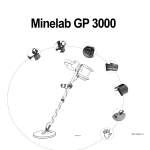
THE MINELAB ‘GP 3000’
THE MINELAB ‘GP 3000’
www.minelab.com
Mains Battery Charger
PROSPECTING TECHNIQUES
The mains battery charger will charge the battery from local mains (AC)
power outlets.
The ‘GP 3000’ has superior ground balancing and it is possible to find quite large
objects near the surface in well-worked areas where other detectors have been unable to
cope with the high degree of mineralisation and / or salt. Therefore the user should dig all
target signals, even in previously detected areas.
For Maximum Gold Recovery
Keep the coil as close to the
Listen very carefully - this is
more important than looking.
SLOW DOWN! Do not rush, take
your time.
STEP 2
Switch the mains outlet on.
Very sudden or large changes in the mineralisation of an area may
produce a signal from the detector.
Check the charger nameplate; it should be rated at 500mA
or1000mA. The 500mA charger will recharge a completely flat
battery in approximately 20 hours. The 1000mA charger will
recharge a completely flat battery in approximately 10 hours.
In the Victorian goldfields, a response may be received from a
concentration of orange/reddish dyke material or clay. In the loamy
conditions of Western Australia, a pocket of dark orange/reddish
colouration may produce a sudden signal change.
Partially discharged batteries require a shorter period to recharge.
Allow approximately 1.5 to 2 hours charging for each hour the
battery was in use if using a 500mA charger and about 0.5 to 0.75
hours for each hour usage on a 1000mA charger.
If detecting areas of extremely variable mineralisation, detecting with
the contours rather than across the changes will often stabilise the
effect.
In some ground (particularly heavily mineralised areas) the
operator may need to sweep the coil 1 or 2 cm above the ground.
This should give a more stable threshold and less ground noise.
Charcoal may sometimes produce signals, similar to a metallic
object, when close to the surface. Charcoal is usually created by
farmers burning off tree stumps or by bushfires.
6
Connect the mains charger to a mains outlet.
DETECTING
When the charcoal under the surface is disturbed, the signal will
vanish.
If in doubt, scrape away some soil above the suspect signal; if the
signal gets stronger, it is likely to be a target. Dig it!
Caution
Vehicle Battery Charger
The Vehicle Battery Charger is
The vehicle battery charger will charge the battery from the cigarette
lighter socket of most motor vehicles.
designed for use with vehicles
STEP 1
which have a negative earth
electrical system.
Most cars manufactured after 1970
should have negative earth electrical
system.
Connecting the charger to a vehicle
with a positive earth system will
cause the fuse in the cigarette lighter
plug to blow and the LED indicator
will not light.
3
BATTERIES
ground as possible.
STEP 1
Connect the charger to the cigarette lighter socket and turn
the ignition switch to Accessories.
This supplies 12v DC power to the cigarette lighter socket. This voltage
is converted by the charger to charge the detector battery. A red LED
indicator will flash while the battery is charging. When the battery is flat
the LED may flash fast enough so as to appear constantly on. As the
battery charges, the LED will flash at a slower rate.
STEP 2
Leave the battery to charge for approx. 10 hours using this charger.
If the battery voltage of your vehicle drops below 11v, the charger will
stop operating. Therefore the battery charger should not flatten the
vehicle battery.
Check that your vehicle battery is in good condition before camping
in remote areas.
Run your engine above idle speed for at least 30 minutes each day
to keep your vehicle battery charged.
15
42
PROSPECTING TECHNIQUES
BATTERIES AND CHARGING