1
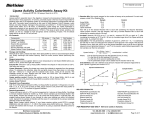
BioVision rev. 10/15 For research use only Gamma Glutamyl Transferase (GGT) Activity Fluorometric Assay Kit (Catalog #K785-100; 100 reactions; Store kit at –20oC) 4. Measurement: For AMC Standard Curve, measure the fluorescence at Ex/Em = 365/460 nm in a microplate reader. For the samples and positive controls, incubate the mix for 3 min at 37°C, then measure fluorescence at Ex/Em = 365/460 nm in a microplate reader (RFU0), incubate for another 30 min to 2 hr at 37°C to measure again (RFU1); incubation times will depend on the GGT activity in the samples. We recommend measuring the fluorescence in a kinetic method (preferably every 3 – 5 min.) and choosing the period of linear range which falls within the AMC Standard Curve to calculate the GGT activity of the samples. Introduction: The Gamma-GlutamylTransferase (GGT; EC 2.3.2.2) is an enzyme that transfers gammaglutamyl functional groups. It is found in many tissues, the most notable one being the liver, and has significance in medicine as a diagnostic marker. BioVision’s GammaGlutamylTransferase Assay Kit provides a convenient tool for sensitive detection of the GGT in a variety of samples. The GGT in sample will recognize L-γ-Glutamyl-AMC as a specific substrate leading to proportional fluorescence development. The activity of GGT can be easily quantified fluorometrically (Ex/Em = 365/460 nm). This assay detects GGT activity as low as 0.02 mIU in sample. II. 5. Calculation: Subtract 0 standard from all readings. Plot the AMC standard Curve, then calculate the GGT activity of the test samples: ∆RFU = RFU1 - RFU0, apply the ∆RFU to the AMC standard curve to get B nmol of AMC generated by GGT in the given time. Kit Contents: Components GGT Assay Buffer GGT Substrate GGT Positive Control AMC Standard (1mM) K785-100 Cap Code Part Number 25 ml 1 Bottle 1 Vial 100 μl WM NM Green Yellow K785-100-1 K785-100-2 K785-100-3 K785-100-4 Where: 2. Sample Preparations: Tissues (10 mg) or cells (1×10⁶) can be homogenized in 200 l of GGT Assay Buffer then centrifuged (13,000 x g, 10 min.) to remove insoluble material. 10-20 l serum samples can be directly added into each well. Adjust test samples and Positive Control to 50 μl/well with GGT Assay Buffer in a 96-well plate. We suggest testing several doses of your sample to make sure the readings are within the linear range of the standard curve. 𝐓×𝐕 ×Sample Dilution Factor = nmol/min/ml = mU/ml B is the AMC amount from standard Curve (in nmol) T is the time incubated (in min) V is the sample volume added into the reaction well (in ml) Unit Definition: One unit is the amount GGT to generate 1.0 μmol of AMC per min at 37°C. Note: One AMC unit is equal to 3.93 IU. III. 1. AMC Standard Curve: Dilute 10 μl of the 1 mM AMC Standard with 990 μl of GGT Assay Buffer to generate a 10 µM 6. AMC Standard Solution. Add 0, 2, 4, 6, 8, 10 l of the diluted 10 µM AMC Standard Solution into a 96-well plate in duplicate to generate 0, 20, 40, 60, 80, 100 pmol/well standard. Adjust the final volume to 100 l with GST Assay Buffer. 𝐁 GGT Positive Control and Serum Sample AMC Standard Curve 8000 15000 10 μl PC 10 μl serum BK 12500 6000 10000 RFU Storage and Handling: Store the kit at -20oC, protected from light. Allow Assay Buffer to warm to room temperature before use. Briefly centrifuge vials before opening. Read the entire protocol before performing the assay. IV. Reagent Reconstitution and General Consideration: GGT Substrate Solution: Reconstitute with 5.5 ml GGT Assay Buffer to prepare substrate solution. Avoid keeping the reconstituted substrate at room temperature for more than 1 hour and aliquot and store at -20oC after use. It is stable for up to 1 month at -20oC after reconstitution or freeze-thaw cycles (< 3 times) GGT Positive Control: Reconstitute with 1 ml dH2O. Pipette up and down several times to completely dissolve the pellet into solution (Don’t vortex). Aliquot enough GGT Positive Control (2 µl per assay) for the number of assays to be performed in each experiment and freeze immediately at -20oC for future use. The GGT Positive Control is stable for up to 1 month at -20oC after reconstitution or freeze-thaw cycles (< 5 times). Keep the GGT Positive Control on ice during the preparation. V. Gamma-GlutamylTransferase Activity Assay Protocol: GGT Activity = RFU I. 4000 y = 83.454x + 13.17 R² = 0.9997 2000 7500 5000 2500 0 0 0 20 40 60 AMC (pmol) 80 100 0 10 20 30 Time (min) VI. RELATED PRODUCTS: ADP/ATP Ratio Assay Kit Glucose Assay Kit Uric Acid Assay Kit Creatine Assay Kit Ammonia Assay Kit Triglyceride Assay Kit Nitric Oxide Assay Kit GGT Activity Colorimetric Assay Kit Ascorbic Acid Quantification Kit Fatty Acid Assay Kit Pyruvate Assay Kit Creatinine Assay Kit Free Glycerol Assay Kit Total Antioxidant Capacity (TAC) Assay Kit Glutamate Kit 3. Reaction Mix: Add 50 μl GGT Substrate Mix into each well containing the test samples and positive controls. Mix well. Do Not Add to AMC Standards. BioVision Incorporated 155 S. Milpitas Boulevard, Milpitas, CA 95035 USA Tel: 408-493-1800 | Fax: 408-493-1801 www.biovision.com | [email protected] Page 1 of 2 BioVision rev. 10/15 For research use only GENERAL TROUBLESHOOTING GUIDE: Problems Cause Solution Assay not working • Use of ice-cold assay buffer • Assay buffer must be at room temperature • Omission of a step in the protocol • Refer and follow the data sheet precisely • Plate read at incorrect wavelength • Check the wavelength in the data sheet and the filter settings of the instrument • Use of a different 96-well plate • Fluorescence: Black plates (clear bottoms) ; Luminescence: White plates ; Colorimeters: Clear plates • Use of an incompatible sample type • Refer data sheet for details about incompatible samples • Samples prepared in a different buffer • Use the assay buffer provided in the kit or refer data sheet for instructions • Cell/ tissue samples were not completely homogenized • Use Dounce homogenizer (increase the number of strokes); observe for lysis under microscope • Samples used after multiple free-thaw cycles • Aliquot and freeze samples if needed to use multiple times • Presence of interfering substance in the sample • Troubleshoot if needed • Use of old or inappropriately stored samples • Use fresh samples or store at correct temperatures until use • Improperly thawed components • Thaw all components completely and mix gently before use • Use of expired kit or improperly stored reagents • Always check the expiry date and store the components appropriately • Allowing the reagents to sit for extended times on ice • Always thaw and prepare fresh reaction mix before use • Incorrect incubation times or temperatures • Refer datasheet & verify correct incubation times and temperatures • Incorrect volumes used • Use calibrated pipettes and aliquot correctly • Use of partially thawed components • Thaw and resuspend all components before preparing the reaction mix • Pipetting errors in the standard • Avoid pipetting small volumes • Pipetting errors in the reaction mix • Prepare a master reaction mix whenever possible • Air bubbles formed in well • Pipette gently against the wall of the tubes • Standard stock is at an incorrect concentration • Always refer the dilutions in the data sheet • Calculation errors • Recheck calculations after referring the data sheet • Substituting reagents from older kits/ lots • Use fresh components from the same kit • Measured at incorrect wavelength • Check the equipment and the filter setting • Samples contain interfering substances • Troubleshoot if it interferes with the kit • Use of incompatible sample type • Refer data sheet to check if sample is compatible with the kit or optimization is needed • Sample readings above/below the linear range • Concentrate/ Dilute sample so as to be in the linear range Samples with erratic readings Lower/ Higher readings in Samples and Standards Readings do not follow a linear pattern for Standard curve Unanticipated results Note: The most probable list of causes is under each problem section. Causes/ Solutions may overlap with other problems. BioVision Incorporated 155 S. Milpitas Boulevard, Milpitas, CA 95035 USA Tel: 408-493-1800 | Fax: 408-493-1801 www.biovision.com | [email protected] Page 2 of 2