1
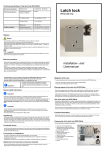
Sliding door lock 13,56 MHz installation Program the Latch lock 13,56 MHz When unpacking, check whether the components as per the description are present. Dispose of the packaging in accordance with the applicable regulations of your country. Insert battery 1. 2. 3. 4. Normally the battery compartment is already open, the cover with screws is contained in an accessory bag. Otherwise, open the battery compartment by unscrewing the two M3x6 screws. Remove the battery from the blister pack. Insert the battery into the battery compartment. Observe correct polarity. Screw on the battery case cover with the M3x6mm screws provided. The device is ready for programming. On delivery, the lock is neutral. Programming can be carried out/altered at any time, as described in the following. Standard configuration means wheater the programming card nor the transponder is programmed. The audible signal is „on“ and the mode „standard“ is activated (automatically closing of the latch). 1.) Store Super Master card (special card): press the programming button of the lock until a long signal tone starts and immediately afterwards a ticking is audible for approx. 10 seconds. During the ticking, you must hold the Super Master card against the card reader panel, until a confirmation tune is audible. TheSuper Master card is now stored. Note: When using a new Super Master card the memory will be erased (long signal). 2.) Store Group Master card (special card): hold the stored Super Master card once against the card reader panel. A ticking is audible for approx. 10 seconds. During the ticking, hold the first Group Master card against the card reader panel to read it in, until a confirmation a long signal is sounded, the ticking continues, it will now be another 4 Group Master cards stored. If no other more Group Master card is created, the ticking ends after about 10 seconds. The Grooup Master card(s) is (are) now stored. Note: Per lock can max. 5 Group Master cards are created. 3.) Store transponder: hold the stored Group Master card once against the card reader panel. A ticking is audible for approx. 10 seconds. During the ticking, hold the transponder (key fob or card) against the card reader panel to read it in, until a confirmation a long signal is sounded, the ticking continues, it will now be another transponder stored. If no other more transponder is created the ticking ends after about 10 seconds. The transponder(s) is (are) now stored. Note: Per Group Master card can max. 64 transponders are created (max. 5 x 64 = 320). 4.) Delete stored transponders individually: hold the relevant Group Master card two times on the card reader panel. A fast ticking is heard for approx. 10 seconds. During the fast ticking, hold the transponder against the card reader panel to delete it, until a confirmation signal is sounded, the ticking continues, it will now be another transponder to delete. If no other more transponder is deleted, the ticking ends after about 10 seconds. The transponder(s) is (are) deleted. Sliding door lock 13,56 MHz general survey 5.) Delete all stored transponders from a Group Master card: hold the relevant Group Master card five times on the card reader panel, until a long signal is sounded. All transponders from this Group Master card are deleted, the latch is moved into the open position. Note: All other tranponders of other Group Master cards remain stored and function. Screwing holes Programming button Spezial programming connector 6.) Delete storedGroup Master cards individually: hold the stored Super Master card two times on the card reader panel. A fast ticking is heard for approx. 10 seconds. During the fast ticking, hold the Group Master card against the card reader panel to delete it, until a confirmation signal is sounded, the ticking continues, it will now be another Group Master card to delete. If no other more Group Master card is deleted, the ticking ends after about 10 seconds. The Group Master card(s) is (are) deleted. Note: Deleting the Group Master card also deletes all tranponders of this Group Master card. 7.) Delete all stored Group Master cards: hold the stored Super Master card five times on the card reader panel, until a long signal is sounded. All Group Master cards from this lock are deleted, the latch is moved into the open position. Note: Deleting all Group Master cards also deletes all tranponders of this lock. 8.) Open the latch e.g. with Super Master card or Group Master cards and hold the latch in this position: Put the Super Master card or one of the Group Master cards 4 times on the card reader panel. The latch will hold open until a authorised transponder will reset the hold open function. Note: All saved transponders are stored, the latch is moved into the open position. Card reader panel Install sliding door lock 13,56 MHz on furniture body and door EEC Declaration of Conformity in accordance with the directives 2004/108/EC 1999/5/EC 1999 2002/96/EC 2003 2011/65/EC for the product: Important! Directive on electro-magnetic compatibility (EMC) Directive on radio equipment and telecommunications terminal equipment and the mutual recognition of their conformity (R&TTE) Directive on waste electric and electronic equipment (WEEE) Directive on the restriction of the use of certain hazardous substances in electrical and electronic equipment (recast) Sliding door lock 13,56 MHz Assembling distance ca. 20 cm Important! RFID Card reader distance LEGIC Key fob up to 15 mm LEGIC card up to 25 mm Check reading distance after assembling the sliding door lock 13,56 MHz! Note! The lock assembly of furniture and the closing part must always be mounted so that the door in the closed state has at least 0.5 mm distance. This tolerance is necessary for the emergency opening in case of the low battery. Make sure that the transponder used have a very good reading quality. There should always be a comfortable reading distance be available from the front of the cabinet of at least 5-10 mm . The mounting distance between two locks should be approx. 20 cm. There is otherwise a risk of interference of the fields of the card reading panels. That can cause discharge of the battery. The following harmonised standards are applied: EN 300330.2 V1.3.1 : 2006 EN 301489-3 V1.4.1 : 2002 EN ISO 12100: 2010 EN 50364 : 2010