1
Introduction 8
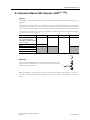
1.3 Host Interface Overview
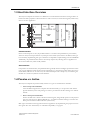
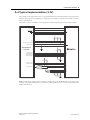
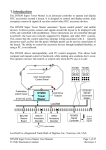
The Anybus CompactCom features two different host communication interfaces. The figure below illustrates the basic properties of these interfaces as well as various I/O and control signals, and how they
relate to the host application.
Parallel Interface
IRQ
Host
CPU
Tx
Rx
Serial Interface
GOP[0...1]
GIP[0...1]
I/O
Anybus
CPU
Network
CE
OE
R/W
Physical Interface
RAM
Communications Controller
Flash
A0 ... A13
D0 ... D7
RESET
OM[0...2]
MI[0...1]
MD[0...1]
Parallel Interface
From an external point of view, the parallel interface is a common 8 bit parallel slave port interface,
which can easily be incorporated into any microprocessor based system that has an address/data type
bus. Generally, implementing this type of interface is comparable to implementing an 8 bit wide SRAM.
Additionally, the parallel interface features an interrupt request line, allowing the host application to
service the module only when actually needed.
Serial Interface
Compared to the serial interface, the parallel interface generally offers much higher performance. However, in some applications this solution may be impractical, e.g. when the host CPU doesn’t have an external address/data bus etc. In such cases, the serial interface provides a simple way of interfacing the
module via a common asynchronous serial interface.
1.4 Passive vs. Active
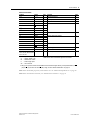
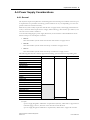
The Anybus CompactCom product family features two types of communication modules:
•
Active CompactCom Modules
Active modules integrates the complete network functionality (i.e. the protocol stack and the
physical interface) in the same package in order to provide network data exchange in a uniform
manner.
•
Passive CompactCom Modules
Passive modules uses a subset of the host interface signals, and generally operates on the physical
level of a serial signal (i.e. RS-232, RS-485 etc.), or enables serial data exchange on another medium/protocol such as USB or Ethernet (serial server).
Both types of modules can be supported in the host application by implementing the proper host interface signals. For more information, see “Module Compatibility” on page 23.
Anybus CompactCom 30 Hardware Design Guide
Doc.Rev. 2.24
Doc.Id. HMSI-168-31