1
System Operations
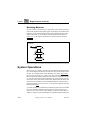
mata containing structured text. As an example consider the system operation in Example 604 that defines the Enter card operation.
Example 604: A system operation schemata for the enter card
operation ––––––––––––––––––––––––––––––––––––––––––––––––––
Operation: EnterCard
Responsibilites: Informs the system of the fact that
a card has been entered into one of the card readers
Inputs: Card identificatio Card reader
identification
Returns: Enter code’ is displayed
Modified objects: A ‘card’ object,a ‘card reader’
object
Preconditions: The door must be closed
Postconditions: The card identification is stored in
a ‘card’ object associated with the ‘cardReader’
object with an id equal to the card reader
identification that was an input to the operation
––––––––––––––––––––––––––––––––––––––––––––––––––––––––––
The different rows in the schemata has the following meaning:
•
Operation: The name of the system operation (equal to the name of
the event that it handles).
•
Responsibilities: A short description of the operation.
•
Inputs: The data that is supplied as parameters.
•
Returns: The events that are returned to the outside of the system as
a result of the operation.
•
Modified objects: The internal objects that are changed by the operation.
•
Preconditions: Predicates that define when definition of the operation given in this schemata is valid.
•
Postconditions: The postconditions for the operation define how the
state of the system has changed due to the execution of the operation.
Note that in general more than one schemata is needed for each system
operation: one schemata is needed for each possible variant of the preconditions.
The criteria for choosing to use the system operations in addition to the
use cases are based on the estimated complexity of the opera-
July 2003
Telelogic Tau 4.5 User’s Manual
,um-st1
3717