1
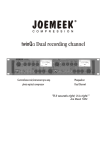
VC1QCS Studio Channel - User's guide
Best results are achieved by using a quality condenser microphone, such
as the JOEMEEK JM47 or even tube based TB-47. A new design of
phantom power system assures adequate power for any 48V phantom
microphone.
Dynamic or ribbon microphones should be used with the phantom power
turned off, then full advantage can be taken of the extreme low noise
performance of this amplifier.
ALWAYS be sure that there is a microphone plugged into the input of the
VC1Q before turning up the input gain. Where this is a capacitor
microphone, be sure that the phantom power is turned on. The Joemeek
VC1Q is capable of very high gain, very much more than most microphone
preamplifiers. While this is essential for professional use, it means that if
not set up correctly, the VC1Q could appear to be noisy. ALWAYS adjust
the input control to make sure that the high levels of sound expected
through the unit make the VU meter indicate well into the red region. This
operation is quite normal as the overload margin of the VC1Q is very high.
(once the VU meter is reading +3, there is a further 22dB available before
distortion takes place). Similarly, remember that the output level from the
VC1Q can be very high, so keep the gain settings of following equipment
set low. - This also applies to monitoring settings.
PHASE SHIFT and QUALITY
It's Fletcher Company theory that 'big' sounds are only possible if the
recording channel keeps the response and phase of the lower frequencies
flat and under control. To achieve this, the JOEMEEK Studio Channel has
an extended frequency range down below 10Hz. This ensures that there
are no sudden phase shifts in the low end. The proof of the theory is that
the sound from the Studio Channel is characteristically full bodied and
rounded in character. Such extreme LF response can often bring its own
problems, so a 'subsonic' (High Pass) filter can be switched in with a front
panel push-button.
OVERLOAD MARGINS.
In the mid 1970s Ted Fletcher designed a range of mixers specifically for
use by the Independent Broadcasting Authority and the BBC. One of the
specification clauses insisted on by them was an extreme overload margin
in the microphone amplifier.
The reason for this additional margin was that although momentary
4