1
Application Notes
2.6
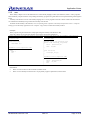
#pragma STRUCT
M16C-family compilers can prohibit structure packing using #pragma STRUCT, and perform sorting for structure members.
Since RX-family compilers lack the corresponding functionality, programs using #pragma STRUCT need special handling when
migrated to RX.
(1)
Prohibiting structure packing
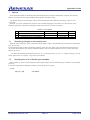
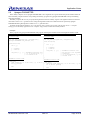
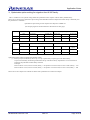
By default, M16C-family compilers place structure members with alignment 1. This means that the structure size may be an odd
number of bytes. To make the structure size an even number of bytes, specify #pragma STRUCT unpack. If this specification causes
the structure size to be an odd number of bytes, 1 byte of padding is inserted to bring the structure size to an even number of bytes.
One of the following needs to be performed to achieve the same effect for RX-family compilers.
• Specify #pragma pack to set the structure alignment to 1.
• If setting the alignment to 1 causes the structure size to be an odd number of bytes, have users enter a 1-byte dummy member
for adjustment.
In addition to specifying #pragma pack, specifying the “pack” option is another way to set structure alignment to 1 on RX-family
compilers. For details about this functionality, see 2.4 Placement of structure members.
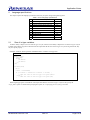
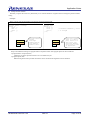
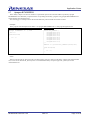
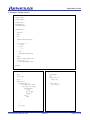
Example:
M16C program with #pragma STRUCT unpack and program migrated to RX
Source code with #pragma STRUCT unpack specified
RX source code
#pragma STRUCT s unpack
struct s {
short i;
char c;
short j;
} ss;
#pragma pack
struct s {
short i;
char c;
short j;
char dmy;
// To get a size with an even number
// of bytes a 1-byte dummy member
// is inserted
} ss;
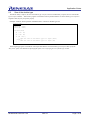
i
c
j
#pragma STRUCT
adds 1 byte of
padding.
The structure
size is 6 bytes.
i
c
dmy
free
REJ06J0078-0100 /Rev.1.00
j
2009.10
Since the alignment
count is 1 due to
pack, there is no
free space. The
structure size is 6
bytes due to
explicitly
inserted members.
Page 12 of 20