
1
SAFETY PRECAUTIONS
• Read this user’s manual to make sure of correct operation before starting installation, wiring, operation, maintenance, and
inspection of the MICRO3C.
• All MICRO3C’s are manufactured under IDEC’s rigorous quality control system, but users must add a backup or failsafe
provision to the control system using the MICRO3C in applications where heavy damage or personal injury may be caused in
case the MICRO3C should fail.
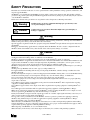
• In this user’s manual, safety precautions are categorized in order of importance to Warning and Caution:
Warning
Warning notices are used to emphasize that improper operation may cause
severe personal injury or death.
Caution
Caution notices are used where inattention might cause personal injury or
damage to equipment.
Warning
• Turn power off to the MICRO3C before starting installation, removal, wiring, maintenance, and inspection on the MICRO3C.
Failure to turn power off may cause electrical shocks or fire hazard.
• Special expertise is required to install, wire, program, and operate the MICRO3C. People without such expertise must not use
the MICRO3C.
• Emergency and interlocking circuits must be configured outside the MICRO3C. If such a circuit is configured inside the
MICRO3C, failure of the MICRO3C may cause disorder of the control system, damage, or accidents.
Caution
• Install the MICRO3C according to instructions described in this user’s manual and the MICRO3 user’s manual. Improper
installation will result in falling, failure, or malfunction of the MICRO3C.
• MICRO3C is designed for installation in equipment. Do not install the MICRO3C outside of equipment.
• Install the MICRO3C in environments described in this user’s manual and the MICRO3 user’s manual. If the MICRO3C is used
in places where the MICRO3C is subjected to high-temperature, high-humidity, condensation, corrosive gases, excessive
vibrations, and excessive shocks, then electrical shocks, fire hazard, or malfunction will result.
• MICRO3C is designed for use in “Pollution degree 2.” Use the MICRO3C in environments of pollution degree 2 (according to
IEC664-1).
• All DC power type MICRO3C units are “PS2” type (according to EN61131).
• Prevent the MICRO3C from falling while moving or transporting the MICRO3C, otherwise damage or malfunction of the
MICRO3C will result.
• Prevent metal fragments and pieces of wire from dropping inside the MICRO3C housing. Put a cover on the MICRO3C during
installation and wiring. Ingress of such fragments and chips may cause fire hazard, damage, or malfunction.
• Use a power supply of the rated value. Use of a wrong power supply may cause fire hazard.
• Use wires of a proper size to meet voltage and current requirements. Tighten M3 terminal screws to a proper tightening
torque of 0.3 to 0.5 N-m.
• Use an IEC127-approved fuse (2A maximum) on the power line outside the MICRO3C. This is required when exporting
equipment containing MICRO3C to Europe.
• Use an IEC127-approved fuse on the output circuit. This is required when exporting equipment containing MICRO3C to
Europe.
• Use an EU-approved circuit breaker. This is required when exporting equipment containing MICRO3C to Europe.
• Make sure of safety before starting and stopping the MICRO3C or when operating the MICRO3C to force outputs on or off.
Incorrect operation on the MICRO3C may cause machine damage or accidents.
• If relays in the MICRO3C output circuit fail, outputs may remain on or off. For output signals which may cause heavy accidents, provide a monitor circuit outside of the MICRO3C.
• Do not connect to the ground directly from the MICRO3C. Connect a protective ground to the equipment containing
MICRO3C using an M4 or larger screw. This is required when exporting equipment containing MICRO3C to Europe.
• Do not disassemble, repair, or modify the MICRO3C.
• When the battery in the MICRO3C is dead, dispose of the battery in accordance with pertaining regulations. When taking
back the dead battery to the store or disposing of the dead battery, use a proper container installed for that purpose. This is
required when exporting equipment containing MICRO3C to Europe.
• When disposing of the MICRO3C, do so as an industrial waste.
• When the battery in the memory card is dead, dispose of the battery in accordance with pertaining regulations.
USER’S MANUAL
PREFACE-1




























![DGID Software [EN]](http://vs1.manualzilla.com/store/data/005717670_1-65b44a14cec330296683d17d94da3fca-150x150.png)