1
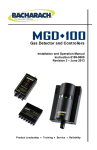
MGD-100 Manual
IMPORTANT: Before testing the sensors on-site, the MGD100 must have been powered up and allowed to stabilize for
at least 24 hours. See Section 5.
IMPORTANT:
Failure to test or calibrate the unit in
accordance with applicable instructions and with industry
guidelines may result in serious injury or death. The
manufacturer is not liable for any loss, injury, or damage
arising from improper testing, incorrect calibration, or
inappropriate use of the unit.
IMPORTANT: Bacharach recommends annual checks and
Bacharach also recommends sensor
gas calibration.
replacement every 3 years or as required. Calibration
frequency may be extended based on application, but should
never exceed 2 years.
IMPORTANT: In applications where life safety is critical,
calibration should be done quarterly (every 3 months) or on a
more frequent basis. Bacharach is not responsible for setting
safety practices and policies. Safe work procedures including
calibration policies are best determined by company policy,
industry standards, and local codes.
NOTE: For improved accuracy and response, the instrument
should be zeroed and calibrated in the environment in which
it is being installed.
There are two concepts that need to be differentiated:
Bump Test
Exposing the sensor to a gas and observing its response
to the gas. The objective is to establish if the sensor is
reacting to the gas and all the sensor outputs are working
correctly. There are two types of bump test.
• Quantified: A known concentration of gas is used.
• Non-Quantified: A gas of unknown concentration is
used.
Calibration
Exposing the sensor to a calibration gas, setting the “zero”
or “Standby voltage”, the span/range, and checking/
adjusting all the outputs, to ensure that they are activated
at the specified gas concentration.
6109-9000 Rev 4
33