1
UM1798
User manual
Audio engine post-processing on STM32F4xx
Graphical Equalizer library
Introduction
This document reviews the software interface and requirements of the Graphic Equalizer
(GrEQ) module.
All necessary interface functions, parameters, integration constraints for the programmer to
integrate the GrEQ library (STM32-AUDIO100A) into his own software are described in this
document.
The GrEQ library is designed to run on an ARM® Cortex®-M4 core without FPU usage, so it
can be integrated and run on all the STM32F40xxx, STM32F41xxx, STM32F42xxx or
STM32F43xxx products.
September 2014
DocID026640 Rev 1
1/19
www.st.com
Contents
UM1798
Contents
1
2
Module overview . . . . . . . . . . . . . . . . . . . . . . . . . . . . . . . . . . . . . . . . . . . . 5
1.1
Algorithm functionality . . . . . . . . . . . . . . . . . . . . . . . . . . . . . . . . . . . . . . . . 5
1.2
Module configuration . . . . . . . . . . . . . . . . . . . . . . . . . . . . . . . . . . . . . . . . . 5
1.3
Resources summary . . . . . . . . . . . . . . . . . . . . . . . . . . . . . . . . . . . . . . . . . 5
Module interfaces . . . . . . . . . . . . . . . . . . . . . . . . . . . . . . . . . . . . . . . . . . . 6
2.1
2.2
3
APIs . . . . . . . . . . . . . . . . . . . . . . . . . . . . . . . . . . . . . . . . . . . . . . . . . . . . . . 6
2.1.1
Function greq_reset . . . . . . . . . . . . . . . . . . . . . . . . . . . . . . . . . . . . . . . . . 6
2.1.2
Function greq_setParam . . . . . . . . . . . . . . . . . . . . . . . . . . . . . . . . . . . . . 6
2.1.3
Function greq_getParam . . . . . . . . . . . . . . . . . . . . . . . . . . . . . . . . . . . . . 7
2.1.4
Function greq_setConfig . . . . . . . . . . . . . . . . . . . . . . . . . . . . . . . . . . . . . 7
2.1.5
Function greq_getConfig . . . . . . . . . . . . . . . . . . . . . . . . . . . . . . . . . . . . . 8
2.1.6
Function greq_process . . . . . . . . . . . . . . . . . . . . . . . . . . . . . . . . . . . . . . 8
External definitions and types . . . . . . . . . . . . . . . . . . . . . . . . . . . . . . . . . . 8
2.2.1
Input and output buffers . . . . . . . . . . . . . . . . . . . . . . . . . . . . . . . . . . . . . . 8
2.2.2
Returned error values . . . . . . . . . . . . . . . . . . . . . . . . . . . . . . . . . . . . . . . 9
2.3
Static parameters structure . . . . . . . . . . . . . . . . . . . . . . . . . . . . . . . . . . . 10
2.4
Dynamic parameters structure . . . . . . . . . . . . . . . . . . . . . . . . . . . . . . . . . 10
Algorithm description . . . . . . . . . . . . . . . . . . . . . . . . . . . . . . . . . . . . . . . 11
3.1
Processing steps . . . . . . . . . . . . . . . . . . . . . . . . . . . . . . . . . . . . . . . . . . . .11
3.2
Data formats . . . . . . . . . . . . . . . . . . . . . . . . . . . . . . . . . . . . . . . . . . . . . . . .11
3.2.1
4
Preset frequency responses . . . . . . . . . . . . . . . . . . . . . . . . . . . . . . . . . 11
Application Description . . . . . . . . . . . . . . . . . . . . . . . . . . . . . . . . . . . . . 15
4.1
Recommendations for Optimal Setup . . . . . . . . . . . . . . . . . . . . . . . . . . . 15
4.1.1
Memory allocation . . . . . . . . . . . . . . . . . . . . . . . . . . . . . . . . . . . . . . . . . 15
4.1.2
Module APIs calls . . . . . . . . . . . . . . . . . . . . . . . . . . . . . . . . . . . . . . . . . 15
5
How to tune and run the application . . . . . . . . . . . . . . . . . . . . . . . . . . . 17
6
Revision history . . . . . . . . . . . . . . . . . . . . . . . . . . . . . . . . . . . . . . . . . . . 18
2/19
DocID026640 Rev 1
UM1798
List of tables
List of tables
Table 1.
Table 2.
Table 3.
Table 4.
Table 5.
Table 6.
Table 7.
Table 8.
Table 9.
Table 10.
Table 11.
Table 12.
Table 13.
Summary of resources . . . . . . . . . . . . . . . . . . . . . . . . . . . . . . . . . . . . . . . . . . . . . . . . . . . . . 5
Parameters for function greq_reset . . . . . . . . . . . . . . . . . . . . . . . . . . . . . . . . . . . . . . . . . . . 6
Parameters for function greq_setParam . . . . . . . . . . . . . . . . . . . . . . . . . . . . . . . . . . . . . . . . 6
Parameters for function greq_getParam. . . . . . . . . . . . . . . . . . . . . . . . . . . . . . . . . . . . . . . . 7
Parameters for function greq_setConfig . . . . . . . . . . . . . . . . . . . . . . . . . . . . . . . . . . . . . . . . 7
Parameters for function greq_getConfig . . . . . . . . . . . . . . . . . . . . . . . . . . . . . . . . . . . . . . . . 8
Parameters for function greq_process . . . . . . . . . . . . . . . . . . . . . . . . . . . . . . . . . . . . . . . . . 8
Input and output buffers . . . . . . . . . . . . . . . . . . . . . . . . . . . . . . . . . . . . . . . . . . . . . . . . . . . . 9
Error values . . . . . . . . . . . . . . . . . . . . . . . . . . . . . . . . . . . . . . . . . . . . . . . . . . . . . . . . . . . . . 9
nb_bands parameter. . . . . . . . . . . . . . . . . . . . . . . . . . . . . . . . . . . . . . . . . . . . . . . . . . . . . . 10
Dynamic parameters. . . . . . . . . . . . . . . . . . . . . . . . . . . . . . . . . . . . . . . . . . . . . . . . . . . . . . 10
Frequency responses for different presets . . . . . . . . . . . . . . . . . . . . . . . . . . . . . . . . . . . . . 11
Document revision history . . . . . . . . . . . . . . . . . . . . . . . . . . . . . . . . . . . . . . . . . . . . . . . . . 18
DocID026640 Rev 1
3/19
3
List of figures
UM1798
List of figures
Figure 1.
Figure 2.
Figure 3.
Figure 4.
Figure 5.
Figure 6.
Figure 7.
4/19
Frequency response for Pop music . . . . . . . . . . . . . . . . . . . . . . . . . . . . . . . . . . . . . . . . . . 12
Frequency response for Jazz music . . . . . . . . . . . . . . . . . . . . . . . . . . . . . . . . . . . . . . . . . . 12
Frequency response for Rock music . . . . . . . . . . . . . . . . . . . . . . . . . . . . . . . . . . . . . . . . . 13
Frequency response for Vocal music . . . . . . . . . . . . . . . . . . . . . . . . . . . . . . . . . . . . . . . . . 13
Frequency response for Classical music . . . . . . . . . . . . . . . . . . . . . . . . . . . . . . . . . . . . . . 14
Frequency response for Hip Hop music . . . . . . . . . . . . . . . . . . . . . . . . . . . . . . . . . . . . . . . 14
Sequence of APIs . . . . . . . . . . . . . . . . . . . . . . . . . . . . . . . . . . . . . . . . . . . . . . . . . . . . . . . . 16
DocID026640 Rev 1
UM1798
Module overview
1
Module overview
1.1
Algorithm functionality
The GraphicEQualizer (GrEQ) module is in charge of fine tuning the sound spectrum
according to user personal preferences. This is done by modifying gain factors at fixed
frequencies represented by sliders.
The number of bands is determined at the initialization phase and can be 5, 8 or 10. The
gain factors are adjustable from -12dB to +12dB in standard mode. The library can be
generated with different maximum gains (+18dB, +24dB).
The current implementation uses 32 bits resolution for all computations, and can be used
with both 16 and 32 bits input/output format.
1.2
Module configuration
GrEQ module supports Mono and Stereo interleaved 16 or 32 bits I/O data, with a maximum
input frame size of 480 stereo samples. This limitation corresponds to 10ms scheduling at
48 kHz sampling frequency.
1.3
Resources summary
Table 1 contains CPU, Flash, Stack and RAM requirements. The core MHz value is an
estimation based on IAR systems® v6.50 simulation profiling.
Table 1. Summary of resources
Flash code
(.text)
Flash data
(.rodata)
Stack
-
-
-
-
-
Stereo/interleaved, 48 kHz
4344 Bytes
8 Bytes
92 Bytes
548 Bytes
3840 Bytes
14.5 MHz
Static RAM Dynamic RAM
DocID026640 Rev 1
CPU frequency
5/19
18
Module interfaces
2
UM1798
Module interfaces
Two files are needed to integrate the GrEQ module. lib_greq_m4.a library supports 16 bits
I/O data, while lib_greq_m4_32b.a library supports 32 bits I/O data. greq_glo.h header file
contains all definitions and structures to be exported to the application SW.
Note also that audio_fw_glo.h file is a generic header file common to all audio modules and
must be included in the audio framework.
2.1
APIs
Six generic functions have a software interface to the main program, they allow the
developer to initialize, reset, set or get parameters and process audio buffers.
2.1.1
Function greq_reset
This procedure initializes the static memory of the Graphical Equalizer module, and
initializes static parameters with default values.
int32_t greq_reset(void *static_mem_ptr, void *dynamic_mem_ptr);
Table 2. Parameters for function greq_reset
I/O
Name
Type
Input
static_mem_ptr
void *
Pointer to internal static memory
Input
dynamic_mem_ptr
void *
Pointer to internal dynamic memory
-
int32_t
Error value
Returned value
Description
This routine must be called at least once at initialization time, when the real time processing
has not yet started.
2.1.2
Function greq_setParam
This procedure writes module’s static parameters from the main framework to the module
internal memory. It can be called after reset routine and before real time processing start. It
handles static parameters (i.e. the parameter values cannot be changed during the module
processing).
int32_t greq_setParam(greq_static_param_t *input_static_param_ptr, void
*static_mem_ptr);
Table 3. Parameters for function greq_setParam
I/O
Input
Input
Returned
value
6/19
Name
Type
Description
input_static_param_ptr greq_static_param_t* Pointer to static parameters structure
static_mem_ptr
void *
Pointer to internal static memory
-
int32_t
Error value
DocID026640 Rev 1
UM1798
2.1.3
Module interfaces
Function greq_getParam
This procedure gets the module’s static parameters from the module’s internal memory to
main framework.
It can be called after reset routine and before real time processing started. It handles static
parameters (i.e. the parameter values that cannot be changed during module processing).
int32_t greq_setParam(greq_static_param_t *input_static_param_ptr, void
*static_mem_ptr);
Table 4. Parameters for function greq_getParam
I/O
Input
Input
Returned
value
2.1.4
Name
Type
Description
input_static_param_ptr greq_static_param_t* Pointer to static parameters structure
static_mem_ptr
void *
Pointer to internal static memory
-
int32_t
Error value
Function greq_setConfig
This procedure sets module dynamic parameters from main framework to module internal
memory.
It can be called at any time during processing.
int32_t greq_setConfig( greq_dynamic_param_t *input_dynamic_param_ptr, void
*static_mem_ptr);
Table 5. Parameters for function greq_setConfig
I/O
Input
Input
Returned
value
Name
Type
input_dynamic_param_ptr greq_dynamic_param_t*
Description
Pointer to dynamic parameters
structure
static_mem_ptr
void *
Pointer to internal static memory
-
int32_t
Error value
DocID026640 Rev 1
7/19
18
Module interfaces
2.1.5
UM1798
Function greq_getConfig
This procedure gets the module dynamic parameters from internal static memory to the
main framework.
It can be called at any time during processing.
int32_t greq_getConfig(greq_dynamic_param_t *input_dynamic_param_ptr, void
*static_mem_ptr);
Table 6. Parameters for function greq_getConfig
I/O
Name
Input
Description
input_dynamic_param_ptr greq_dynamic_param_t*
Input
Returned
value
2.1.6
Type
Pointer to dynamic parameters
structure
static_mem_ptr
void *
Pointer to internal static memory
-
int32_t
Error value
Function greq_process
This procedure is the module’s main processing routine.
It should be called at any time, to process each frame.
int32_t greq_process(buffer_t *input_buffer, buffer_t *output_buffer, void
*static_mem_ptr);
Table 7. Parameters for function greq_process
I/O
Input
Output
Input
Name
Type
input_buffer
buffer_t*
Pointer to input buffer structure
output_buffer
buffer_t
Pointer to output buffer structure
static_mem_ptr
void *
Pointer to internal static memory
-
int32_t
Error value
Output
Description
This routine can run in place, meaning that the same buffer can be used for input and
output.
2.2
External definitions and types
2.2.1
Input and output buffers
The GrEQ library uses extended I/O buffers, which contain, in addition to the samples, some
useful information on the stream, such as the number of channels, the number of bytes per
sample and the interleaving mode.
8/19
DocID026640 Rev 1
UM1798
Module interfaces
An I/O buffer structure type, as described below, must be respected each time before calling
the processing routine; else, errors will be returned:
typedef struct {
int32_t
nb_channels;
int32_t
nb_bytes_per_Sample;
void
*data_ptr;
int32_t
buffer_size;
int32_t
mode;
} buffer_t;
Table 8. Input and output buffers
Name
Type
nb_channels
int32_t
Number of channels in data:
1 for mono, 2 for stereo, 4 for 3.1 multichannel,...
nb_bytes_per_Sample
int32_t
Dynamic of data in number of bytes:
16 bits = 2, 24 bits = 3, 32 bits = 4
data_ptr
void *
Pointer to data buffer (must be allocated by the main framework)
buffer_size
int32_t
Number of samples per channel in the data buffer
mode
int32_t
In case of stereo stream, left and right channels can be interleaved:
0 = not interleaved, 1 = interleaved.
2.2.2
Description
Returned error values
Table 9 lists possible returned error values:
Table 9. Error values
Definition
Value
Description
GREQ_ERROR_NONE
0
No error
GREQ_UNSUPPORTED_NB OF BYTEPERSAMPLES
-1
Input data is not 16 bit sample format
GREQ_UNSUPPORTED_NB_CHANNELS
-2
Input data is neither mono nor stereo
GREQ_UNSUPPORTED_NB_OF_BANDS
-3
Number of bands not supported
GREQ_UNSUPPORTED_GAIN_PRESET
-4
Gain preset index not supported
GREQ_UNSUPPORTED_INTERLEAVING_MODE
-5
Input data is stereo / not interleaved
GREQ_UNSUPPORTED_FRAME_SIZE
-6
Frame size not supported
GREQ_UNSUPPORTED_GAIN
-7
Gain not supported
GREQ_BAD_HW
-8
Unsupported HW for the library
DocID026640 Rev 1
9/19
18
Module interfaces
2.3
UM1798
Static parameters structure
The GrEQ initial parameters are set using the corresponding static parameter structure
before calling the greq_setParam() function.
struct greq_static_param {
int16_t
nb_bands;
}
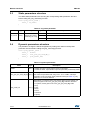
Table 10. nb_bands parameter
Name
nb_bands
2.4
Type
Description
int16_t
Defines the number
of bands (5, 8 or 10)
nb_bands
Center frequencies
5
125, 400, 1278, 4088, 13074
8
100, 203, 412, 837, 1698, 3447, 6998, 14206
10
62, 115, 214, 399, 742, 1380, 2567, 4775, 8882, 16520
Dynamic parameters structure
It is possible to change the GrEQ configuration by setting new values in the dynamic
parameter structure before calling the greq_setConfig() function.
struct greq_dynamic_param {
int16_t
enable;
int16_t
user_gain_per_band_dB[];
int16_t
gain_preset_idx;
}
Table 11. Dynamic parameters
Name
enable
Type
Description
int16_t
0: disable the effect, output buffer is equal to input buffer
1: enable the effect, output buffer is equal to input buffer processed by GrEQ
Sets the gain for each band.
The values are specified in dB, and go from -12 to +12dB in 1dB steps.
user_gain_per_band_dB[10] int16_t
Depending on the “nb_bands” static parameter value (see Table 10), only
values 5, 8 or 10 can be selected.
gain_preset_idx
10/19
GrEQ library is configured with 6 gain presets. When the user selects one
preset, the gains in the “user_gain_per_band_dB[]” table are discarded.
0: no preset, use the gains in the “user_gain_per_band_dB[]” table
1: Pop
int16_t 2: Jazz
3: Rock
4: Vocal
5: Classical
6: HipHop
DocID026640 Rev 1
UM1798
Algorithm description
3
Algorithm description
3.1
Processing steps
The GrEQ algorithm is based on the parallelization of band-pass filters (BPFs).
The BPFs are characterized by their center frequencies and Q factor. Depending on the
number of bands (5, 8 or 10), the center frequencies and Q factor are set so that BPFs
cover the audible spectrum, with each center frequency equally spaced on a logarithmic
scale.
The GrEQ embeds a special processing which reduce drastically the neighboring effect of a
band on the others. Each band gain can thus be set quasi-independently from the others.
Each BPF is implemented using an optimized bi-quadratic structure, using 32 bits
coefficients.
3.2
Data formats
Input of GrEQ module is expected to be an audio stream, stereo/interleaved, in 16 or 32 bits
format. All operations are done with 32 bits resolution. The output format is an audio stream,
stereo/interleaved signal in 16 or 32 bits format.
3.2.1
Preset frequency responses
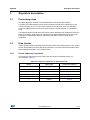
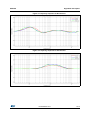
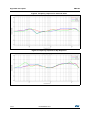
The frequency responses for each music style are shown in dedicated figures, as
summarized in Table 12.
Table 12. Frequency responses for different presets
Preset
Music style
Frequency response
1
Pop
Figure 1
2
Jazz
Figure 2
3
Rock
Figure 3
4
Vocal
Figure 4
5
Classical
Figure 5
6
HipHop
Figure 6
.
DocID026640 Rev 1
11/19
18
Algorithm description
UM1798
Figure 1. Frequency response for Pop music
Figure 2. Frequency response for Jazz music
12/19
DocID026640 Rev 1
UM1798
Algorithm description
Figure 3. Frequency response for Rock music
Figure 4. Frequency response for Vocal music
DocID026640 Rev 1
13/19
18
Algorithm description
UM1798
Figure 5. Frequency response for Classical music
Figure 6. Frequency response for Hip Hop music
14/19
DocID026640 Rev 1
UM1798
Application Description
4
Application Description
4.1
Recommendations for Optimal Setup
The GrEQ module can be executed at any place in an audio processing chain (because it
applies a linear algorithm, there is no restriction on the order of execution).
However, care should be taken in the gain distribution all over the processing chain, as the
GrEQ applies pre-attenuation. At the input of the GrEQ, some margin is taken in order to
avoid any saturation when the user is setting positive gains. The default available library is
generated with a maximum gain of 12dB, as a consequence 2 bits of guard are taken.
4.1.1
Memory allocation
The static and dynamic parameters structures must be allocated. Their types are defined in
greq_glo.h header. Example of allocation:
/* parameters structure memory allocation */
greq_static_param_t *static_param_ptr = malloc(sizeof(greq_static_param_t)));
greq_dynamic_param_t *dynamic_param_ptr = malloc(sizeof(greq_dynamic_param_t)));
The static and dynamic memory pointer must be allocated too. The size of each is defined in
greq_glo.h header. Example of allocation:
/* memory structure memory allocation */
void *static_mem_ptr = malloc(greq_static_mem_size);
void *dynamic_mem_ptr = malloc(greq_dynamic_mem_size);
It is then needed to allocate the memory for input and output audio buffers.
4.1.2
Module APIs calls
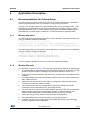
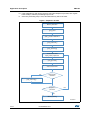
The sequence is shown in Figure 7, and each step is described in detail in the following list:
1.
As explained above, GrEQ static and dynamic structures have to be allocated, as well
as input and output buffer accordingly to the structures defined in Section 2.2.1.
2.
Once memory has been allocated, the call to greq_reset() function will initialize internal
variables.
3.
The GrEQ configuration for the desired filter response can now be set by initializing the
static_param structure.
4.
Calling the greq_setParam() function will then configure the GrEQ internal memory
according to the desired number of bands.
5.
Then the gains per band or the preset can be changed by setting the dynamic
parameters structure and calling greq_setConfig() function.
6.
The audio stream is read from the proper interface and input_buffer structure has to be
filled according to the stream characteristics (number of channels, sample rate,
interleaving and data pointer). Output buffer structure has to be set as well.
7.
Calling the greq_process() function will execute the GrEQ algorithm.
8.
The output audio stream can now be written in the proper interface.
9.
If needed, the user can set new dynamic parameters and call the greq_setConfig()
function to update module configuration.
DocID026640 Rev 1
15/19
18
Application Description
UM1798
10. If the application is still running and has new input samples to proceed, then it goes
back to step 6, else the processing loop is over.
11. Once the processing loop is over, allocated memory has to be freed.
Figure 7. Sequence of APIs
<HV
0HPRU\DOORFDWLRQ
JUHTBUHVHW
VWDWLFBSDUDPLQL]LDOL]DWLRQ
JUHTBVHW3DUDP
JUHTBVHW&RQILJ
$XGLRVWUHDPUHDG
LQSXWBEXIIHUSUHSDUDWLRQ
JUHTBSURFHVV
$XGLRVWUHDPZULWH
1HZ&RQILJ
QHHGHG"
1R
JUHTBVHW&RQILJ
6DPSOHVWR
SURFHHG"
<HV
1R
0HPRU\IUHHLQJ
069
16/19
DocID026640 Rev 1
UM1798
5
How to tune and run the application
How to tune and run the application
The STM32 audio framework provides an example application for the GrEQ library. It uses
the library with 10 bands, and typically implements 10 sliders which allow gain adjustment
for each band. It also proposes a list-box for selecting one of the six presets.
Tuning of the GrEQ depends entirely on the loudspeaker, user preference and music style.
There is no real recommendation for tuning.
DocID026640 Rev 1
17/19
18
Revision history
6
UM1798
Revision history
Table 13. Document revision history
18/19
Date
Revision
30-Sep-2014
1
Changes
Initial release.
DocID026640 Rev 1
UM1798
IMPORTANT NOTICE – PLEASE READ CAREFULLY
STMicroelectronics NV and its subsidiaries (“ST”) reserve the right to make changes, corrections, enhancements, modifications, and
improvements to ST products and/or to this document at any time without notice. Purchasers should obtain the latest relevant information on
ST products before placing orders. ST products are sold pursuant to ST’s terms and conditions of sale in place at the time of order
acknowledgement.
Purchasers are solely responsible for the choice, selection, and use of ST products and ST assumes no liability for application assistance or
the design of Purchasers’ products.
No license, express or implied, to any intellectual property right is granted by ST herein.
Resale of ST products with provisions different from the information set forth herein shall void any warranty granted by ST for such product.
ST and the ST logo are trademarks of ST. All other product or service names are the property of their respective owners.
Information in this document supersedes and replaces information previously supplied in any prior versions of this document.
© 2014 STMicroelectronics – All rights reserved
DocID026640 Rev 1
19/19
19