1
Initial Suitability Inspection Manual (Web) July 2015
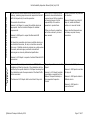
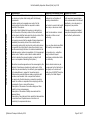
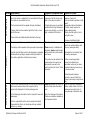
Each passenger requires their own seating position.
A minimum seat squab width of 400mm shall be required
for each seating position.
Passenger seats shall be firmly and securely fixed in position
when available for use.
Seating Positions
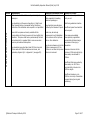
The maximum passenger carrying capacity is 8 passengers.
A seating position fitted with a safety belt shall be counted
as one seating position. For bench seats without safety belts
then the number of seating positions shall be assessed as
multiples of the required minimum squab width of 400mm
each. For example a bench seat (with no seat belts) of
1500mm squab width shall be assessed as providing three
seating positions.
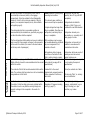
Seats, seatbelts and anchorages cannot be simply
added/changed without some certifying proof. A
“converted” seat or seat mechanism is unlikely to be
accepted unless the presenter provides some proof of being
fit for purpose. A swivel seat is required to meet the
relevant standards.
Assess seating positions as
outlined in “Requirements.
For some the Vehicle Registration
Certificate data will indicate the
original seating capacity inc.
driver and vehicle classification
(e.g. goods vehicle) which will
help identify a modified vehicle.
If doubt exists then the vehicle
presenter will need to provide the
associated proof/information.
Box S1 in the Vehicle Registration
Certificate details the total
number of seats including the
driver’s seat.
The intent is clear: a maximum
capability of seating 8 passengers
is not to be exceeded.
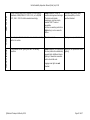
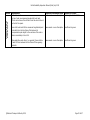
Insufficient seat width.
Insecure passenger seat(s)
Excess of seating positions
compared to that stated in Vehicle
Registration Certificate.
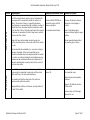
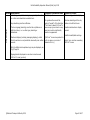
Seating layout such that possible
number of seating positions
exceeds 8 when assessed as
described. E.g. a long bench seat
that has more than 8 seat belts,
or whose size allows for more
than 8 multiples of 400mm.
Method of deletion of a seating
space to prevent occupation is
obviously temporary in nature or
of potential danger to passengers
(e.g. armrest secured by Velcro,
exposed sharp edges, lack of
padding).
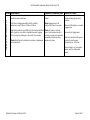
A Technical Assessor's full Report is required in all cases
where seats, seat belts or anchorages are not original
fitment, e.g. vehicles adapted from vans. See also “Modified
vehicle Documentary Proof” at the start of this Section.
© National Transport Authority 2015.
Page 15 of 57