1
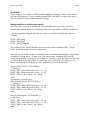
Arbiter Users Guide page 33 The first entry in each line is the index number assigned to that constant or integer. The userreadable (UR) values of each index number can be deduced by looking at the order in which the
relevant constants are defined in the structure and/or topology files. Index numbers are assigned
in the order variable names are declared, so for instance if the integers are declared as:
nx
ny
nxLCS
jrmj1
jrmj2
nxmis
nevs
then the index 1 corresponds to nx, 2 corresponds to ny, and so forth.
The second entry in each line is the actual value assigned to that scalar. In the case of constants,
each entry will be a complex number with its components in parentheses.
Functions/Integerarrays
These sections report the values assigned to functions or integer arrays.
The first line of each data block contains two integers. The first is the index number assigned to
that particular function. Index numbers are assigned on the basis of the order in which variable
names are declared, as with integers/constants. The second is the index number of the domain
that the function is defined on.
The remainder of each block contains the actual data. Each line contains the number of the cell
that the number applies to (these are typically sequential) followed by the data value.
Bricks/Domains
These sections contain all of the data generated when defining a brick or domain. These are by
far the most complicated sections of the OG file, so some explanation is needed.
As with most other sections, the first entry in each data block is the index number assigned to the
specific brick or domain. As with other index numbers, this is based on the order in which
variable names are defined. Note this is the order in which the names are defined in the relevant
variable name list, which may be different than the order in which its content (i.e. the topology
language instruction that actually generates the element) is defined.
After this, however, there are five more sections. They are described as follows:
Dimensionslist
This consists of a single line, listing the maximum extent of the domain in each dimension.
Coordinatelist
This is a list of all of the nodes in that brick or domain, followed by the coordinate values
assigned to that node. The first entry in each line is the index number of that node, so there will
be one more column in this section than in the dimensions list.