1
Solution of this problem in ArbiTER is relatively straightforward. The formula in Eq. 21 is written in equation language, with the differential operators
∂ 2 /∂r2 , ∂/∂r, and ∂ 2 /∂z 2 defined in such a way as to implement zero-derivative
boundary conditions on all outer boundaries and zero-value boundary conditions on the central axis. Radius is input as a 1D profile function, which is
then distributed across the entire domain. The source term is a product of two
1D profile functions (one for r and one for z) which are distributed across the
domain before being multiplied.
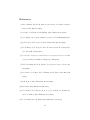
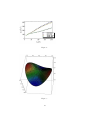
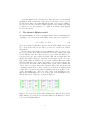
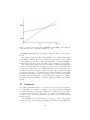
The analytic and numerical solutions are compared in Fig. 6. In this case, the
analytic solution was a superposition of 30 modes, and the numerical solution
was calculated at a grid resolution of 100 radial points and 101 axial points.
A 1% discrepancy between the solutions exists for the data shown, however,
this discrepancy was found to scale with the convergence conditions specified as
command-line options to the matrix solver. It is therefore presumed that this
discrepancy can be made asymptotically small.
E.
Extended domain method in x-point geometry
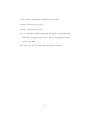
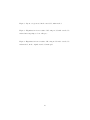
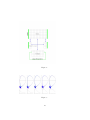
In the 2DX emulation topology (i.e. for a single-null x-point geometry plasma),
there is a branch cut next to the x-point across which a phase-shift periodic
boundary condition is applied, i.e. the eigenfunction on one side of the branch
cut is matched to that on the other side times a phase factor which accounts
for the toroidal periodicity of the modes [8]. In this section we present an
alternative to this technique. The motivations for this and the situations where
19