1
PRO
WEL D
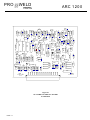
ARC 1 2 0 0
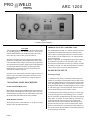
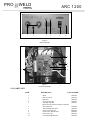
Figure 2
CONTROL PANEL FRONT
CAUTION
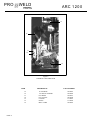
The stud labeled GND is connected to the unit chassis and is
for grounding purposes only. Do not connect a wire from the
terminal labeled GND to one of the three-phase line terminals as this may result in “hot” power unit chassis
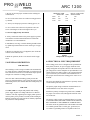
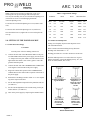
This unit is equipped with input voltage jumper links either
installed or in a bag on the jumper link board to allow operation from different line voltages. If installed, the jumper links
are positioned for the highest voltage stated on the nameplate
or on the input data label. In either case the jumper links
should always be checked to see if they are properly positioned for the voltage being used.
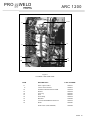
Open the access door located on the lower portion of the rear
panel to expose the jumper link board. If necessary, reposition the jumper links to match the line voltage being used.
(see Figure 6.1)
7.0 CONTROL PANEL DESCRIPTION
START/STOP PUSH BUTTON
Momentarily depressing the START button will energize the
main contactor inside the unit allowing all circuits to be activated and the the cooling fan to run. Momentarily depressing
the STOP button will deactivate the entire machine.
TIME RANGE SWITCH
This switch is used to select either the “A” or “B” time range
settings on the time adjustment knob.
PAGE 3
THERMAL/GUN FAULT LED INDICATOR
The thermal/gun fault LED “on” indicates either the internal
temperature in the main transformer has reached its maximum or there is a shorted gun solenoid or a shorted control
cable. In either case the LED will stay “on” and lockout the
gun from triggering.
If there is a gun fault, by unplugging the gun control cable at
the welder the LED will be “off” when the welder is first
turned off then turned back on. If there is a thermal overload
the LED will remain “on” until the temperature on the transformer comes down to a safe operating temperature.
8.0 WELD GUN SET-UP
8.1 Plunge Length
1. A different and correctly sized chuck and ferrule grip are
needed for each different stud diameter and style that will be
welded (see PRO WELD Accessories catalog for help in this
area). The appropriate chuck, or stud holder, is inserted into
the tapered chuck adapter and tapped lightly to insure a tight
fit. The ferrule grip is inserted in the hole in the foot and secured with the locking screws to hold it in place.
2. Studs must NOT bind or hang up on the foot, ferrule grip,
or ferrule during the entire stud welding process. To assure
this, the foot/ferrule arrangement must be centered in relation
to the stud to be welded. To assure centering, loosen the leg
screws that hold the foot to the legs. Place a stud in the
chuck and a ferrule in the ferrule grip. With the leg screws
loosened, the foot will move freely in all directions. Adjust
the foot so that the stud is centered in the ferrule and no contact occurs between the stud and the ferrule during retraction
or forward plunge of the stud.