1
AFQTP 4B071-18
Craftsman Training Guide: Response Operations
TASK STEPS
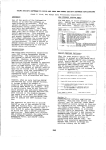
Input and Interpret Data in CHART:
1. Select the agent of concern from the drop-down list in STEP 1 within CHART.
2. Input temperature data in STEP 2.1
3. Input exposure concentration in STEP 3.2
4. Select the appropriate detection limit in STEP 3a.3
5. Input estimated exposure duration in STEP 4.4
6. Click “Calculate Risk” button to generate Chemical Health Risk Assessment Data.
7. Interpret risk assessment data using CHART User Guide.
8. Communicate health risk assessment data to appropriate decision makers/CCs/potentially affected members.
Input and Interpret Data in CHEMRAT:
1. Select agent of concern from the drop-down list in CHEMRAT.5
2. Select whether the agent is viscosity (“Neat” or “Thickened”)6 based on intel from drop down list.
3. Determine the type of weapon system (i.e. TBM Air, TBM Ground, or a specific TBM that may target the
operating area).7
4. Select the estimated number of in-bound TBMs or TBMs causing agent deposition.
5. Select appropriate target area.8
6. Input the appropriate surface (i.e. asphalt, concrete, or sand).
7. Obtain temperature, wind and stability, using appropriate conversions.9
8. Area coverage – set to “Peak.”10
9. Set exposure duration initially to 1 hour (matches persistency table).11
10. Select protection level.12
11. Interpret risk assessment data using Chemical Hazard Estimation Method and Risk Assessment Tool (CHEMRAT)
user’s manual and Hazard Duration Estimate Using CHEMRAT checklist.13
12. Communicate health risk assessment data to appropriate decision makers/CCs/potentially affected members.
LOCAL REQUIREMENTS: Develop scenario with exercise inputs for CHEMRAT/CHART tools.
NOTES:
1.
The default temperature unit of measure is Fahrenheit. This is indicated by a check in the box labeled “Check for
Degrees F.” Selected agents have toxicity estimates for Percutaneous Vapor exposure under hot and moderate
temperatures. Hot temperatures are defined as greater than 85 degrees F. Moderate temperatures are defined as 65
to 85 degrees F. In general, as the temperature increases, the effective Percutaneous Vapor dosage decreases.
CHART will use the temperature input to determine the appropriate toxicity values to calculate and display.
2.
Determining the concentration of a particular chemical warfare agent in the environment is limited by the
equipment technologies employed. The default unit of measure is milligrams per cubic meter. If parts per million
(ppm) are to be used, indicate by a check in the box labeled “Check for ppm Units.” There are several methods of
determining the concentration, to include a measured concentration; a concentration equal to the detection limit of
a particular piece of equipment; and a concentration generated from a CHEMRAT prediction.