1
CLA-VAL CPC
Actuated Position Control 4-20 mA
` How does a Hydraulically Balanced Actuator Regulate?
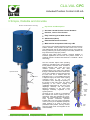
Valve Closing (Fig. 1)
The «brushless» motor drives the orifice coupling
downwards towards the requested set point which in
turn decreases the variable orifice size. Subsequently
less and less water discharges from the cover chamber
to the valve outlet (Vs). Water flowing from the valves
inlet port (Ve) enters the valve cover chamber via the
calibrated fixed orifice which becomes increasingly
greater than Vs generating the downward motion of the
diaphragm assembly. This closes the valve to the
prescribed set point corresponding to the analogical
[4-20 mA] signal transmitted to the «brushless» motor.
The displacement of water from the main valve
diaphragm assembly is performed purely hydraulically,
and there is no mechanical connection between the
orifice coupling and the valve stem.
Orifice coupling
Stem tube
In the set position, the inlet water Ve balances the
discharge water Vs, which explains why any in-balance
between these two values permits an immediate and
smooth reaction which delivers a smooth motion of the
internal diaphragm assembly.
Fig. 1
In the completely closed position, the leakage created
by the mechanical tolerance between the orifice
coupling and the stem tube is stopped drip tight at the
outlet of the Electronic Position Actuator CPC by a
separate solenoid valve installed in its discharge line.
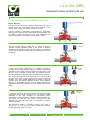
Valve Opening (Fig. 2)
The «brushless» motor drives the orifice coupling upwards
to the requested set point which in turn increases the
variable orifice size. Subsequently, more and more water is
discharged from the main valve cover chamber to the valve
outlet (Vs). Water entering into the valve cover Ve via the
calibrated orifice is not compensating for the water leaving
the top cover via Vs. This permits the diaphragm assembly
to move upwards which opens the valve to the prescribed
set-point corresponding to the analogical [4-20 mA] signal
transmitted to the «brushless» motor. The displacement of
the main valve diaphragm assembly is performed purely
hydraulically, since there is no mechanical connection
between the orifice coupling and the valve stem.
Orifice coupling
Stem tube
In the set position, the inlet water Ve is balancing the water
discharged via Vs, which explains why any in-balance
between these two values permits an immediate and
smooth reaction which delivers a smooth motion of the
internal diaphragm assembly.
Due to these CLA-VAL features both pressure differential
values [valve inlet ⇒ cover chamber] or [cover chamber ⇒
valve outlet] are identical therefore any change of pressure
in the system does not affect the set position of the main
valve.
` CLA-VAL Europe
www.cla-val.ch
Fig. 2
[email protected]
© Copyright CLA-VAL Europe - Specifications subject to change without notice - no contractual illustrations.
2 - LIN040DE
A 02/10