1
TEST ■ ■ ■
LABORATORY TIME
Measurement data for BEHRINGER X32
Digital Mixing Console
By Stefan Kosmalla
In a digital console, there are two major analog interfaces that have a significant influence on the overall performance of the system. On one hand, we
pay particular attention to the microphone preamps, on the other, the output
stages. The standards here are the maximum overload resistance (the so-called
headroom), the proportion of distortion, not to mention the signal to noise
ratio of the circuit. It is important to note that, in spite of BEHRINGER X32's
surprisingly low retail price, world-renowned British manufacturer MIDAS designed the mic preamps.
The measurements conducted on the BEHRINGER X32 were carried out as an
entire measuring chain, starting with XLR input 1 all the way through to the
XLR 16 analog output (right master) with the NTi FX-100 analyzer. Therefore,
the interpretation of distortion, noise and frequency response shown here
refers to the entire system taken in one pass.
Beginning at the preamplifiers, we established a maximum input level of +23
dBu before clipping the input stage. The gain controller provides from -12 dBu
all the way up to 60 dB. The maximum output voltage is a whopping +21 dBu,
which shows the fine resolution -1 dB master LED display. At 0 dBFS, the console starts to show the first deformation of the measuring signals, which
clearly indicates the end of the scale. The normalized level of 0 dBu is achieved
with an LED display of -21 dB.
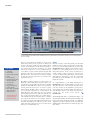
The frequency response of the X32 is aimed precisely to the preset sample
rate of 48 kHz, and as shown in Figure 1, reaches exactly 24 kHz at the end
of the transmission behaviour.
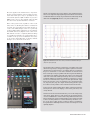
mixers. Below the display section is the Main output
fader, plus 8 motorized faders with four layers (DCA,
Bus 1-8, Bus 9-16 and Matrix outputs). LCD displays
(addressable scribble strips) are also used here.
To the right of the main display are the controls for
Monitor and Phones Levels. Since the headphone
jacks are located in the left and right handholds, it is
important to order a case that provides easy access to
the headphone jacks. The rest is quickly enumerated:
control buttons for Scenes and 6 Mute Groups, a
smartphone rack, 4 user-assignable encoders, including LCDs and 8 customizable buttons on three layers.
The user can program quick access to frequently used
parameters, up to a maximum of 36 buttons/encoders.
As the name suggests, X32's back panel features 32
XLR inputs, plus 16 mix bus XLR Outputs, 6 Aux Inputs and Outputs (TRS and RCA), AES / EBU professional digital output and a MIDI interface. In the era
of iPad and Tablet PCs, the candidate with USB and
Ethernet jacks for future remote control is also in
good shape. At the time of testing X32's Software Editor and iPad app were not yet available, but they were
demonstrated at PL+S in Frankfurt and should be
forthcoming.
In addition to the console's traditional inputs and outputs, two AES-50 network jacks are provided for docking with the BEHRINGER's new S16 digital stage box,
three of which can be addressed by the console (maximum of 96 in x 48 out). With the designers' inclusion
of a proprietary ULTRANET connector, the X32 becomes a "total sound technology package," merging
the console with BEHRINGER's P16 Personal Monitoring System (see test in issue 1/2012).
Designed primarily as a ”live” console, the
BEHRINGER X32 can also be used for studio applications, thanks to the included Control Room outputs
and XUF recording card. More on this later.
The inner values …
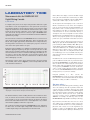
Figure 1: The measurement at 19 dBu output voltage shows a frequency response up to half the
sampling rate—exactly 24 kHz cut-off frequency at 48 kHz sample rate.
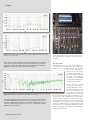
The distortion behavior, and the resulting harmonic and non-harmonic distortions, are critical to the assessment of sound. In addition to the THD total harmonic distortion, we also measured the harmonic proportions K2 and K3
between 5 Hz and 24 kHz. The values were consistently below 0.02%, and thus
demonstrated negligibly low distortion components.
We consider the total distortion behaviour (in Figure 2) very low – THD values
less than 0.04% at 1.8 dBu output voltage, which is reduced even further at
+19 dBu output voltage in the range between 80 Hz and 10 kHz.
www.tools4music.de
The X32 uses 40-bit floating-point technology, which
offers the advantage that the signal flow inside the
console cannot be overridden—this keeps the signal
quality at a high level from the start. MIDAS designed
the onboard mic preamps, in both the console and the
S16 stage boxes. And if you look closer, you'll find
even more features courtesy of MIDAS and KLARK
TEKNIK—for example, the S16 stage boxes use the
KLARK TEKNIK's SuperMAC networking technology.
Keyword effects: The X32 also offers 8 stereo effects
slots, which can be controlled as either a Send or Insert effect. The FX selection covers many standard applications and consists of 7 reverb algorithms (for
example, a replica of the EMT 250 "Space Washing
Machine" and the Quantec QRS Space Simulator), two