1
Smart
Q
Ultraviolet Sensor
TECHNOLOGY
•
•
•
•
The output from an ultraviolet lamp is normally made visible by emitting some violet light - true ultraviolet is invisible.
Fluorescent lamps produce UV light by the emission of low-pressure mercury gas. Fluorescence occurs when UV is absorbed by a phosphorescent coating on the inside of the tube and re-emitted as visible light.
The sun is a source of UV. UV in sunlight can, in some cases, penetrate clouds, mist and fog. Fresh snow can reflect up to 85% of the sun’s rays.
Halogen bulbs or lamps, which are not UV protected by a plastic or glass shield, are another source of UV.
Investigations
Using the Slow range:
• Absorption of ultraviolet by different types of clothing (not related to colour)
• Whether the colour of clothing affects absorption of UV
• Investigate the UV protection provided by sunglasses
• Investigate absorption of UV radiation by suntan lotion
• Investigate how different material like plastic, glass (auto glass comparison), clothes, soft drinks, etc. absorb or reflect UV light
• Direct or diffuse solar radiation - a considerable amount of UV does not come directly from the sun but is scattered by the atmosphere
• Fluorescent rocks
• Fluorescent dyes from washing powders that absorb UV and then emit light
• Different light levels produce different UV levels
Using the Fast range:
• Variation of UV along a fluorescent tube compared to light output
Investigate absorption of UV radiation by suntan lotion
The sun protection factor (SPF) was developed to rate the general effectiveness of
sunscreens and lotions to block UV-B rays. (Historically UV-A was not seen as
damaging and the ability to block this section of the UV spectrum was not included).
SPF ratings numbers are determined by dividing 100 by the percentage of UV-B
rays transmitted through the sunscreen. For example, if a sunscreen blocks 95% of
UV-B then it is allowing 5% through. Divide 100 by 5 = 20 therefore the SPF of this
sunscreen is SPF 20. A sunscreen that blocks 97% of UV-B would have a rating of
30 (100 ÷ 3 = 33). The actual difference between the effectiveness of an SPF of 20
and an SPF of 30 is 2%.
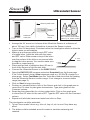
For this activity you would need a UV source. We used a small battery powered UV
fluorescent lantern supplied as a security device for identifying markings made with
a UV marker.