1
Illustrated Add-On to TANT 1.2 readme.txt, April 23, 2006 by YT1NT
Written by DG7YBN on Feb. 07, 2009
What does that mean to terrestrial low signal communication?
Excursion by YT1NT (edited by DG7YBN):
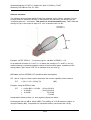
May we consider a general case of an antenna with a symmetrical elevation pattern i.e.
equal top and bottom half-spaces. This is always the case with
• Single Yagis
• Multiple Horizontally Stacked Yagis
• Multiple Vertically Stacked Yagis
with symmetrical current distributions, when all of these antennas are operated with an
elevation of 0 degrees. In other words, this is almost always the case in terrestrial
communication.
Under these conditions, the 'antenna temperature' does not depend at all
on the radiation pattern, and it is always:
Tant = (Tsky + Tearth) / 2
(ignoring ohmic losses)
As TANT is assuming uniform sky- and earth temperatures for the full sight (360° turn) of sky
sphere respectively earth up to horizon what you get is just the medium value between TSky =
200 K and TEarth = 1000 K.
Every per coordinate determined infinitesimal patch of environment in the sky has a
complementary patch on the ground. Since the antenna pattern is symmetric, the gain per
sky patch and complementary earth patch is equal. Hence all the integration mechanism may
be crossed out of the equation. What is left may look as simple as this:
(200 K + 1000K) / 2 = 600 K
In straight words:
• Tant will stay the same as long as the elevation pattern is symmetrical.
• Tant will not depend on gain, sidelobes, F/B or F/R ratio, etc.
Does this mean that Tant indicates absolutely nothing about antenna qualities for terrestrial
communications? …. Yes, it indicates absolutely nothing if you take the Tant – figure for 0° of
antenna elevation angle as an objective. This follows from the assumptions underlying the
definition of antenna temperature (Tant) and specifically the assumption that Tearth is the
same in all directions. If Tearth is the same in all directions then sidelobes and F/B ratio do
not matter on the issue of antenna temperature.
Of course, we all know that sidelobes and F/B ratio matter very much in real world terrestrial
communication. But this is not taken into account in the Tant definition. Thus consequently
Tant, as it is defined, can not express those valuable qualities of antennas
for terrestrial communications.
If we wanted to express the 'quality' of the antenna's directional pattern, we'd have to define
different Tearth values in different directions. Until we do so, both, the assertions of Tant and
TANT are of limited use for terrestrial work. We may only deduce, that a yagi with lower Tant
than a referencing one at 30° elevation will be quieter in terrestrial work.
11/13