1
Dealing with Evidence
7
for a sequent Γ ` Γ 0 is that one or more of the formulae in Γ 0 can be guaranteed
to hold when all of the formulae in Γ are satisfied. Thus sequents may be used
to state both facts with an empty set of hypotheses (for example, limits on
the possible values of a sensor reading, which might influence the selection of
a particular representation), and conditional statements with a non-empty set
of hypotheses. The empty sequent, denoted `, can also be used for some types
of certificate if the claim that they might support is judged to be either too
informal or too specific to be reflected as a formal judgment.
The task of choosing a suitable logic for the formulae in certificates may
not be easy, and will depend on context. For instance, in Programatica, we are
experimenting with a logic of partial functions, while for Java we might adopt
the JML logic [15]. In our prototype, we have so far avoided this issue by allowing
only atoms (i.e., basic propositional variables) as the formulae in sequents.
3.2
Validation and Editing
A certificate is valid if its sequent is consistent with the evidence it provides. For
example, a certificate with sequent ` A is valid if it provides evidence for A, but
invalid if it contains either incomplete evidence or evidence for a different formula
B. In the latter case, there are at least two ways to make the certificate valid,
either by changing its evidence to support A, or by changing its sequent to ` B.
In this way, validity provides an interface between the evidence from external
tools and the language of sequents that is used for evidence management.
The actions needed to determine whether a given certificate is valid will
depend on the type of the certificate, and may, in some cases, involve significant
computation. (Section 4 includes specific examples of the steps that are needed
to validate the certificate types used in our prototype.) To permit a quick test of
validity, each certificate includes a flag that is set to true only when the certificate
is known to be valid. If either the certificate itself or a part of the source text
that it depends on is changed, then the flag will be set to false. This records the
fact that a subsequent validity check is required, and does not necessarily mean
that the certificate is, in fact, invalid.
The actions needed to edit a certificate—such as modifying it so that its
validity can be established—will also depend on the type of the certificate, and
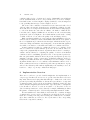
may, in some cases require significant user interaction. The screenshots in Fig.3
show the editors for three of the different kinds of certificate in our prototype.
Clearly, there is some commonality in the editors—each of dialog boxes shows an
icon and a name for a particular type of certificate, and an indication of the given
certificate’s status (either valid or unknown). At the same time, there are also
some significant differences from one certificate type to the next. The leftmost
editor, for example, is for automated testing, and does not display a sequent
because all certificates of that type use the empty sequent, `. The rightmost
editor is used with certificates obtained by resolution (See Sec.4.2) and includes
several fields that are not present in the other examples. Where appropriate,
the editor dialog for a certificate includes buttons allowing the user to invoke
associated external tools with appropriate settings for that certificate and hence