1
Eleftherios Avramidis
RankEval for Machine-Learned Ranking (63–72)
4. Implementation
4.1. Coding and Architecture
The code has been written in Python 2.7, taking advantage of the easier calculation
due to the dynamic assignment of items in the lists. Few functions from numpy and
scipy libraries are included, which therefore sets them as prerequisites for running
the tool. The code is available in an open git repository.2
The code includes one function for each ranking measure, with the exception of
NDGC and ERR which are merged into one loop for saving computational time. Each
function receives as parameters the predicted and the human (also referred to as original) rankings. Depending on how many the results of each function are, they are
returned as single float values, tuples or dict structures, as explained in the documentation of each function. The code is organized in two Python modules, so that
the functions can be imported and used by other Python programs.
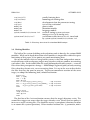
• ranking.segment, where the segment-level calculation takes place, and
• ranking.set, where the segment-level calculations are aggregated to provide
results for the entire data set. This mainly includes averaging (as explained
previously) but also the simple measures (Section 3.5). There is also a utility
function that executes all available functions and returns the results altogether.
The ranking lists are handled by the sentence.ranking.Ranking class, which includes
the functions for normalizing the included values.
4.2. Stand-Alone Execution
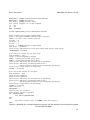
A stand-alone execution is also possible using the command line script rankeval.py which resides on the root of the package. This script is responsible for reading command line parameters on the execution, opening and parsing the files with the
ranking lists, starting the evaluation and displaying the results. The script supports
reading two formats:
• a text-based format, similar to the one used for WMT Evaluation Shared Task
• an XML-based format, which includes the sentence-level ranking annotations
along with the source and translated text. This format has been used in several
quality estimation tasks
4.3. Linear Computation of ERR
Since the mathematical formula for the computation of the Expected Reciprocal
Rank is computed in exponential time, we use the simplified computation suggested
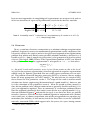
by Chapelle et al. (2009), which is outlined in Algorithm 1. The algorithm reduces the
2 https://github.com/lefterav/rankeval
69