1
that a back wheel will go off the pavement, causing a stability
problem. Avoid this at all times by steering an exaggerated
wide arc around the obstacle.
instructions provided with this accessory (see also page 40 of
this manual)
DISMOUNTING
If you must steer in a tight spot, such as entering a doorway
or when turning around, stop, turn the handlebars to where
you want to go, then apply the power gently. This will make
the Scooter turn sharply. It will still go gently, and with
complete stability. Practice in an open area, until you are
proficient.
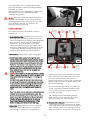
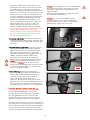
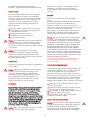
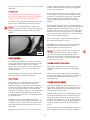
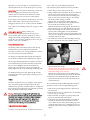
Always switch off your Scooter before dismounting. Locate
the seat lever and pull up (Fig 15). Now you can swing the
seat away, lock it, and ease yourself onto your feet.
If you prefer you can swing the armrests back to allow you to
pivot on your seat and then ease yourself onto your feet.
Reversing requires attention. Be sure your 'Speed Adjustment
Dial' is turned to minimum before you reverse (Fig 10, page 10).
Push the left thumb reverse control lever (Fig 13, page 11).
Remember, when you reverse you have to steer in the opposite
direction to the way you want to go. Practice is required here,
again use that open space. Please note as a safety requirement
reverse speed is half of forward speed.
Caution: Do not use the handlebars as a crutch to lever
yourself out of your seat. Failure to observe this warning may
damage the handlebar mechanism and make the Scooter
unstable.
Note: If your Scooter is set up for left forward driving the
afore mentioned description is reversed.
REMEMBER: If it is a tight turn, turn your steering column
before applying power. Steer wide of all corners and
obstacles, please move slowly and with care.
Warning: Do not turn your 'on-off' power key switch to the
'off' position when your Scooter is in motion, failure to
observe this warning may irreparably damage the main
electronic speed control unit or drive transmission. Always
first slow your Scooter down to a stationery position before
you switch your Scooter off.
FIG 15
PARKING IN PUBLIC
If you need to park and leave your Scooter, simply remove
your key. This will keep the brake on and make your Scooter
more difficult to move. It is best to leave it in sight of
someone like a store assistant etc. who can watch it for you.
Another precaution is to you're your serial number and
the date of purchase.
CONTROL THROUGH TIGHT SPOTS
When you start using your Scooter you will meet some
obstacles that will require some practice to drive through
smoothly.
Here are some common problems, with tips that will help
you master them quickly. You will soon be in control through
doors and up and down ramps with surprising ease by
following these tips.
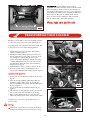
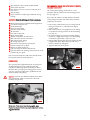
Your serial number can be found on a plate attached to the
front cross member located under the body cover.
BASIC DRIVING
CONTROL THROUGH DOORS
Make certain you are comfortably seated on your Scooter
and both armrests are down. Ensure that the 'Speed
Adjustment Dial' (Fig 10, page 10) is turned to minimum for
your first drive. When you have become more confident you
can increase the setting to a higher speed. Push the right
'Thumb Lever Control' (Fig 12, page 11), as described earlier.
You will very gently move forwards. Release the lever, and
you will gently stop. Practice these two basic functions until
you get used to them.
Approach an unfamiliar door slowly, sizing it up. Does it
have a knob or push bar? Does it open toward you or away?
Think in terms of using the power of the Scooter to do the
work for you! You need not strain.
Hold the doorknob or bar in one hand and apply power with
the other hand. (Remember that you can drive forwards by
using your left thumb to move the wig-wag lever towards
you.) If the door is self closing, you can go through, allowing
the door to close behind you, if you go quickly enough. If
not, just stop when you're clear of the door and push it
closed.
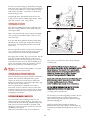
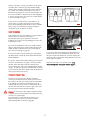
Steering the Scooter is easy and logical by turning the
handle bars in the direction you wish to manoeuvre. Be sure
to remember to give a wide clearance when turning so that
the rear wheels follow the path of the front one, instead of
cutting short.
If the door opens toward you, hold the knob or bar with one
hand and gently let the reverse power do the work. When
Cutting short on pavement corners or 'cut outs' can mean
17