1
Product Description
IP-16DAC provides three independent channels of high resolution 16-bit digital to analog
conversion. Applications include instrumentation, precision positioning, calibration,
remote programming. Factory calibration and low drift produce high accuracy and high
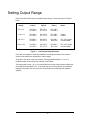
repeatability for precision laboratory applications. Four output ranges, including bipolar
and unipolar, plus remote sense, provide direct interface to target hardware in most
cases.
Sophisticated features make the IP-16DAC versatile and easy to interface in demanding
jobs. The digital voltages (DAC registers) are readable by software. The DACs may be
cleared by software or reset to either bipolar or unipolar zero. External power supplies
may be used to minimize system noise. The DACs include internal de-glitching hardware
that produces a faster settling time.
Factory Calibration traceable to the National Bureau of Instruments is standard. Zero
offset is calibrated to ± 1LSB. Gain is calibrated to ±0.008%. Output is always
monotonic. Calibration consists of correction parameters burned into a custom PROM
on each IndustryPack. Driver software reads the calibration parameters to correct digital
data prior to writing to the DAC.
Worst case differential non-linearity over temperature is ±1 LSB. This exceptional
linearity may be used to digitally construct low-distortion waveforms. DC drift with
temperature is typically 2 ppm/°C for both the DAC and the on board voltage reference.
Since the average power dissipation for the fully loaded IndustryPack is less than one
watt, normal temperature drift is negligible.
A very high precision on board reference is used to provide exceptional stability.
Software autocalibration provides a continuous accuracy of plus or minus one LSB (least
significant bit).
The IP-16DAC conforms to the IndustryPack Interface Specification. This guarantees
compatibility with multiple carrier boards, busses and form factors. This compatibility
permits application code migration between otherwise incompatible systems. This
provides for a longer life of the customers’ software investment.
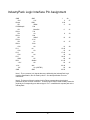
Connection to the IP-Precision ADC is via a standard 50-conductor ribbon cable. Four
parallel wires are used for each buffered output to reduce wiring resistance. Buffered
virtual ground connections exist between channels to reduce channel to channel
crosstalk. A low current sense input is provided to minimize total system error. This
cable may be terminated in a 50 position screw terminal block, available from SBS
Technologies, or any user-determined hardware. Provision is made to permit external
power supply connections if desired.
5