1
US 20120188940A1
(19)
United States
(12) Patent Application Publication (10) Pub. N0.: US 2012/0188940 A1
Agrawal et al.
(54)
(43) Pub. Date:
SPATIOTEMPORAL ANNOTATION OF DATA
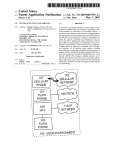
(52)
PACKETS IN WIRELESS NETWORKS
(57)
(75) Inventors:
Dakshi AgraWal, Monsey, NY
US '5 Chatschik Bisdikian 5
Chappaqua, NY (US)
Jul. 26, 2012
US. Cl. ...................................................... .. 370/328
ABSTRACT
Techniques for annotating data packets with time and/or loca
tion information in wireless networks are p rovided. In one
aspect, a method for processing information streams pro
duced by end-computing devices that are transmitted over a
(73)
Assignee;
International Business Machines
wireless network having at least one network element is pro
Corpnratinn, Armonk NY (Us)
vided. The method includes the following steps. Data packets
which originate from the end-computing devices and are
(21) Appl_ No;
13/012,387
(22)
Jan 24 2011
Filed
'
'
received by the network element are inspected for spatiotem
poral metadata. Spatiotemporal metadata is inserted into the
data packets and the data packets are transmitted if the step of
’
inspecting the data packets reveals that the data packets are
P bl,
_ Cl _? _
u lcatlon assl canon
(51) Int, Cl,
H04 W 4/00
missing spatiotemporalmetadata. Otherwise the data packets
are transmitted if the step of inspecting the data packets
reveals that spatiotemporal metadata is already present in the
data packets.
(2009.01)
m
user equipment
(UE) - sensor
_
Bata?ew at
simsadmfurmztion
1 4
106
‘‘ \~_Al
’,
,
-_
mu?owuwid
spa?otempmtmewdata
ummwmm
zpaliatempmaime’tadata
applications
Patent Application Publication
Jul. 26, 2012 Sheet 1 0f 4
US 2012/0188940 A1
user equipment
(UE) - sensor
mmad'infarmatlon
1 4
'
spa?gtgmparalmgtadata
applications
FIG. 1
106
Patent Application Publication
Jul. 26, 2012 Sheet 2 0f 4
US 2012/0188940 A1
29
1"
204
ton?gu ration
- rver
208
set geospatial
manual canfiguratio
d \mstream
Type address:
(4, “mm; pm
iwvzomi pm
39 Main 58,
Privacy configuration:
<3! damnation XYZ)
I SEW" dam sum‘
/
applications
Eamon by w mm
<if dcstlnatian ABC>
?errwe an i,» mention mfearmmwn
<if origin dwicn
émer‘strew
address
0 & app‘; A)
Sensor
v
FIG. 2
Patent Application Publication
Jul. 26, 2012 Sheet 3 0f 4
302
304
US 2012/0188940 A1
$9
/
x
K
K‘
Install Inc-aware
network element ‘
Phase I
LAN?semp
Set ‘Manon
Mummers
9
(LANE)
306
,
{AME waits far
_
datavackets
.
mspect data packet for
m?ilfjffiii'?‘iflw
39s
/,
spatimemporal metadata
51 B
Phase II "
apatiatem poral
m mad-m?
ma
Insert permlsslble
‘i
1H,?‘
/
Agni
FIG. 3
Patent Application Publication
Jul. 26, 2012 Sheet 4 0f 4
US 2012/0188940 A1
FIG. 4
j'im?
420 \
425 \
Nntvrork
Pmcessar
If?
TOfFmm
1*" "1P Camputaar
Natwerk
43° \*
Memw
Q l
I‘will WW“;
; Display 3
4-4
L mm mmmw ‘J
*
mama's
43:, f
n
Mcdia
~?450
Jul. 26, 2012
US 2012/0188940 A1
SPATIOTEMPORAL ANNOTATION OF DATA
PACKETS IN WIRELESS NETWORKS
FIELD OF THE INVENTION
[0001] The present invention relates to location-aWare
Wireless networks and more particularly, to techniques for
annotating data packets With time and/or location information
in such Wireless netWorks.
BACKGROUND OF THE INVENTION
[0002]
Enhanced availability of mobile Internet has
resulted in a hyper-groWth of smart mobile applications.
Many of these applications make use of spatially annotated
information to provide a broad set of location-aWare services
such as ?nding the nearest (Greek) restaurant, or the nearest
ing at least one netWork element is provided. The method
includes the folloWing steps. Data packets Which originate
from the end-computing devices and are received by the
netWork element are inspected for spatiotemporal metadata.
Spatiotemporal metadata is inserted into the data packets and
the data packets are transmitted if the step of inspecting the
data packets reveals that the data packets are missing spa
tiotemporal metadata. OtherWise the data packets are trans
mitted if the step of inspecting the data packets reveals that
spatiotemporal metadata is already present in the data pack
ets.
[0008]
A more complete understanding of the present
invention, as Well as further features and advantages of the
present invention, Will be obtained by reference to the folloW
ing detailed description and draWings.
(cheap) gas-station, targeted mobile advertisements, and so
BRIEF DESCRIPTION OF THE DRAWINGS
on. The introduction of smart, sensing-enabling technologies
can only hasten the groWth trend of mobile applications.
[0003] Many of these mobile applications can bene?t if
their application (in the mobile device) or the application
tion-aWare Wireless netWork according to an embodiment of
server (in the cloud or datacenter) is aWare of the spatial
[0009]
FIG. 1 is a diagram illustrating an exemplary loca
the present invention;
[0010] FIG. 2 is a diagram illustrating several exemplary
coordinates of the information sources. If the source device is
Ways by Which a netWork element in a location-aWare Wire
equipped With a global positioning system (GPS), it can
attach geo-coordinate metadata to application sessions. HoW
ever, possessing GPS may not alWays be possible (due to form
embodiment of the present invention;
[0011] FIG. 3 is a diagram illustrating an exemplary meth
factors (i.e., anything related to the form characteristics of an
object such as shape, siZe and Weight), cost reasons, energy
consumption, etc.) or GPS may not be alWays operational,
e.g., in indoor environments.
[0004] Cellular netWork infrastructure can provide value
add by estimating device location and creating location meta
data for the device. Traditional cellular base-stations can esti
less netWork can attain location aWareness according to an
odology for processing information streams produced by
end-computing devices that are transmitted over a netWork
having at least one netWork element, such as the netWorks of
FIGS. 1 and 2 according to an embodiment of the present
invention; and
[0012] FIG. 4 is a diagram illustrating an exemplary appa
ratus for processing information streams produced by end
in homes) or pico cells (e.g., in malls), and WiFi hotspots
(e.g., in airports) may be con?gured With location informa
computing devices that are transmitted over a netWork having
at least one netWork element, such as the netWorks of FIGS. 1
and 2 according to an embodiment of the present invention.
tion. This information can be stored in a netWork provider’s
infrastructure and become available through a location ser
vice to end-user applications. The location service can query
DETAILED DESCRIPTION OF PREFERRED
EMBODIMENTS
mate device location using transmit poWer. Femto cells (e.g.,
the infrastructure of the provider to retrieve the location of the
source, or an estimate of it, that can then be used to customiZe
the location service response to the user, for example, Where
a user uses her mobile telephone to connect to a location
service provider, say, to search for movie theaters and movies
near her location. The location service provider queries the
cellular company provider for the location of the user. The
[0013]
As described above, in order to create open, smart,
location-enabled applications, the dependencies on existing
location infrastructures need to be reduced. Accordingly, pro
vided herein are techniques that alloW location-based ser
vices to exist independently of associating With a location
infrastructure that must be queried for location information.
The present techniques alloW data streams to become spa
cellular company provides this information using, for
example, the cell toWer information that the mobile telephone
tiotemporally rich even When their sources are unable to
Was connected to, assisted GPS, etc.
[0005] As can be seen from this example, the location data
and hence location services are intimately tied to the cellular
vided herein are techniques to manage the content of meta
company provider Who Will also typically oWn the relation
ship With the end-user. In other Words, data of spatiotemporal
signi?cance become tied to a location infrastructure and the
utility of these data is restricted by the access rights to that
location infrastructure, e. g., requires access to location infor
mation from a cellular company provider.
[0006] Therefore, the creation of open, smart, location
enabled applications, Wherein the dependencies on existing
location infrastructures are reduced Would be desirable.
SUMMARY OF THE INVENTION
provide the necessary metadata information. Further pro
data added to satisfy end-user preferences, such as privacy
levels.
[0014] According to the present techniques, the embedding
is performed by special netWork elements such as a WiFi base
station, a gateWay, a sensor netWork controller, etc. These
netWork elements examine the tra?ic that passes through
them, for example using deep packet inspection (DPI), and if
the netWork elements ?nd location metadata missing, the
netWork elements insert on-the-?y the (estimated) location
information of the source in the data stream.
[0015] FIG. 1, for example, is a diagram illustrating exem
plary location-aWare netWork 100. NetWork 100, in this case
a Wireless netWork, includes at least one end-computing
[0007] The present invention provides techniques for anno
tating data packets With time and/or location information in
device, i.e., user equipment (UE) 102, e.g., sensors, mobile
Wireless netWorks. In one aspect of the invention, a method
telephones, personal digital assistants (PDAs), personal com
puters, laptop computers, etc., accessing internet-based appli
for processing information streams produced by end-comput
cations 106 though a netWork element(s) 104, such as by a
ing devices that are transmitted over a Wireless netWork hav
WiFi base station, a gateWay, a sensor netWork controller
US 2012/0188940 A1
Jul. 26, 2012
and/ or a femto cell access point (FAP) located at a home of a
user. An apparatus that may serve as a network element 104 is
metadata missing, incorrect existing location metadata and/or
provided in FIG. 4, described beloW. Information streams
produced by the end-computing devices are transmitted over
netWork 100. As Will be described in detail beloW, according
to the present teachings the netWork elements examine the
information streams that pass therethrough, for example
policies), netWork element 104 can insert, remove and/or
impermissible location metadata (e.g., violating set privacy
otherWise alter on-the-?y the (estimated) location informa
tion of the source and/or time data in the data stream. The
concept of altering data packets on-the-?y is Well knoWn to
those of skill in the art. By Way of example only, Writing
using deep packet inspection (DPI), and if the netWork ele
on-the-?y is commonly done in routers Which can even alter
ments ?nd location and/ or temporal metadata missing from
information as a packet Waits to be transmitted on an outgoing
application data-carrying packets, the netWork elements
port. The router may, if necessary, momentarily delay the
transmission to perform this operation.
[0018] In FIG. 1, end-computing devices 102 (e.g., user
insert on-the-?y the (estimated) location and/or time infor
mation (e.g., spatial, temporal and/or spatiotemporal meta
data) of the source in the information stream. The concept of
deep packet inspection by netWork elements With capabilities
to read data packets (including payload) is Well knoWn to
equipment (UE)) produce sensed information that is then
consumed by applications 106.As highlighted above, the user
equipment (UE) can include sensors. A sensor can be a
those of skill in the art and thus is not described further herein.
The information stream may also be referred to herein as data
streams, With the understanding that the terms may be used
simple, single task entities, a sensor in the strict sense, e.g., a
haZmat sensor sensing presence and/ or concentration of haZ
interchangeably. As noted earlier, the insertion (or replace
ment) of the spatiotemporal information in data packets is
done only to application data-carrying packets. Depending on
acoustic sensor, etc. A mobile telephone is an example of a
multisensory device as it may include a microphone, an accel
the application context, there may not be a need to insert
spatiotemporal information to data packets such as system
management and control packets, set-up connection packets,
etc., not meant to be “seen” and processed by end-user appli
cations.
[0016] In the example shoWn in FIG. 1, there are tWo ?oWs
of data, a ?rst How and a second How. The ?rst data How
ardous material, a temperature sensor, a vibration sensor, an
erometer, a GPS sensor and possibly a temperature sensor.
Hence, the mobile telephone itself is the sensor. Alternatively,
a Bluetooth®-equipped mobile telephone may collect infor
mation from multiple Wearable Bluetooth®-equipped sen
sors carried by a person (a pedometer, a heartbeat sensor, a
body temperature sensor, etc.) and then pass this information
(indicated by dashed arroWs) involves end-computing
to a remote health-care monitoring application.
[0019] For the user equipment (UE) that does not embed
devices that do not embed location or time information in the
location information into the data stream, netWork element
data stream. These end-computing devices can include user
104 can insert its location information as a proxy for the
equipment (UE) such as sensors and/or mobile telephones
(Which may be considered to be a type of sensor, see beloW).
Network element 104, e.g., a FAP, upon inspection of the ?rst
location of the user equipment (UE) (With the assumption that
data How, and folloWing consultation With privacy con?gu
ration parameters (see beloW), embeds, if necessary, spatial
(e. g., location information), temporal (e. g., a timestamp
re?ecting the current clock time read by the netWork element)
and/or spatiotemporal metadata (e.g., spatiotemporal meta
data) in the data stream. Whether it is spatial metadata, tem
poral metadata or spatiotemporal metadata, if any, that gets
embedded in the data stream depends on the design and
application needs. For example, there may be a sensor system
that reports information (e.g., temperature) only When the
sensor system is explicitly queried by the application. In this
case, the sensor may only provide the result of a temperature
measurement (e.g., 22 degrees Celsius (0 C.)), and include no
time or location information. In this instance, embedding
spatiotemporal metadata Would be preferable. In other occa
sions, a sensor may report threshold crossings it experiences.
For example, the sensor may report that the temperature has
just gone past 50° C. and provides only the time When this
event Was noted. An application tied to the sensor measure
ments Would deduce the sensor location by reading a sensor
identi?cation (ID) from the packet With the threshold cross
ing noti?cation and mapping it to a location. Thus, in this case
the user is close by). Accordingly, netWork element 104 is
preferably programmed With its location and/or has the capa
bilities to determine its location. By Way of example only,
With a FAP in a user’s home the user can program the PAP
With a particular address (or any other coarser/?ner location
information, see beloW). Alternatively, the PAP can have
access to GPS capabilities and can determine its location
automatically. The latter set-up Would be bene?cial for situ
ations Where the netWork element is moved, since it Would not
require any input from the user to update its location. Exem
plary embodiments involving such location-aWare netWork
elements (LANEs) are described in detail beloW.
[0020] The location information may be coarse-grained or
?ne-grained depending on user preferences and the localiZa
tion capabilities. For example, the process of embedding may
be policy-controlled (based, e.g., on a set of permission rules,
see beloW) to de?ne the location granularity to be embedded
in the data stream. For example, in the case of a FAP located
at the home of a user that is con?gured to embed location
information, the PAP could be con?gured by the user based
on various criteria, so as to satisfy privacy concerns of the
user. The FAP may be con?gured to embed home location
information at various degrees of granularity, such as at the
room level, the apartment level, building level, street block
embedding spatial metadata Would be preferable. In yet other
level, neighborhood level or nothing at all. According to an
cases, a more poWerful sensor may be equipped With a global
exemplary embodiment, When the location information is
coarse-grained the information includes only a home address
resolved to GPS coordinates, and When the location informa
tion is ?ne-grained the information has localiZation informa
tion, i.e., relative to the home address, such as room level.
[0021] A second data How (indicated by a solid arroW in
positioning system (GPS) device and thus can also add its
location along With the time of a sensed event (such as the
threshold crossing). In this instance, no additional spatial or
temporal metadata is needed.
[0017] By Way of example only, netWork element 104 can
be con?gured to examine the data that passes through it, for
example using DPI, and if netWork element 1 04 ?nds location
FIG. 1) involves end-computing devices (e.g., user equipment
(UE)) that can collaborate to estimate, e.g., using triangula
Jul. 26, 2012
US 2012/0188940 A1
tion, their local position, i.e., their location relative to each
other. For example, localization may be relative to a “local”
coordinate system. Upon transmitting their data, these end
computing devices embed this relative location (localization
information) in the data stream they transmit (i.e., to netWork
element 104). Network element 104, upon inspecting the data
stream, and following consultation With set privacy guide
lines, may re?ne the localiZation information. For example,
netWork element 104 may alter the relative location to a
global location (e. g., While the original location may be noted
simply as “on the left side of the room,” the generic “room”
may be replaced With speci?c information such as “kitchen”)
or replace altogether the location information as in the case
described above Where the user equipment does not embed
location information into the data stream. User equipment
of FIG. 1 presented above, the present techniques provide for
using con?gurable permission lists describing the alloWable
information for embedding that are consulted prior to embed
ding any metadata to the data stream.
[0024] FIG. 2 is a diagram illustrating some exemplary
Ways by Which a netWork element in a location-aWare net
Work (such as Wireless netWork 100 of FIG. 1, described
above) can attain “location aWareness.” As described above,
the present location-aWare netWork includes user equipment
(UE) (not shoWn) accessing Internet-based applications, in
this case lntemet applications 206, through a netWork ele
ment(s), in this case netWork element 204. As shoWn in FIG.
2, netWork element 204 includes a doWnstream (incoming)
port through Which data packets arrive and an up stream (out
(UE) With location-aWareness capabilities still only knoW a
going) port through Which data packets are transmitted (see
relative location With respect to say a “generic” room. Net
Work element 104 may knoW that these devices are Within the
kitchen, so netWork element 104 can change the reference
coordinate system from that of the room to that of the house.
[0022] While netWork element 104 may insert, remove and/
beloW).
[0025]
FIG. 2 illustrates three non-limiting exemplary
methods by Which netWork element 204 can acquire “location
aWareness.” A location-aWare netWork element is also
referred to herein as a “LANE.” The ?rst method involves
or otherWise alter, supplement or replace the location infor
mation in the data stream as described above, other tech
niques may also be used to change the location information.
In one exemplary embodiment, Whenever netWork element
manual con?guration of netWork element 204 by the user.
104 identi?es missing (or non-complying, i.e., impermis
ing to the con?guration module of the LANE). In the example
sible) location information in a data packet ?oW, netWork
shoWn in FIG. 2, the user accesses the LANE con?guration
console through a Web interface via the user’s personal com
element 104 can generate a brand neW data packet to the same
destination that includes the updated information (assuming
that it also clears any non-compliant information). Alterna
tively, in another exemplary embodiment, Whenever netWork
element 104 identi?es missing (or non-complying, i.e.,
impermissible) location information, netWork element 104
replaces the data packet With the missing (or non-complying,
i.e., impermissible) information With one that contains the
alloWable location information and is otherWise identical to
the original packet. The implementation of both of these
functions in a DPI netWork element Would be apparent to one
of skill in the art.
[0023] As highlighted above, the present techniques
address several important aspects of spatiotemporal data
transfer. The ?rst aspect is being able to alloW location-based
services to exist independently of associating With a location
infrastructure that must be queried for location information.
With reference to the description of FIG. 1 presented above,
the present techniques provide for the embedding of spa
tiotemporal metadata directly in the data (e.g., sensory data)
Namely, a user directly enters an address (e.g., “30 Main
Street”) through a LANE con?guration console (not shoWn)
(e.g., through a Web interface or a client application interfac
puter (PC) 208. Optionally, netWork element 204 may consult
With a geospatial service (having a geospatial database
(GeoSp db) 209) and substitute the address provided by the
user With the GPS coordinates (latitude (lat) and longitude
(long)) of the location, or of an area containing the location
(increase the granularity). Google maps is such a geospatial
service. With Google maps, for example, a user can provide
an address and retrieve the GPS coordinates of the address.
For example, as shoWn in FIG. 2, the user has provided the
address “30 Main Street” as its location and netWork element
204 consults a geospatial service to obtain the GPS coordi
nates for 30 Main Street, Which netWork element 204 can use
to replace (or alternatively supplement) the location informa
tion from the user. This option may also be bene?cial in
situations Where, for example, the user makes a mistake in
inputting his/her location and/ or When the location informa
tion the user inputs is not at the same granularity level as the
set policy. By Way of example only, if the privacy policy in
stream. This Would satisfy the ?rst aspect as applications and
place is set at a coarser granularity than What the user has
services can noW extract the required spatiotemporal infor
to become spatiotemporally rich even When their sources are
inputted, the LANE can substitute its GPS readings for that of
the user’s but at the correct privacy level. This Would require
that the netWork element provide location information of its
oWn, i.e., aside from What the user provides.
[0026] The second method involves a bootstrap, or assisted
unable to provide the necessary metadata information. Again
With reference to the description of FIG. 1 presented above,
con?guration, i.e., Wherein a netWork provider remotely sets
the geospatial information for netWork element 204. Namely,
the present techniques provide for embedding spatiotemporal
a netWork service provider (having a con?guration server
210) of the netWork to Which netWork element 204 is con
mation directly from the data stream Without requiring que
rying for location information from a third party, such as a
cellular company. The second aspect is alloWing data streams
metadata to a data stream by an entity other than the source of
the stream. Serving as a surrogate of the source for the pur
nected remotely con?gures netWork element 204 When net
pose of enriching the data stream With spatiotemporal meta
Work element 204 poWers on. According to an exemplary
data, spatiotemporal metadata becomes available to applica
embodiment, an operator (from the netWork service provider)
consults a geospatial database (install db) of the locations of
its installed LANEs (Which may include actual subscribers’
home locations) and con?gures each LANE (remotely)
tions and services even When the source is unable to supply
the required information. The third aspect is managing the
content of metadata added to satisfy end-user preferences,
such as privacy levels.Again With reference to the description
accordingly.
Jul. 26, 2012
US 2012/0188940 A1
[0027] The third method involves self-con?guration (e.g.,
GPS, triangulation, etc.) by network element 204. In the third
method, the LANE self-con?gures using GPS, triangulation
information from other LANEs that already knoW their po si
tion, etc.
[0028] As highlighted above, the user equipment may be
con?gured to obtain sensory information from (stationary
placed) sensors, e.g., placed in buildings, on roads, etc. As
shoWn in FIG. 2, sensory measurements obtained from these
netWork 100 described, for example, in conjunction With the
description of FIGS. 1 and 2, above. Methodology 300
includes tWo phases, a ?rst phase (set-up of a LANE, steps
302 and 304) and a second phase (operation of the LANE,
steps 306-314).As describe above, LANE stands for location
aWare netWork element (i.e., a netWork element that has
“acquired” location aWareness, see description of FIG. 2,
above). With regard to the ?rst phase, in step 302, the LANE
is installed. A LANE, such as netWork element 104 Was
sensors are part of the data stream to the netWork element.
described, for example, in conjunction With the description of
Privacy guidelines may also be set at the sensor level.
FIG. 1, above. In step 304, the LANE (e.g., netWork element
Independently ofhoW a LANE acquires its location
104) is con?gured (“set location parameters”) such as acquir
information, end-users may set conditions of When and hoW
to embed location information in data streams, labeled “Pri
vacy con?guration” in FIG. 2. In FIG. 2 this is shoWn as part
[0029]
ing location information for the LANE and con?guring the
of the end-user manual con?guration of LANE, but alterna
tives are possible. As indicated in FIG. 2, through some client
application running on, e. g., a personal computer, a user can
manually enter (type) the location information (e.g., “30
Main Street”) to be recorded in a sensory data stream. Like
Wise, privacy policies/con?guration may be entered manually
by a user through a client application. Such is the case, With
social netWork privacy rules When, for example, a social
<if . . . then> privacy rules (see, for example, the description
of FIG. 2, above), referred to more generally as permission
rules beloW. As described in detail beloW, the permission rules
may also dictate When (i.e., With What frequency) spatiotem
poral metadata may be inserted into the data packets. For
example, the permission rules may dictate that spatiotempo
ral metadata may be inserted into the data packet only once
per source destination ?oW or only once per given interval of
time, e. g., once every 10 minutes. This is done for ef?ciency
netWork user speci?es Who can see updates in personal status
sake, i.e., to prevent taking duplicative actions.
information (friends, friends of friends, etc.). Spatial infor
[0031] With regard to the second phase, in step 306, the
LANE (e.g., netWork element 104) Waits for data packets
mation may be treated in a very similar Way, and describe
under What conditions (the clauses, see beloW) spatial infor
mation may be revealed. By Way of example only, a service
subscriber may provide her privacy constraints to the netWork
provider Who then con?gures LANE accordingly as part of a
service agreement the netWork provider has With the sub
scriber. In FIG. 2, the privacy con?guration is shoWn as a
collection of <if . . . then> rules, Where represent conditions,
such as origin of a data packet, destination of a data packet,
application to Which a data packet relates, time and date, etc.,
and <then> represent actions (shoWn in italics in FIG. 2) to be
taken if the conditions are satis?ed. Example actions shoWn in
FIG. 2 include, adjusting the location granularity embedded
arriving at a doWnstream port, e.g., from the sensor side (see
description of FIG. 2, above). Upon receipt of a data packet,
in step 308, the LANE inspects the packet for time and loca
tion information (spatiotemporal metadata). This inspection
may involve deep packet inspection (DPI) techniques, as the
time and location information Will likely be embedded in the
payload of the packet, e.g., Within the payload portion of a
transmission control protocol/internet protocol (TCP/IP)
packet. HoWever, the packet inspection may also include
shalloW packet inspection, such as inspecting the TCP/IP
packet headers, to extract information that could be used later.
in the data stream, such as just a Zip code, or just a street name,
[0032] Upon inspection of the packet, in step 310, the
or embed nothing, or even remove any geo spatial information
LANE consults the list of permission rules for the spatiotem
that might exist in the data stream. Using the example pro
poral metadata in the packet and makes a determination as to
vided in FIG. 2, the user can designate that if the destination
Whether the packet contains permissible or impermissible
spatiotemporal metadata. As described above, the LANE
(e. g., netWork element 1 04) may be con?gured directly by the
user With the user’s privacy guidelines and/or the privacy
of the data packet is XYZ, then only Zip code location infor
mation should be inserted into the data stream. On the other
hand, if the data packet destination is ABC, then all location
information is removed. For example, a user may share his/
her full location information to a localiZation service for
guidelines may be set at other levels, e. g., at the sensor. Note
that even if the data packet does contain spatiotemporal meta
data, the LANE may still consult the list of permission rules
summoning a taxi cab, but only provide coarse location infor
mation that alloWs people to ?nd him/her (such as friends,
to determine Whether supplying spatiotemporal metadata is
Where the user does not necessarily Want them to knoW
permissible (or impermissible).
exactly Where he/ she is, but only that the user is in the area, or
in the same toWn). If the user con?gures these ‘customized’
privacy settings, the user can specify speci?c destinations/
settings, group s/types of destinations, etc. For example, a user
may specify location expression granules such as full address,
or just street name, or just Zip code, etc., and origin and
destination groups, and then (using the client application)
make statements of the form if data from group A are destined
to group B alloW location granule C. This is hoW social
netWorks manage privacy rules for their content.
[0030] FIG. 3 is a diagram illustrating an exemplary meth
[0033]
In step 312, the LANE determines Whether or not
the data packet contains permissible spatiotemporal meta
data. If the packet contains permissible spatiotemporal meta
data (i.e., the data packet meets all of the privacy guidelines),
then the LANE transmits the packet out on an upstream port
(see FIG. 2). The LANE then returns to Waiting for a next
packet from doWnstream and steps 306-312 are repeated. On
the other hand, if the packet contains impermissible spa
tiotemporal metadata (i .e., the data packet violates the privacy
guidelines), or if the packet contains insuf?cient or no spa
end-computing devices that are transmitted over a netWork
tiotemporal metadata at all, then in step 314 the LANE
inserts/embeds alloWable (permissible) spatiotemporal meta
data in the packet accordingly and transmits the packet out an
having at least one netWork element, such as location-aWare
upstream port (see FIG. 2). Steps 306-312 are then repeated.
odology 300 for processing information streams produced by
Jul. 26, 2012
US 2012/0188940 A1
[0034] While packet inspection may be performed at each
incoming packet, for example as in methodology 3 00, embed
ding of spatiotemporal metadata may occur only as often (or
ratus 400 can be con?gured to implement one or more of the
steps of methodology 300 of FIG. 3 for processing informa
tion streams produced by end-computing devices that are
as frequent) as necessary. For example, the LANE may
transmitted over a Wireless netWork having at least one net
embed permissible spatiotemporal metadata only once per
Work element such as location-aWare netWork 100 described,
source destination ?oW (identi?ed by a common TCP/IP
address/port source and destination pair), or over a given
interval of time, e.g., once every 10 minutes. Or, as a result of
in conjunction With the description of FIGS. 1 and 2. As
highlighted above, netWork 100 includes at least one netWork
DPI, the LANE may embed permissible spatiotemporal
metadata once per application session, or over a given interval
of time, e.g., once every 10 minutes for packets that appear to
be part of the same application session. In this case, the step
element (e.g., netWork element 104). Apparatus 400 can be
con?gured to serve as one or more of the netWork elements in
netWork 100.
[0038]
Apparatus 400 comprises a computer system 410
of “insert permissible spatiotemporal metadata” is preceded
and removable media 450. Computer system 410 comprises a
by a determination of Whether embedding is necessary for
processor device 420, a netWork interface 425, a memory 43 0,
a media interface 435 and an optional display 440. NetWork
interface 425 alloWs computer system 410 to connect to a
reasons such as the aforementioned ?oW or session rules.
[0035]
It is notable that in step 312, the term “contain
permissible spatiotemporal metadata” can be interpreted
quite generically based on What permissible is. Permissible
Will include both the granularity of spatial information and
netWork, While media interface 435 alloWs computer system
410 to interact With media, such as a hard drive or removable
media 450.
also When the information can be permitted to be Written.
[0039]
Hence, the example above of Writing a speci?c piece of infor
discussed herein may be distributed as an article of manufac
ture that itself comprises a machine-readable medium con
taining one or more programs Which When executed imple
mation every 10 minutes is an example of When a piece of
spatial information can be Written. To be a little more speci?c,
by Way of example only, there might be various authors of
permission conditions. For example, end-users may specify
content permissions (What location information can be
added), operators may also provide operation permissions
(When a location metadata can be added in an information
stream). A LANE device Will aggregate these permissions
As is knoWn in the art, the methods and apparatus
ment embodiments of the present invention. For instance,
When apparatus 400 is con?gured to implement one or more
of the steps of methodology 300 the machine-readable
medium may contain a program con?gured to inspect data
packets Which originate from the end-computing devices and
sensory streams.
are received by the netWork element for spatiotemporal meta
data; and insert spatiotemporal metadata into the data packets
and transmit the data packets if the step of inspecting the data
packets reveals that the data packets are missing spatiotem
poral metadata, otherWise transmit the data packets if the step
of inspecting the data packets reveals that spatiotemporal
metadata is already present in the data packets.
[0036] The above exemplary embodiments have consid
ered the embedding or updating of permissible spatial infor
medium (e.g., ?oppy disks, hard drive, optical disks such as
mation in information streams passing through a netWork
removable media 450, or memory cards) or may be a trans
and When it performs step 312 the LANE device Will decide
What needs to be altered With regard to spatial metadata. Thus,
the permission rules, consulted in step 310 (above), may
contain an aggregation of permission rules from end-users
and operators that determine the spatial information provided
and the frequency by Which the information is provided in the
[0040]
The machine-readable medium may be a recordable
element such as netWork elements 104 or 204 employing
mission medium (e.g., a netWork comprising ?ber-optics, the
techniques such as DPI. In an entirely analogous manner,
permissible temporal information can also be embedded or
updated in information streams. A netWork element, such as
World-Wide Web, cables, or a Wireless channel using time
division multiple access, code-division multiple access, or
netWork elements 104 or 204, can employ a technique such as
developed that can store information suitable for use With a
DPI to inspect a passing packet for temporal information. If
temporal information is missing, a timestamp may be entered
computer system may be used.
[0041] Processor device 420 can be con?gured to imple
ment the methods, steps, and functions disclosed herein. The
based on the time indicated by the internal clock of the net
Work element. A user may con?gure the formatting details of
other radio-frequency channel). Any medium knoWn or
the time, for example, to provide both time and date informa
tion, or only time, or con?gure the time granularity to be in
minutes, seconds, milliseconds, etc. Note, that contrary to
spatial information, time information can be, in general, more
memory 430 could be distributed or local and the processor
device 420 could be distributed or singular. The memory 430
reliably estimated by a recipient application by simply using
devices. Moreover, the term “memory” should be construed
broadly enough to encompass any information able to be read
its oWn local clock. Hence, providing rules for temporal pri
could be implemented as an electrical, magnetic or optical
memory, or any combination of these or other types of storage
vacy may be less crucial than in the case of spatial informa
from, or Written to, an address in the addressable space
tion. Nonetheless, the same techniques employed for provid
accessed by processor device 420. With this de?nition, infor
ing permission rules, such as using a broWser application on
mation on a netWork, accessible through netWork interface
425, is still Within memory 430 because the processor device
420 can retrieve the information from the netWork. It should
be noted that each distributed processor that makes up pro
cessor device 420 generally contains its oWn addressable
memory space. It should also be noted that some or all of
a PC connected to the con?guration module of a netWork
element, can also be used to provide permission rules for
temporal information used to con?gure rules for When to
Write and hoW to Write (i.e., format) time information.
[0037] Turning noW to FIG. 4, a block diagram is shoWn of
an apparatus 400 for implementing one or more of the meth
odologies presented herein. By Way of example only, appa
computer system 410 canbe incorporated into an application
speci?c or general-use integrated circuit.
Jul. 26, 2012
US 2012/0188940 A1
[0042]
Optional video display 440 is any type of video
display suitable for interacting With a human user of appara
tus 400. Generally, video display 440 is a computer monitor
or other similar video display.
[0043]
Although illustrative embodiments of the present
invention have been described herein, it is to be understood
that the invention is not limited to those precise embodiments,
and that various other changes and modi?cations may be
made by one skilled in the art Without departing from the
scope of the invention.
What is claimed is:
1. A method for processing information streams produced
by end-computing devices that are transmitted over a Wireless
netWork having at least one netWork element, the method
comprising the steps of:
inspecting data packets Which originate from the end-com
puting devices and are received by the netWork element
for spatiotemporal metadata; and
inserting spatiotemporal metadata into the data packets and
transmitting the data packets if the step of inspecting the
data packets reveals that the data packets are missing
spatiotemporal metadata, otherWise transmitting the
data packets if the step of inspecting the data packets
reveals that spatiotemporal metadata is already present
in the data packets.
2. The method of claim 1, further comprising the step of:
consulting permission rules that dictate What spatiotempo
ral metadata is permissible and What spatiotemporal
metadata is impermissible, and Wherein the step of
inserting spatiotemporal metadata into the data packets
is performed in accordance With the permission rules.
3. The method of claim 2, Wherein the step of inserting
spatiotemporal metadata into the data packets comprises the
step of:
inserting permissible spatiotemporal metadata into the
data packets and transmitting the data packets if the step
of inspecting the data packets reveals that the data pack
ets are missing spatiotemporal metadata or contain
impermissible spatiotemporal metadata, otherWise
transmitting the data packets if the step of inspecting the
data packets reveals that spatiotemporal metadata is
already present and that the spatiotemporal metadata
present is permissible.
4. The method of claim 2, Wherein the permission rules are
related to privacy guidelines regarding the spatial metadata in
the data packet.
5. The method of claim 1, further comprising the step of:
consulting permission rules that dictate When spatiotem
poral metadata may be inserted into the data packets, and
Wherein the step of inserting spatiotemporal metadata
into the data packets is performed in accordance With the
permission rules.
6. The method of claim 5, Wherein the permission rules
include inserting spatiotemporal metadata into the data pack
ets once per source destination ?oW or over a given interval of
time.
7. The method of claim 5, Wherein the step of inserting
spatiotemporal metadata into the data packets comprises the
step of:
inserting permissible spatiotemporal metadata into the
data packets and transmitting the data packets if the step
of inspecting the data packets reveals that the data pack
ets are missing spatiotemporal metadata or contain
impermissible spatiotemporal metadata, otherWise
transmitting the data packets if the step of inspecting the
data packets reveals that spatiotemporal metadata is
already present and that the spatiotemporal metadata
present is permissible.
8. The method of claim 1, Wherein the netWork element
comprises at least one of a WiFi base station, a gateWay, a
sensor netWork controller and a femto cell access point.
9. The method of claim 1, further comprising the steps of:
con?guring the netWork element With spatial metadata
related to a location of the netWork element; and
using the spatial metadata for the netWork element to
supplement or replace the spatiotemporal metadata
already present in the data packets.
10. The method of claim 9, Wherein the step of con?guring
the netWork element is performed by a user of one of the
end-computing devices.
11. The method of claim 9, Wherein the step of con?guring
the netWork element is performed remotely by a netWork
service provider of a netWork to Which the netWork element is
connected.
12. The method of claim 9, Wherein the step of con?guring
the netWork element is performed by the netWork element
using global positioning system information.
13. The method of claim 2, further comprising the step of:
con?guring the netWork element With the permission rules.
14. The method of claim 1, Wherein the step of inspecting
the data packets is performed by the netWork element using
deep packet inspection.
15. The method of claim 2, further comprising the step of:
removing the spatiotemporal metadata already present in
the data packets if the spatiotemporal metadata already
present in the data packets is impermissible.
16. A Wireless netWork over Which information streams
produced by end-computing devices are transmitted, the net
Work having at least one netWork element comprising:
a memory; and
at least one processor device, coupled to the memory,
operative to:
inspect data packets Which originate from the end-com
puting devices and are received by the netWork ele
ment for spatiotemporal metadata; and
insert spatiotemporal metadata into the data packets and
transmit the data packets if the step of inspecting the
data packets reveals that the data packets are missing
spatiotemporal metadata, otherWise transmit the data
packets if the step of inspecting the data packets
reveals that spatiotemporal metadata is already
present in the data packets.
17. An article of manufacture for processing information
streams produced by end-computing devices that are trans
mitted over a Wireless netWork having at least one netWork
element comprising a machine-readable recordable medium
containing one or more programs Which When executed
implement the steps of:
inspecting data packets Which originate from the end-com
puting devices and are received by the netWork element
for spatiotemporal metadata; and
inserting spatiotemporal metadata into the data packets and
transmitting the data packets if the step of inspecting the
data packets reveals that the data packets are missing
spatiotemporal metadata, otherWise transmitting the
data packets if the step of inspecting the data packets
reveals that spatiotemporal metadata is already present
in the data packets.