1
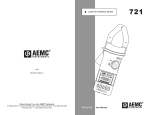
Clamp-On Harmonic Meter Model 725
Description
DESCRIPTION
The Clamp-On Harmonic Meter Model
725 is a portable, battery operated power
quality instrument. The Model 725 combines the simplicity and familiarity of digital clamp-ons with today’s critical information on power quality and harmonics.
Operation is simple and direct. Select
Amps/Volts, AC or DC on the rotary dial,
connect, ad measure. The push of a button gives additional or more specific information. You can trouble shoot and measure power power quality and harmonics
with the ease of using a digital clamp-on,
simply, safely, and economically.
The Model 725 performs current and voltage measurements in True RMS as well
as current and voltage in DC, and provides immediate readings of Total
Harmonic Distortion (%THD), Individual
Harmonic order Hdc and 1st through the
25th, Distortion Factor (%DF), Crest
Factor (CF) and Peak of distorted currents and complex voltages. It also gives
the Min, Max, and Average measurement
values so you can record for over 24
hours with an internal clock logging
record time. Frequency (Hz) can be measured through either the current or the
voltage at any time for the fundamental
as well as the individual harmonic orders.
The Model 725 incorporates True RMS
electronics and Hall effect technology to
ensure accurate readings on distorted
waveforms. The Model 725 uses two balanced Hall sensors to measure current.
The voltage and current inputs are filtered, amplified, and sampled by a 12-bit
analog-to-digital converter. A 16-bit
microprocessor assures all calculations,
including an FFT, and recordings. An 8bit microprocessor assures the management of the measurement functions, the
LCD and the EEPROM memory configuration.
The user may select Auto Ranging or
Manual Ranging, AC or DC + AC measurements, and even/odd or odd only
individual harmonics. The Model 725 also
provides percent Ripple for DC measurements, Crest Factor for half cycle peaks,
Transformer Harmonic Derating Factor
(THDF) and K-Factor. The Smooth function provides a 3-second measurement
average for stable readings, and Hold
locks a reading on the display.
The combination digital/analog display
gives measurements on a large 4-digit,
10,000 display, with a 31-segment bar
graph to indicate trends and surges.
During harmonics measurements, the
primary/secondary display format allows
dual monitoring of measured values.
Other features include Auto Off to conserve battery power, low battery indicator, battery voltage test for current battery
status, and a beeper for verification of
control and MIN/MAX capture.
Beyond the absolute product ruggedness and overall design qualities, the
Model 725 is built with GE Lexan® and
meets specific physical standards. The
Model 725 also meets or exceeds UL®
1244 safety standards as well as IEC
1010-1 Category III for 600 V ratings.
The Model 725 is comfortable to hold,
compact and easy to maneuver in a
crowded breaker panel or transformer.
Yet the hooked jaw design facilitates
clamping and accommodates two 500
MCM conductors.
The high sensitivity Model 725 features
another uncommon advantage by measuring low input levels (300 mA and 50
mV), permitting power quality measurements on low power or idling equipment.
OPERATIONS & FUNCTIONS
CURRENT & VOLTAGE
The Model 725 performs current and
voltage measurements in True RMS as
well as current and voltage in DC.
Voltage and current measurements may
be displayed as AC only or as AC + DC,
indicating that the measurement includes
the DC component. Significant amounts
of DC current in any distribution system
can shorten the lives of transformers,
motors and switch mode power supplies.
DC is also useful for UPS battery measurements and DC motor drive currents.
During DC measurements, the Model
725 can be used to display the percentage of AC ripple in a DC signal.
HARMONIC DISTORTION
Pressing the HARM push button in AC
volts or AC amps accesses a range of
harmonics information. The 725 will display the amplitude or frequency of individual harmonics, the percentage of each
referenced to the fundamental or to the
total RMS, as well as %THD (total harmonics referenced to the fundamental)
and %DF (total harmonics referenced to
total RMS). These parameters permit
identification of harmonic sources and
their magnitude.
The Model 725 may be set up to display
both odd and even harmonics, which normally cause the greatest concern in electrical distribution systems. The bar graph
simultaneously displays the True RMS
signal value in real time to indicate sudden variations. During harmonics measurements, the dual screen mode simultaneously indicates harmonics information and rotary switch selection on separate screens.
TRANSFORMER EVALUATION
Crest Factor: Crest factor measurements, which can be performed on amps
or volts AC, may be sed to evaluate harmonic content. Measure the output voltage waveform of you UPS to verify that
no “flat-topping” of the waveform is
occurring (CF < 1.414).
K Factor: K Factor information may be
accessed in the harmonic mode while
measuring AC current. The K factor is
essentialy an index of a transformer’s
ability to handle nonlinear load current
without overheating. Applying a K factor
rated transformer helps ensure that dangerous heating or transformer failure will
not result due load currents rich in harmonic content. The K Factor may also be
used to verify that a currently installed K
Factor rated transformer is correctly
loaded with nonlinear devices. A typical
rating for a transformer supplying power
with a variable speed drive is K-4.
Typically, a K-20 is required on mainframe computer loads.
THDF: THDF, or transformer Harmonic
Derating Factor, is accessed through the
AC current range. THDF is a method of
calculating transformer derating established by the Computer and Business
Equipment Manufacturers Association
(CBEMA) for phase-to-neutral loads.
THDF can be applied to electrical sys-