1
3
Proto Language Essentials
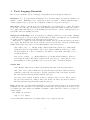
Here are some essentials to the Proto language, along with the most frequently used functions.
Evaluation Proto is a purely functional language. Proto is written using s-expressions in a manner very
similar to Scheme. Evaluating a Proto expression produces a program: a dataflow graph that may be
evaluated against a space to produce an evolving field of values at every point on the space.
Data Types All Proto expressions produce fields that map every point in space to a value. The values
produced are categorized into four basic types: fields, lambdas, tuples, and scalars. A number is a scalar or
vector (tuple with scalar values), a local is anything but a field, and a boolean is a scalar interpreted as a
logical value: false is 0, anything else is true.
Namespaces and Bindings Proto is a lexically scoped language. Names are not case sensitive. Bindings
contain values and are looked up by name. Lexical bindings are visible only within the scope in which they
are bound, and shadow bindings of the same name from enclosing scopes.
When the Proto compiler encounters an unknown identifier name, it searches its path for a file named
name.proto. If it finds such a file, then it loads the contents of the file and looks up the identifier again.
Definitions in subdirectories can be accessed with identifiers of the form dir/name.
(def .name (.arg ...) ,@body): Define a function name in the current scope, with as many
arguments as there are arg identifiers. The body is evaluated within an extended scope where
the arg identifiers are bound to arguments to the function. fun, which omits name, creates
anonymous functions.
(let ((.var ,value) ...) ,@body): Extends scope, binding all var identifiers to their associated value in parallel. The body is evaluated in the extended scope. let* is like let, except
that identifies are bound sequentially, so later ones can use earlier ones in their definition.
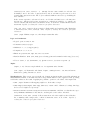
Control Flow
(all ,@forms): All forms are evaluated in parallel and the value of the last form returned.
(mux ,test ,true ,false): Evaluates both true and false expressions. When test is true,
returns the result of the true expression, otherwise returns the result of the false expression.
The true and false expressions must return the same type.
(if ,test ,true ,false): Restricts execution to subspaces based on test. Where test is
true, the true expression is evaluated; where test is false, the false expression is evaluated.
The true and false expressions must return the same type.
State Because Proto is a purely functional language, we create state using feedback loops. A state variable
is initialized at some value, then evolves that value forward in time. In regions where the feedback loop is
not evaluated, the state variable is reinitialized, resuming evolution when the feedback loop begins to be
evaluated again.
For example, the expression:
(rep t 0 (+ t (dt)))
creates a timer that returns how long evaluation has been proceeding at each device.
2