1
US008250604B2
(12) Ulllted States Patent
(10) Patent N0.:
Unger et a].
US 8,250,604 B2
(45) Date of Patent:
(54) NEAR REAL-TIME MULTIPLE THUMBNAIL
i
Aug. 21, 2012
23611 Ft a1~ ~~~~~~~~~~~~~ ~ 3753/
lIl'llZu
GUIDE WITH SINGLE TUNER
(75)
2007/0050813 A1
Inventors: Robert Allan Unger, El Cajon, CA
. . . . . . . . . . . . . . . . . . . . . . ..
3/2007 Lee
FOREIGN PATENT DOCUMENTS
(Us); James Alnell?lolagilles San
W0
W0 9607270 A1
Marcos, CA (U S)
3/1996
OTHER PUBLICATIONS
(73) Assignees: Sony Corporation: Tokyo (JP); Sony
“InterVideo Home TheaterTM 2, Platinum,” InterVideo, Corel
Electronics Inc., Park Ridge, NJ (US)
Website, © 2008,
“Time Warner Cable Mobile TV”, Time Warner Cable Website, ©
(*)
Notice:
Subject to any disclaimer, the term of this
patent is extended or adjusted under 35
U_S_C_ 1540;) by 749 days_
2008.
“Win/TV-Celebrity Digital Video Board,” Win/TV Celebrity, Haup
pauge Computer Works, Inc., © 1995.
Robotfunk FloWmotion 2.0 User Manual, © 2000-2003.
(21) App1.No.: 12/012,766
* Cited by examiner
(22)
Primary Examiner * Scott Beliveau
Filed:
Feb‘ 5’ 2008
(65)
Prior Publication Data
US 2009/0199241 A1
Assistant Examiner * Patrick A Ryan
(74) Attorney, Agent, or Firm * Miller Patent Services;
Aug. 6, 2009
Jerry A_ Miller
(51) Int- Cl-
(57)
(2006.01)
G06F 13/00
(2006 01)
A method of present1ng a v1deo electron1c program gu1de
(200601)
'
_
725/44
725/41 _ 715/838
(EPG), consistent With certain embodiments involves estab
c anne s, Wit a se ecte c an
1 is11ing.a sortin.g o f te 1 evision
.
.11. 1
11
1
‘1 11.
H04N 5/455
(52) us. Cl.
58
ABSTRACT
G06F 3/00
F M f
( ) S16
"" "_ ""
h
.
’
0 1, a?“ glatlqon earcl """"
ee app lcanon
(56)
e or Comp ete Seam
’
N
""" "
one
lstory'
.
.
.
nel hav1ng a h1ghest sort1ng pnor1ty, and other channels be1ng
arranged in pairs in a hierarchy beloW the selected channel;
displaying a plurality of WindoWs representing a plurality of
References Cited
the channels in a cross media bar menu arrangement, With the
principal focus channel being represented at a WindoW
U S PATENT DOCUMENTS
appearing at an intersection of horizontal and vertical bars in
' '
g’j
the cross media bar menu arrangement and the pairs of chan
*
639343964 B1
7,743,343 B2 *
2002/0171686 A1
340/825 24
nels arranged on either side of the selected channel in the
8/2005 Schaffer et ai‘ """"" "
'
6/2010 Fong et a1. .................. .. 715/841
ggii?glzfglal'
cross media bar menu arrangement; and retrieving sample
clips of the channels in focus section of the sort order, and
11/2002 Kamen et a1.
*
2003/0221 192 A1,, 110003 Raggtlpon et a1
2005/0138564 A1 *
6/2005
2005/0273838 A1 *
12/2005
2006/0031880 A1 *
presenting the clips as repeating clips in their respective Win
lifrswor?ly et a1 ~~~~~~~ ~~ 348/565
Fogg .............. ..
Witheiler ..
725/4l
.. 715/745
doWs. This abstract is not to be considered limiting, since
other embodiments may deviate from the features described
in this abstract
.... .. 725/126
2/2006 Stark et a1. .................... .. 725/45
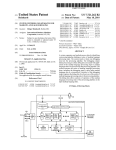
18 Claims, 9 Drawing Sheets
USER INVOKES
MENU AND
SELECTS CHANNEL
CATEGORY ‘EG ,
FAVOR‘TES)
TUNE TUNER TO
CENTER CHANNEL
C IN CATEGORY
CHECKIF ANY OF
CH, 01, 0+2, C-Z
ARE 1N SAME TS
CACHE N SECOND
CLiP 0F CENTER
CHANNEL AND M OR
P SECOND CLIP OF
OTHER CHANNELS
1
BEGIN REPEATING
DiSPLAY OF CENTER
CACHE N M OR P
SECOND CLIP OF
CHANNEL CLIP AND
ANY OTHER CACHED
ANY OF 011, 0-1,
C+Z C-Z CHANNELS
CUPS
IN TS
A
TUNE TO TS FOR
ONE OF REMAiNiNG _/
UNCACHED
CHANNELS
US. Patent
Aug. 21, 2012
Sheet 1 019
US 8,250,604 B2
CHANNEL 7.1
(C+2)
'\
CHANNEL 2.4
(0+1)
18
J
12
10 \
j
K 14
FAVORITES
. . .
SPORTS
(DEFAULT CHANNEL 3.2
:C)
NEWS
'
CHANNEL 2.3
(6-1)
\
22
FIG. 1
\_
CHANNEL 3.3
((3-2)
0 . .
US. Patent
o 0 0
Aug. 21, 2012
SPORTS
FIG. 2
Sheet 2 of9
US 8,250,604 B2
US. Patent
Aug. 21, 2012
7.1
Sheet 3 of9
C “
ST
HF
UHEIQ
10\
0 a 0
SPORTS
FIG. 3
3.3N
“MEET
TH " 88" j
/
a
US 8,250,604 B2
US. Patent
' ' .
Aug. 21, 2012
SPORTS
FIG. 4
Sheet 4 of9
US 8,250,604 B2
US. Patent
Aug. 21, 2012
3@
I8
TUNE TUNER TO
CHANNEL = C-1
I \52
USER INVOKES
MENU AND
SELECTS CHANNEL
CACHE M SECOND CLIP
OF CHANNEL C-1
CATEGORY (E.G.,
FAVORITES)
I
I
‘CR
TUNE TUNER TO
CENTER CHANNEL
C IN CATEGORY
I
BEGIN REPEATING
DISPLAY OF CENTER
CHANNEL CLIP
I
/46
TUNE TUNER TO
CHANNEL = C+1
I
CACHE M SECOND CLIP
4&
OF CHANNEL 0+1
I
58
I
\
TUNE TUNER TO
I r60
CACHE P SECOND CLIP
62\ I
BEGIN REPEATING DISPLAY
OF CHANNEL C+2
I
TUNE TUNER TO
CHANNEL = 0-2
L\
I
CACHE P SECOND CLIP
OF CHANNEL C-2
I \66
BEGIN REPEATING DISPLAY
OF CHANNEL C+1
K50
FIG. 5
BEGIN REPEATING DISPLAY
OF CHANNEL C-‘I
OF CHANNEL C+2
I
K
O1 05
CHANNEL = C+2
CACHE N SECOND
CLIP OF CENTER
CHANNEL
\
US 8,250,604 B2
Sheet 5 0f 9
BEGIN REPEATING DISPLAY
OF CHANNEL C-2
64
US. Patent
Aug. 21, 2012
;
US 8,250,604 B2
Sheet 6 0f 9
104
USER INVOKES
MENU AND
SELECTS CHANNEL
FIG. 6
CATEGORY (E.G.,
FAVORITES)
T
@__,
40
TUNE TUNER TO
CENTER CHANNEL
C IN CATEGORY
T
CHECK IF ANY OF
C+1, C-1, C+2, C-2
ARE IN SAME TS
114
T
CACHE N SECOND
CLIP OF CENTER
\_ CHANNEL AND M OR
P SECOND CLIP OF
OTHER CHANNELS
IN TS
134
T
\
CACHE N M OR P
BEGIN REPEATING
DISPLAY OF CENTER
CHANNEL CLIP AND
ANY OTHER CACHED
CLIPS
SECOND CLIP OF
ANY OF C+1, C-I,
C+2, C-2 CHANNELS
IN TS
I
TUNE TO TS FOR
ANY OF C+1, C-1, C+2, C-2 REMAIN
UNCACHED?
NO
126
YES
ONE OF REMAINING
UNCACHED
CHANNELS
130
US. Patent
Aug. 21, 2012
Sheet 7 of9
US 8,250,604 B2
RETURN TO FULL
DISPLAY OF
SELECTED
@
162
CHANNEL
170
166
CHANNEL
SCROLLED?
174
NEW CENTER J
CHANNEL = C
178
FIG. 7
US. Patent
Aug. 21, 2012
Sheet 8 of9
US 8,250,604 B2
RETURN TO FULL
DISPLAY OF
162
/
SELECTED
CHANNEL
170
166
CHANNEL
SCROLLED?
100
20s
FIG, 8
CACHE CLIP FOR NEWLY
ExPoSED CHANNEL
WINDOW AND DISPLAY IN
NEWLY ExPoSED WINDOW
174
NEW CENTER J
CHANNEL = C
178
RETURN TO A
US. Patent
Aug. 21, 2012
Sheet 9 of9
US 8,250,604 B2
254
\
TUNE CHANNEL
L
$39
COMMERCIAL
CHECK
\
262
266
NO
YES
FIG. 9
SKIP CHANNEL AND
RETURN LATER
f WHEN COMMERCIAL
276
ENDED
270
US 8,250,604 B2
1
2
NEAR REAL-TIME MULTIPLE THUMBNAIL
GUIDE WITH SINGLE TUNER
be described in detail speci?c embodiments; With the under
standing that the present disclosure of such embodiments is to
COPYRIGHT AND TRADEMARK NOTICE
be considered as an example of the principles and not
intended to limit the invention to the speci?c embodiments
shoWn and described. In the description beloW, like reference
A portion of the disclosure of this patent document con
numerals are used to describe the same, similar or corre
tains material Which is subject to copyright protection. The
sponding parts in the several vieWs of the draWings.
copyright oWner has no objection to the facsimile reproduc
tion of the patent document or the patent disclosure, as it
appears in the Patent and Trademark Ol?ce patent ?le or
The terms “a” or “an”, as used herein, are de?ned as one or
more than one. The term “plurality”, as used herein, is de?ned
as tWo or more than tWo. The term “another”, as used herein,
is de?ned as at least a second or more. The terms “including”
records, but otherWise reserves all copyright rights Whatso
ever. Trademarks are the property of their respective oWners.
and/or “having”, as used herein, are de?ned as comprising
(i.e., open language). The term “coupled”, as used herein, is
de?ned as connected, although not necessarily directly, and
BACKGROUND
not necessarily mechanically. The term “program” or “com
It is commonplace for electronic program guides (EPGs)
used to navigate a multitude of television channels to provide
a listing including text descriptions of titles of programs.
puter program” or similar terms, as used herein, is de?ned as
Sometimes text descriptions may not sul?cient for a vieWer to
make an informed selection of What to Watch on TV. Hence,
“channel sur?ng” is a popular means for ?nding a program.
puter system. A “program”, or “computer program”, may
a sequence of instructions designed for execution on a com
include a subroutine, a function, a procedure, an object
20
When tWo or more tuners are available, a clip or trailer can
tion, an applet, a servlet, a source code, an object code, a
be provided by using the secondary tuner to “surf” While a
primary tuner continues to provide a primary program. But,
generally When only one tuner is available, only one shoW can
be vieWed at a time. If the user is “sur?ng” for the next shoW
to Watch, he can only see one active channel at a time. A
common solution is to have a single live playback in the
corner of the screen based upon the highlighted entry in the
on-screen text display.
BRIEF DESCRIPTION OF THE DRAWINGS
Certain illustrative embodiments illustrating organiZation
and method of operation, together With objects and advan
tages may be best understood by reference detailed descrip
tion that folloWs taken in conjunction With the accompanying
draWings in Which:
shared library/ dynamic load library and/ or other sequence of
25
30
populating the menu bar With video clips in a manner consis
tent With certain embodiments of the present invention.
35
40
appearances of such phrases or in various places throughout
embodiment. Furthermore, the particular features, structures,
or characteristics may be combined in any suitable manner in
45 one or more embodiments Without limitation.
The term “or” as used herein is to be interpreted as an
inclusive or meaning any one or any combination. Therefore,
50
The term “processor”, “controller”, “CPU”, “Computer”
and the like as used herein encompasses both hard pro
consistent With certain embodiments of the present invention.
grammed, special purpose, general purpose and program
55
mable devices and may encompass a plurality of such devices
or a single device in either a distributed or centraliZed con
invention.
FIG. 8 is another How chart depicting a channel scroll
operation in a manner consistent With certain embodiments of
?guration Without limitation.
the present invention.
60
sion consistent With certain embodiments of the present
invention.
In certain embodiments, the present invention provides a
method to provide near real-time thumbnail clips of real time
content for navigation and selection. Since sometimes text
descriptions are suitably informative to make an informed
selection of What to Watch on TV. The equivalent of a movie
trailer is desired. With only one tuner, only one shoW can be
vieWed at a time. If the user is “sur?ng” for the next shoW to
DETAILED DESCRIPTION
65
While this invention is susceptible of embodiment in many
different forms, there is shoWn in the draWings and Will herein
“A, B or C” means “any ofthe folloWing: A; B; C; A and B; A
and C; B and C; A, B and C”. An exception to this de?nition
Will occur only When a combination of elements, functions,
steps or acts are in some Way inherently mutually exclusive.
of populating the menu bar With video clips in a manner
FIG. 9 is a How chart depicting a commercial check deci
other program-like content Which may not be reported as a
program in an electronic program guide.
Reference throughout this document to “one embodi
ment”, “certain embodiments”, “an embodiment” or similar
terms means that a particular feature, structure, or character
istic described in connection With the embodiment is included
in at least one embodiment of the present invention. Thus, the
this speci?cation are not necessarily all referring to the same
FIG. 6 is a How chart depicting another example operation
FIG. 7 is a How chart depicting a channel scroll decision in
a manner consistent With certain embodiments of the present
instructions designed for execution on a computer system.
The term “program”, as used herein, may also be used in a
second context (the above de?nition being for the ?rst con
text). In the second context, the term is used in the sense of a
“television program”. In this context, the term is used to mean
any coherent sequence of audio video content such as those
Which Would be interpreted as and reported in an electronic
program guide (EPG) as a single television program, Without
regard for Whether the content is a movie, sporting event,
segment of a multi-part series, neWs broadcast, etc. The term
may also be interpreted to encompass commercial spots and
FIG. 1 is an exemplary depiction of a cross media bar menu
consistent With certain embodiments of the present invention.
FIG. 2 is another exemplary depiction of a cross media bar
menu having video icons consistent With certain embodi
ments of the present invention.
FIG. 3 is another exemplary depiction of a cross media bar
menu having video icons and text overlay consistent With
certain embodiments of the present invention.
FIG. 4 is another exemplary depiction of a cross media bar
menu having video icons after channel scrolling consistent
With certain embodiments of the present invention.
FIG. 5 is a How chart depicting an example operation of
method, an object implementation, in an executable applica
Watch, he can only see one active channel at a time.
In certain embodiments, this invention captures short clips
from multiple channels on “both sides” of the highlighted
US 8,250,604 B2
3
4
channel as Well as the highlighted channel. As used herein, the
forming a part of the Electronic Program Guide (EPG) or
“highlighted channel is considered the channel of primary
menu system that de?nes the order in Which the programs
appear in the text, graphical or (in the case of embodiments
focus, Whereas other channels appearing on the video menu
system may be considered to be of secondary or peripheral
consistent With the present invention) video depictions. This
focus. A single tuner can scan a group of channels and cache
ordering, if automated can use any suitable algorithm includ
thumb-nail video clips to play in “repeat” mode. This Way the
ing ?xed placement, order of frequency, time of vieWing,
“surfer” can broWse the channel list vieWing “cached” thumb
proximity in the transport stream, or manual selection by the
nail video clips of the recently captured channels. These clips
vieWer. In any event, the program guide or menu system
establishes a sorting of television channels, With a selected
can play alongside the program’s text description, as a clip
based Cross Media Bar (XMB) display, or other formats as
channel having a highest sorting priority, and other channels
being arranged in pairs in a hierarchy beloW the selected
desired for the user interface.
In embodiments consistent With the present invention a
“cache” of short clips is captured from multiple channels.
Any or all of the cached clips can be displayed simulta
neously. The channel navigation system can pre-fetch chan
nels to be cached based on location of the neighboring chan
nels in the sort order. Any suitable sorting algorithm can be
used to calculate the proximity of channels based on current
sort mode: genre, title, station ID, Network, favorite list, auto
favorite (list could keep track of the amount of time a given
program/genre is vieWed, and sort based on past use), etc.
20
Applications using XMB provide a good example as
shoWn in the descriptions beloW. At any point in time there
Will be a ?nite number of channels of interest. Snapshot clips
of these channels are captured in a rotating sequence With the
egory, Which may be numerically arranged, arranged accord
ing to proximity in the transport stream (TS) or manually
25
primary thumbnail alternating With the other six. Each snap
arranged by the user or as determined by some other algo
rithm. It is illustrative to note that a random sequence of high
de?nition HD virtual channel numbers have been a?ixed to
these channels Which are designated C+l (18), C+2 (20), C-1
(22) and C-2 (24). The channel numbers of 7.1, 2.4, 3.2, 2.3
and 3 .3 have been designated purely as an indication that they
shot Will cover a short span of time (eg up to about 30
seconds or so). An example sequence might be C for the
center channel, C+l, C, C-l, C, C+2, C, C-2, C, C+3, C, C-3,
C repeating until the primary is rotated to another selection or
the current primary focus is selected to be Watched.
While embodiments consistent With this invention make
channel
In the example shoWn, a total of ?ve channels may be
presented as menu selections for ease of explanation, but
more or feWer may be presented Without departing from
embodiments consistent With the present invention. In this
example, the default channel that appears in the center is
referred to as channel C. The channel may be default by virtue
of any desired mechanism (e.g., last vieWed channel on the
favorites list or default as designated by the vieWer). Above
and beloW default channel C are other channels in this cat
30
may not be in numerical order.
In accord With certain embodiments consistent With the
present invention, When the menu is invoked and, for example
“favorites” is selected, the initial vieW Will display either
use of a single tuner to obtain the thumbnails, TVs With an
internet connection can probably get thumbnails online as
the tuner, the TV can send a request for meta-data to a ho st on
icons or virtual channel listings in text, and may further dis
play other information about the content.
Referring noW to FIG. 2, it is desirable in accord With
embodiments consistent With the present invention to begin
the Internet (e.g., using Sony’s Bravia Internet Video Link
populating the WindoWs 12, 18, 20, 22 and 24 With video clips
Well. In the case of the Internet, the caching system can be
more elaborate: Instead of caching a live video stream using
(BIVL) protocol). Meta-data can include a “previeW” video
clip highlighting the channels current shoW. Since this Would
be a canned video clip, it can potentially shoW-off the focus
program better than a cached clip of the live video channel.
Other meta-data can also be passed including text descrip
tions, related shoWs etc.
Turning noW to FIG. 1, this ?gure illustrates an exemplary
cross-media bar (XMB) menu system similar in con?guration
to that currently in use With Sony Electronics Inc.’s and Sony
35
40
retrieve clips of content With Which to ?ll the WindoWs 12, 18,
20, 22 and 24. Since only one tuner may be available, this can
be achieved by ?rst tuning and receiving channel C, Which by
45
WindoWs are sequentially retrieved. Since the user might logi
50
sports, neWs, favorites, movies, etc.). When the user navigates
cally select highly preferred channels at WindoW locations
C-1 and C+l (WindoWs 18 and 22), it folloWs that these
channels might be retrieved sequentially next for a period of
time M, Which might be a shorter period of time (e.g., 5 to 15
seconds). Finally, the channels C-2 and C+2 can be retrieved
to a desired source or collection, a vertical bar appears pro
viding a listing of members of the collection or television
channels. In this example, three of the series of horiZontal
channel selections are shoWn as sports 10, favorites 12, and
virtue of default status shouldbe of high likelihood of interest.
This clip is shoWn in WindoW 12 and retrieved for a suitable
period oftime N (e.g., 10 to 20 seconds). After this point, the
clip is repeated in this WindoW 12 While clips for the other
Corporation’s Bravia® series television sets. In such an
arrangement, horiZontal icons may be used to represent
sources of content or collections of television channels (e.g.,
or trailers to provide a more dynamic environment from
Which the vieWer can select content. Hence, it is desirable to
sequentially to place repeating clips in WindoWs 20 and 24.
55
These clips might also be shorter (e.g., 5 to 15 or 5 to 10
neWs 14. In this example, assume that the user selects favor
seconds). Initially, it may be desirable to populate the various
ites 12 by navigation using navigation controls (after invok
WindoWs With text or icons from the system information
ing the menu system). It is also assumed that only one tuner is
available in the present application, but embodiments may
also utiliZe multiple tuners.
In certain embodiments, upon invoking the menu and
selecting favorites, normally an array of television program
titles Will appear vertically. Alternatively, a set of icons rep
resenting netWorks or the like may be presented. HoWever, the
user may Wish to see clips of programming content When this
selection is made. In any case, it is assumed that an order has
been established either manually or by a sorting algorithm
available until video clips can be captured, and then overlay
the image With text and/or logos. Or, alternatively, the splice
60
point betWeen videos could be occupied With a netWork logo,
program title, other text from the meta-data, etc.
Hence, preferably, the center channel C Will display the
longest repeating clip While the channels farther from the
65
center might display the same or shorter length clips or pro
gressively shorter clips as the WindoW gets farther aWay from
center. Also recall that for convenience, the present example
shoWs only ?ve such WindoWs, but seven or nine, or more or
US 8,250,604 B2
5
6
less may also be present. In such case, the general procedure
segment of the content at 42 so that the user can immediately
is the same. It is also noted that for digital content, a single
begin taking advantage of the previeW of the content. When N
receiver may be able to effectively retrieve more than one
seconds of content have been displayed, those N seconds are
cached and begin repeating at 44. The tuner then moves on to
channel simultaneously if they are a part of the same transport
stream, by simply ?ltering more than one set of content for
caching based on the packet identi?ers for the channels occu
pying the same transport stream. In such case, the actual
proximity of the WindoW to the center position Would play a
tune channel C+1 at 46 While preferably simultaneously
shoWing the real time content at WindoW 18 While caching M
seconds of the content at 48. Once M seconds are cached, the
M second clip may begin repeated play at 50. A similar
secondary role in favor of more rapid population of the Win
process is repeated to tune to channel C—1 at 52 While dis
doWs.
In one preferred implementation, the center channel Win
playing the content in WindoW 22, caching M seconds of
channel C—1 and repeating play of the clip at 52, 54 and 56
doW Would provide a clip of longest duration, the WindoWs
respectively. N, M and P are referred to as the clip times and
closest to center Would be someWhat shorter in duration and
the duration of the clips farther from the center Would be of
can vary in a number of Ways as Will be discussed.
decreasing duration. This permits more rapid population of
display clips of length P at 58, 60 and 62 for channel C+2, and
A similar process is carried out to capture and repeatedly
the WindoWs and places emphasis on the WindoWs closest to
at 64, 66 and 68 for channel C-2. The process can be similarly
center.
incremented for additional channels if more than ?ve are to be
FIG. 2 depicts the fully populated WindoWs With moving
video playing in each WindoW. In certain embodiments, sev
eral features can be added to enhance the quality of the chan
nel selection experience. In one enhancement, once all Win
shoWn in the EPG. It is noted that the tuning time plus time for
capture of the cache should be optimiZed for a given system
20
since acquisition of a neW channel can take approximately 1
second, up to ?ve seconds can be consumed in this process
doWs are populated, the process repeats so that a more recent
plus the actual time for doWnload of the sample clip. Hence,
clip continually repopulates the various WindoWs. In another
clip length should be balanced With user friendliness of the
interface. Several example times for display of the samples,
embodiment, commercial detection can be used to avoid
shoWing repeated clips of commercial spots rather than tele
25
Without intent of limitation, for a ?ve channel interface
include 20-15-7, 15-10-5, or 20-10-10 or 15-5-5 seconds
starting at the channel C and moving outWard. Thus, P can be
shorter or equal to M, or all channel time clips can be
30
that the virtual channel information or broadcaster logo may
be displayed as an overlay for reference in these WindoWs 12,
vision programming. Several processes Will be described
later and this enhancement can be added in the manner
depicted.
Weighted equally to produce 10-10-10, etc. It is also noted
In the event tWo tuners are available, one tuner can con
tinuously shoW the real time broadcast of channel C in Win
doW 12 While the second tuner retrieves the clips used to
populate Windows 18, 20, 22 and 24. Moreover, if trailers are
18, 20, 22 and 24 along With the video clips.
available from another source available to the receiver (e.g.,
set top box) such as the Internet, these trailers can be retrieved
to populate the various WindoWs instead of or as a supplement
The process speed can be potentially enhanced by use of a
process 100 depicted in FIG. 6 starting at 104. At 36, the user
35
to caching clips from live broadcast.
invokes the menu and selects a channel category as described
FIG. 3 depicts the EPG as shoWn in FIG. 2 supplemented
previously. The tuner then tunes to the center channel in the
category as before at 40. HoWever, it is noted that if any of
by overlay of channel and netWork information. Any variety
channels C+1 (18), C+2 (20), C—1 (22) and C-2 (24) are
of information can be presented in this manner as an overlay
including program name, virtual channel, network, netWork
carried on the same transport stream at 114 from the source,
40
logo, description, etc.
since several channels are often accommodated by a single
Referring noW to FIG. 4, the EPG (absent the text or icon
transport stream, it is possible to speed up the process. In this
case, the caching and populating of the WindoW of several
overlay for ease of vieWing in these diagrams) is depicted
programs can be carried out simultaneously at 118. Those
after the user utiliZes the remote controller or other control
mechanism to scroll doWn the channels by one channel. In
45
this case, clips continue playing for those channels that have
position at 122. When all of the WindoWs have been cached at
126, the process can return to 40 Where updating of the
WindoWs can begin. If any WindoWs remain to be populated at
been captured, While a neW clip is cached for the neW channel
in the WindoW (or WindoWs) that are revealed. The clips
already playing may be truncated (e. g., the clip from channel
C moves to C—1 and may be reduced in length according to
50
the established time for positions adjacent the center). Simi
larly, at the next opportunity, the length of the clips moving
their length. Moreover, clips from channels not yet exposed
populating each of the WindoWs With a short clip and live
55
Will occur to those skilled in the art upon consideration of the
present teachings.
When the user scrolls to a neW channel or selects a channel
60
using the order C, C+1, C—1, C+2, C-2, but other orderings
can be easily adapted (e.g., C, C—1, C+1, C-2, C+2; or C,
C+1, C, C—1, C, C+2, C, C-2; etc.). The user invokes the
menu system and selects a category (e.g., favorites, sports,
neWs, Weather, local channels, etc.) at 36. At 40 the receiver is
directed to begin reception of channel C and displays the
content in the WindoW 12 simultaneously With caching a
video can be presented in the C channel WindoW until a
channel is changed. Many other variations are possible and
consideration of the present teachings.
One elementary example of the basic process 30 is depicted
in FIG. 5 for populating the menu With video clips starting at
32. In this embodiment, channel WindoWs are populated
126, the tuner tunes to an un-cached channel at 130 and
caches any channels in that transport stream at 134 and con
trol returns to 122. In this manner, the WindoWs can poten
tially be populated With clips more rapidly. In another
embodiment, further speed enhancement can be achieved by
into positions closer to or at the center are updated to increase
can be pre-fetched for immediate use When the user scrolls to
a neW center channel. Many variations Will be apparent upon
cached programs can then be repeated in their respective
WindoWs for the respective time designated for the WindoW
for vieWing, the operations 150 of FIG. 7 can be carried out
starting at 154. If a channel is selected at 158, the system exits
the menu display and begins to display the selected channel
on the full screen or other normal vieWing mode at 1 62 and the
menu process ends at 166 until re-invoked by the user. If a
65
channel is scrolled up or doWn at 170, the position of the
images Within the WindoWs (and possibly the relative siZe of
the imageiWith C being largest) are shifted to the next
US 8,250,604 B2
7
8
position. The tuner then sets a new channel C at 174. The
process can then return to 40 in process 30 in one embodi
ment, or to 40 in process 100 in another embodiment at 178.
display of the cross media bar menu, and displaying the
selected channel in a normal vieWing mode. In certain
embodiments, the method can be carried out using a single
television receiver. A computer readable storage medium can
Other variations are also possible.
Another variant is depicted as process 200 starting at 204 in
FIG. 8 Which is similar process 150 except that the tuning,
store instructions Which, When executed on one or more pro
grammed processors, carry out any of the above processes.
In another embodiment, a method of presenting a video
electronic program guide (EPG) involves establishing a sort
ing of television channels, With a selected channel having a
capturing and repeat display process (e.g., as in 64, 66 and 68
of process 30) are carried out at 208 for the neWly exposed
channel resulting from the scrolling operation prior to reset
ting and tuning to the channel noW occupying the C position.
This rapidly populates the vacant channel position before
highest sorting priority, and other channels being arranged in
pairs in a hierarchy beloW the selected channel; displaying a
plurality of WindoWs representing a plurality of the channels
proceeding back to a process similar to that of process 30 or
100.
in a cross media bar menu arrangement, With the principal
focus channel being represented at a WindoW appearing at an
intersection of horizontal and vertical bars in the cross media
bar menu arrangement and the pairs of channels arranged on
A variant in any of the above process is depicted as process
250 of FIG. 9 starting at 250. In this variant, each tuning
process at 258 is folloWed by a check to see if the channel is
currently playing a commercial spot at 262. If not, the process
proceeds as normal at 270. If a commercial spot is currently
either side of the selected channel in the cross media bar menu
playing, the channel is skipped at 276 and the process (e.g.,
focus section of the sort order, and presenting the clips as
similar to 30 or 100) then proceeds to the next channel and
returns at a later time to capture the clip for the channel after
arrangement; and retrieving sample clips of the channels in
20
sample clip has a clip time, and Wherein the clip time of the
principal focus channel’s clip is longer than the clip time of
other clips in the sort, and Wherein the clip time of each clip
decreases With increasing distance from the principal focus
the commercial spot is completed.
Many variations are possible Without departing from the
scope of embodiments consistent With the present invention.
By Way of example, although the XMB interface Was
repeating clips in their respective WindoWs, Wherein each
25
depicted With the video WindoWs arranged vertically, they
could equally Well be arranged horiZontally.
clip.
In certain embodiments, repeating the retrieving and pre
senting can be carried out at a prioritiZed periodic rate. In
Thus, a method of presenting a video electronic program
certain embodiments, if any tWo or more channels are
guide (EPG), consistent With certain embodiments involves
received over the same transport stream, the order of retrieval
of the tWo or more channels is modi?ed from strictly distance
order, and the clips that are received over the same transport
establishing a sorting of television channels, With a selected
30
channel having a highest sorting priority, and other channels
being arranged in pairs in a hierarchy beloW the selected
channel; displaying a plurality of WindoWs representing a
stream are retrieved substantially simultaneously. In certain
embodiments, the method further involves checking each
channel to determine if its content currently contains a com
plurality of the channels in a cross media bar menu arrange
ment, With the principal focus channel being represented at a
35
WindoW appearing at an intersection of horizontal and vertical
bars in the cross media bar menu arrangement and the pairs of
channels arranged on either side of the selected channel in the
cross media bar menu arrangement; and retrieving sample
clips of the channels in focus section of the sort order, and
mercial spot, and if so, skipping the retrieval and presenting of
any channel currently containing a commercial spot until
such time as the commercial spot has ended. In certain
40
presenting the clips as repeating clips in their respective Win
embodiments, the WindoW siZe for the principal focus chan
nel is larger than the WindoW siZe for others of the channels.
In certain embodiments, the process further involves overlay
ing the video clips With identifying information relating to at
doWs.
least one of the netWork, program or the channel being dis
In certain embodiments, each sample clip has a clip time,
and Wherein the clip time of the principal focus channel’s clip
is longer than the clip time of other clips in the sort. In certain
embodiments, the clip time of each clip decreases With
increasing distance from the principal focus clip. In certain
embodiments, each sample clip has an equal clip time. In
certain embodiments, the retrieving and presenting are
played. In certain embodiments, the method further involves
repeated at a prioritized periodic rate. In certain embodi
receiving a user command for selection of a channel and
45
responsive thereto removing display of the cross media bar
menu, and displaying the selected channel in a normal vieW
ing mode. A computer readable storage medium can store
instructions Which, When executed on one or more pro
50
grammed processors, carry out any of the above processes.
Those skilled in the art Will recogniZe, upon consideration
ments, if any tWo or more channels are received over the same
of the above teachings, that certain of the above exemplary
transport stream, the order of retrieval of the tWo or more
embodiments can be based upon use of one or more pro
channels is modi?ed from strictly distance order, and the clips
grammed processors, computers or other programmable
that are received over the same transport stream are retrieved
devices. HoWever, the invention is not limited to such exem
substantially simultaneously In certain embodiments, the
55
process further involves checking each channel to determine
if its content currently contains a commercial spot, and if so,
skipping the retrieval and presenting of any channel currently
puters, micro-controllers, optical computers, analog comput
containing a commercial spot until such time as the commer
cial spot has ended. In certain embodiments, the WindoW siZe
for the principal focus channel is larger than the WindoW siZe
for others of the channels. In certain embodiments, the
method further involves overlaying the video clips With iden
tifying information relating to at least one of the netWork,
program or the channel being displayed. In certain embodi
plary embodiments, since other embodiments could be
implemented using hardWare component equivalents such as
special purpose hardWare and/or dedicated processors. Simi
larly, general purpose computers, microprocessorbased com
60
ers, dedicated processors, application speci?c circuits and/or
dedicated hard Wired logic may be used to construct altema
tive equivalent embodiments.
Certain embodiments described herein, may be imple
mented using one or more programmed processors executing
65
programming instructions that are broadly described above in
ments, the method further involves receiving a user command
How chart form that canbe stored on any suitable electronic or
for selection of a channel and responsive thereto removing
computer readable storage medium. HoWever, those skilled in
US 8,250,604 B2
9
10
the art Will appreciate, upon consideration of the present
teaching, that the processes described above can be imple
mented in any number of variations and in many suitable
4. The method according to claim 1, further comprising
repeating the retrieving and presenting at a prioritized peri
programming languages Without departing from embodi
5. The method according to claim 1, further comprising
checking each channel to determine if its content currently
contains a commercial spot, and if so, skipping the retrieval
and presenting of any channel currently containing a com
mercial spot until such time as the commercial spot has
ended.
6. The method according to claim 1, Wherein a WindoW siZe
for the principal focus channel is larger than a WindoW siZe for
others of the channels.
7. The method according to claim 1, further comprising
odic rate.
ments of the present invention. For example, the order of
certain operations carried out can often be varied, additional
operations can be added or operations can be deleted Without
departing from certain embodiments of the invention. Error
trapping can be added and/ or enhanced and variations can be
made in user interface and information presentation Without
departing from certain embodiments of the present invention.
Such variations are contemplated and considered equivalent.
While certain illustrative embodiments have been
overlaying the sample clips With identifying information
described, it is evident that many alternatives, modi?cations,
permutations and variations Will become apparent to those
skilled in the art in light of the foregoing description.
relating to at least one of a netWork, a program or a channel
being displayed.
8. The method according to claim 1, further comprising
What is claimed is:
1. A method of presenting a video electronic program guide
(EPG), comprising in combination:
receiving a user command for selection of a channel and
responsive thereto removing display of the cross media bar
20
normal vieWing mode.
establishing a sorting priority of a plurality of television
9. The method according to claim 1, carried out using a
channels that reside on a plurality of separate transport
streams, With a principal focus channel comprising a
selected channel having a highest sorting priority, and
other channels being arranged in pairs of equivalent
single television receiver.
10. A non-transitory computer readable storage medium
25
sorting priority in a hierarchy relative to the selected
guide (EPG), comprising in combination:
Where the sorting priority is determined by a selected cat
egory of channels;
displaying a plurality of WindoWs representing a plurality
establishing a sorting priority of a plurality of television
channels that reside on a plurality of separate transport
streams, With a principal focus channel comprising a
of the channels in a cross media bar menu arrangement,
selected channel having a highest sorting priority, and
other channels being arranged in pairs of equivalent
With the principal focus channel being represented at a
35
selected channel in the cross media bar menu arrange
40
representing the pairs of channels having loWer sorting
priority being equivalently situated progressively fur
of the channels in a cross media bar menu arrangement,
WindoW appearing at an intersection of horiZontal and
vertical bars in the cross media bar menu arrangement
the respective equivalent sorting priority of the pair of
45
sequentially retrieving sample clips of the plurality of tele
and the pairs of channels arranged on either side of the
selected channel in the cross media bar menu arrange
ment, With WindoWs representing the pairs of channels
vision channels that reside on the plurality of separate
transport streams in the selected category in order of the
situated opposite each other relative to the intersection
of the horiZontal and vertical bars and With the WindoWs
sorting priority starting at the highest sorting priority
and proceeding in order to the loWest sorting priority by
tuning to, in order of the sorting priority, each transport
Where the sorting priority is determined by a selected cat
egory of channels;
displaying a plurality of WindoWs representing a plurality
With the principal focus channel being represented at a
ther from the principal focus channel WindoW relative to
channels;
sorting priority in a hierarchy relative to the selected
channel from highest sorting priority to loWest sorting
priority of the other channel pairs;
ment, With WindoWs representing the pairs of channels
situated opposite each other relative to the intersection
of the horiZontal and vertical bars and With the WindoWs
storing instructions Which, When executed on one or more
programmed processors, carry out a process according to
claim 1.
11. A method of presenting a video electronic program
channel from highest sorting priority to loWest sorting
priority of the other channel pairs;
WindoW appearing at an intersection of horiZontal and
vertical bars in the cross media bar menu arrangement
and the pairs of channels arranged on either side of the
menu arrangement, and displaying the selected channel in a
50
representing the pairs of channels having loWer sorting
priority being situated progressively further from the
stream carrying each channel, except that Where a loWer
principal focus channel WindoW relative to the respec
or equal sorting priority channel in the selected category
tive equivalent sorting priority of the pair of channels;
sequentially retrieving sample clips of the plurality of tele
of channels is carried in the same transport stream as a
channel that is currently being retrieved, then the loWer
or equal sorting priority channel is retrieved along With
the channel that is currently being retrieved by selecting
packet identi?ers of the loWer or equal sorting priority
channel; and
presenting the sample clips as repeating clips in their
55
sorting priority starting at the highest sorting priority
and proceeding in order to the loWest sorting priority by
tuning to, in order of the sorting priority, each transport
60
respective WindoWs.
2. The method according to claim 1 Wherein each sample
clip has a clip time, and Wherein the clip time of the sample
clip of the principal focus channel is longer than the clip time
of other sample clips in the sort.
3. The method according to claim 1, Wherein each sample
clip has an equal clip time.
vision channels that reside on the plurality of separate
transport streams in the selected category in order of the
stream carrying each channel, except that Where a loWer
or equal sorting priority channel in the selected category
of channels is carried in the same transport stream as a
65
channel that is currently being retrieved, then the loWer
or equal sorting priority channel is retrieved along With
the channel that is currently being retrieved by selecting
packet identi?ers of the loWer or equal sorting priority
channel; and
US 8,250,604 B2
11
12
presenting the sample clips as repeating clips in their
14. The method according to claim 11, Wherein a WindoW
siZe for the principal focus channel is larger than a WindoW
siZe for others of the channels.
respective WindoWs;
Wherein each sample clip has a clip time, and Wherein the
clip time of the sample clip of the principal focus chan
nel is longer than the clip time of other sample clips in
the sort, and Wherein the clip time of each sample clip
decreases With increasing distance from the sample clip
of the principal focus channel.
12. The method according to claim 11, further comprising
repeating the retrieving and presenting at a prioritiZed peri
odic rate.
15. The method according to claim 11, further comprising
5
overlaying the sample clips With identifying information
relating to at least one of a network, a program or a channel
being displayed.
16. The method according to claim 11, further comprising
receiving a user command for selection of a channel and
responsive thereto removing display of the cross media bar
menu arrangement, and displaying the selected channel in a
normal vieWing mode.
17. The method according to claim 11, carried out using a
13. The method according to claim 11, further comprising
checking each channel to determine if its content currently
single television receiver.
18. A non-transitory computer readable storage medium
contains a commercial spot, and if so, skipping the retrieval
and presenting of any channel currently containing a com
mercial spot until such time as the commercial spot has
ended.
programmed processors, carry out a process according to
claim 11.
storing instructions Which, When executed on one or more



![1] n T169](http://vs1.manualzilla.com/store/data/005696581_1-b5b272b0c99ea5fca956b563015d9b67-150x150.png)